Conversion Rate Optimization for SEO by Novalab SEO Agency

Conversion rate optimization for SEO is the process of improving how users who arrive through organic search complete meaningful actions on a website. These actions may include form submissions, demo requests, purchases, account registrations, or qualified leads. Unlike traditional CRO, which often focuses on paid campaigns or isolated landing pages, conversion rate optimization for SEO applies across the full organic search experience.

Organic traffic is driven by intent. Users arrive with expectations shaped by their query, the search result they clicked, and the wording used in titles and descriptions. When a page fails to confirm relevance quickly or introduces friction, users leave. Rankings may stay stable, but results do not improve.

At Novalab SEO Agency, conversion rate optimization for SEO is treated as a growth discipline tied directly to revenue and income. Traffic alone is not a goal. Rankings alone are not a goal. Growth happens when organic demand is converted into measurable business outcomes.

Why Conversion Rate Optimization for SEO Matters

Many websites invest heavily in content creation and keyword rankings. Far fewer invest in what happens after users arrive from search. This gap explains why many sites show strong visibility but weak lead generation or sales.

Organic search is often described as a top-of-funnel channel. This view creates a false separation between SEO and conversions. In practice, many organic searches already carry commercial intent. Users search for solutions, providers, pricing, comparisons, and next steps.

SEO Traffic Already Contains Demand

When these searches lead to pages that are unclear or unfocused, demand is wasted. Conversion rate optimization for SEO exists to ensure that existing visibility produces results rather than missed opportunities.

How Organic Traffic Underperforms Without CRO

Low conversion rates from organic traffic are rarely caused by poor traffic quality. In most cases, the issue lies in page experience, intent mismatch, or usability problems.

Common issues include unclear messaging, weak page structure, slow load times, poor mobile behavior, and friction in forms or checkout flows. Pages may rank because they match keywords, not because they satisfy user needs.

The Cost of Ignoring Conversion Performance

Many SEO pages are long but unfocused. Users arrive, scan briefly, and leave because they cannot quickly understand what the page offers or what action to take. Conversion rate optimization for SEO identifies and removes these barriers across organic entry points.

onversion Rate Optimization for SEO Is Not Traditional CRO

One of the key differences between CRO for SEO and generic CRO is scope. SEO pages are not standalone landing pages. They exist within a broader site structure, internal linking system, and search context.

Changes must improve conversions without weakening rankings.

Removing Friction Instead of Forcing Action

Instead of asking how to push users toward conversion, conversion rate optimization for SEO asks how to remove friction for users who already want to act. This shift changes how pages are written, structured, and designed.

Search Intent as the Foundation of SEO Conversions

Every organic visit begins with a query. That query reflects a problem, a goal, or a decision stage. When a page does not match that stage, conversions suffer even if rankings are strong.

Informational Intent

Users searching for information want clarity and explanation. They are not ready for aggressive calls to action.

Commercial Intent

Users comparing options need structure, proof, and clear positioning.

Transactional Intent

Users ready to act expect speed, confidence, and minimal friction.

Conversion rate optimization for SEO aligns page structure, copy flow, and calls to action with these expectations. When intent and page purpose align, conversion rates improve without increasing traffic.

Schedule a Free Call

Organic Traffic Is Not a Single Audience

Organic visitors arrive at different stages of decision-making. Some are researching problems. Others are comparing solutions. Some are ready to commit.

Treating all organic users the same leads to poor performance.

Matching Page Roles to User Readiness

Category pages, service pages, educational content, and comparison pages require different conversion logic. Conversion rate optimization for SEO accounts for this diversity and designs conversion paths that reflect real user behavior.

At Novalab SEO Agency, conversion paths are built around how users actually move through organic search, not generic funnels.

Keyword Targeting and Conversion Outcomes

Keyword selection has a direct impact on conversion performance. Pages that target too many keywords often attract mixed intent traffic, which creates confusion.

Focused Keyword Mapping

Conversion rate optimization for SEO refines keyword-to-page mapping so pages attract users with compatible intent. This improves engagement, reduces exits, and increases the likelihood of action.

Ranking for fewer, well-aligned keywords often produces stronger revenue and income results than broad visibility.

Page Structure and First Impression Clarity

Organic users scan pages. They look for confirmation that they are in the right place. If that confirmation is delayed or unclear, attention drops.

Structuring Pages for Decision Making

Effective CRO for SEO uses clear headings, logical progression, and visible priorities. The opening section confirms relevance. The following sections explain value and scope. Supporting details come later. Calls to action are visible without being intrusive.

At Novalab SEO Agency, page structure is designed to support decisions, not just search engines.

Content That Converts Organic Traffic

Content that ranks does not always convert. Conversion-focused SEO content must be clear, relevant, and purposeful.

Pages should answer the core question behind the search, remove doubts, and explain what happens next. Length matters less than structure and clarity.

Improving Performance Without Adding Content

Conversion rate optimization for SEO often improves results by reorganizing existing content rather than adding more.

Calls to Action on SEO Pages

Calls to action on SEO pages often underperform because they ignore intent. Aggressive CTAs on informational pages push users away. Weak CTAs on commercial pages reduce lead volume.

Intent-Based CTAs

Conversion rate optimization for SEO designs CTAs based on readiness. Informational pages guide users deeper. Commercial pages guide users toward contact, demos, or transactions.

Placement matters. CTAs should appear where users naturally pause or decide.

Trust as a Conversion Factor in SEO

Users arriving from organic search often compare several results before choosing. Pages that lack credibility signals lose out even when rankings are strong.

Clear business information, transparent messaging, reviews, and real examples support confidence. Conversion rate optimization for SEO includes evaluating trust signals across all organic entry pages.

Technical Performance and User Confidence

Technical performance affects conversion behavior directly. Slow pages increase abandonment. Layout instability disrupts reading. Broken elements reduce confidence.

Core Web Vitals, mobile usability, and stable rendering influence how users interact with pages. Improvements here often increase conversions without content changes.

Mobile Behavior and SEO Conversions

Most organic traffic is mobile. Many sites still design conversion paths around desktop behavior.

Mobile users scroll faster and abandon more quickly when friction appears. Forms, buttons, and navigation must support touch behavior and smaller screens.

Conversion rate optimization for SEO includes mobile-specific analysis and adjustments. Improvements in mobile experience often unlock immediate gains.

Internal Linking and Conversion Progression

Pages that rank but lead nowhere waste opportunity. Users need clear next steps.

Conversion rate optimization for SEO uses internal linking to guide users from informational content toward commercial pages naturally. Links support progression rather than distraction.

Measuring Conversion Rate Optimization for SEO

Measuring conversion rate optimization for SEO requires a different mindset than measuring paid traffic performance. Organic users rarely convert on their first visit. Many conversions happen after several sessions, multiple page views, or even across different channels.

If performance is measured only through last-click attribution, SEO appears less valuable than it actually is. CRO for SEO focuses on contribution, not just the direct completion of an action.

At Novalab SEO Agency, measurement is tied to revenue and income impact, not surface-level metrics.

Why Last-Click Metrics Fail for SEO

Organic search often introduces users early in the decision process. A user may arrive through an informational query, return later through a branded search, and convert on a service page.

When attribution models ignore assisted conversions, SEO pages that drive demand appear ineffective even when they are critical to growth.

Conversion rate optimization for SEO requires tracking multi-session behavior and assisted conversion paths to understand the true impact.

Evaluating Conversion Performance by Page Type

Not all SEO pages are meant to convert directly. Treating all pages the same leads to poor optimization decisions.

Service pages, category pages, comparison pages, and informational content all serve different purposes within the conversion journey.

Entry Pages vs Decision Pages

Some pages introduce users to a problem or solution. Others help users compare options. Some close the action.

CRO for SEO evaluates whether pages perform their intended role rather than forcing direct conversions on every page.

This prevents weakening strong pages simply because they are not designed to close leads immediately.

Designing Conversion Paths for Organic Users

Many websites rank well but fail to guide users forward. Organic users often land on deep pages rather than the homepage. If those pages do not provide clear next steps, users leave without progressing.

Conversion rate optimization for SEO focuses on designing intentional conversion paths that support user momentum.

Guiding Users Without Forcing Action

Conversion paths may include contextual internal links, secondary calls to action, or related content suggestions that match intent.

The goal is not to pressure users into converting, but to make progression natural and obvious.

When conversion paths are clear, organic traffic produces more value without any increase in rankings.

Assisted Conversions and SEO Performance

Assisted conversions are central to understanding CRO for SEO. Many organic pages influence conversions indirectly.

A blog article may introduce a concept. A comparison page may narrow choices. A service page may close the lead. All contribute to the outcome.

Tracking Assisted Conversion Impact

Conversion rate optimization for SEO requires analytics setups that track assisted conversions, path length, and organic influence across sessions.

Improving an early-stage page can increase overall conversion volume even if that page never directly converts.

Common CRO Mistakes in SEO Campaigns

Many SEO campaigns underperform because of avoidable CRO mistakes.

One common issue is optimizing pages for keyword coverage instead of clarity. Pages become bloated, unfocused, and harder to understand.

Another issue is a cluttered page design. Multiple forms, popups, banners, and competing CTAs reduce action rather than increase it.

Simplifying Decision Making

CRO for SEO reduces noise. Pages should have a primary action aligned with intent. Secondary actions should support progression without distraction.

When users understand what to do next, they act more often.

SEO-Safe CRO Testing Methods

Testing is an essential part of conversion rate optimization for SEO, but it must be done carefully. Changes that improve conversions but reduce rankings create long-term losses.

SEO-safe testing focuses on elements that do not alter core relevance signals.

Elements Safe to Test

Layout adjustments
CTA placement and wording
Trust signal positioning
Form design and field clarity
Visual hierarchy

Removing major content sections, changing heading structures aggressively, or altering internal linking without analysis can create instability.

At Novalab SEO Agency, CRO tests are designed to protect rankings while improving outcomes.

Understanding Test Duration and Data Quality

Organic traffic fluctuates naturally. Short testing windows often produce misleading results.

Conversion rate optimization for SEO relies on statistically meaningful data and trend analysis rather than short-term changes.

Patience is part of effective CRO.

Scaling CRO Improvements Across SEO Pages

When a CRO change improves performance on one page type, it should be evaluated for broader application.

Scaling requires documentation, templates, and standards. Without structure, teams repeat the same work across pages.

Turning Wins Into Systems

CRO for SEO becomes powerful when improvements are repeatable. Successful patterns are applied across similar pages, creating compound gains.

This approach turns optimization into a system rather than a series of isolated fixes.

CRO Priorities by Business Model

Conversion logic differs by business model.

SaaS websites focus on demos, trials, and onboarding clarity.
Service businesses focus on lead quality and consultation requests.
Marketplaces focus on actions and transactions.

Conversion rate optimization for SEO adapts to how revenue and income are generated. Conversion goals must reflect real business outcomes.

Mobile Conversion Behavior in SEO

Mobile traffic often represents the majority of organic visits. Many pages that perform well on desktop fail on mobile.

Mobile users scroll faster, interact differently, and abandon quickly when friction appears.

Mobile-Specific CRO Focus Areas

  • Tap targets and spacing
  • Form usability
  • CTA visibility
  • Scroll behavior
  • Navigation clarity

Improvements in mobile experience often produce immediate conversion gains.

Internal Linking as a Conversion Lever

Internal linking is often treated as an SEO-only tactic. In reality, it plays a direct role in conversions.

Pages that rank but lead nowhere waste opportunity.

Conversion rate optimization for SEO uses internal linking to guide users from informational content toward commercial pages naturally.

Links should support progression, not distraction.

Search Snippet Alignment and On-Page Experience

Titles and descriptions set expectations. When page content fails to deliver on those expectations, users leave.

CRO for SEO includes reviewing how pages appear in search results and ensuring alignment between snippets and page content.

This improves both click-through rates and on-page conversion behavior.

Reducing Friction in Forms and Actions

Forms are often the final barrier between intent and action.

Long forms, unclear fields, and unnecessary steps reduce completion rates.

Improving Form Completion Without Reducing Quality

CRO for SEO focuses on clarity rather than removal. Users should understand why information is requested and what happens next.

Small improvements in form design often produce measurable gains.

CRO for SEO as an Ongoing System

Conversion rate optimization for SEO is not a one-time project. Search behavior changes. User expectations shift. Platforms evolve.

At Novalab SEO Agency, CRO for SEO follows an iterative process. Data informs changes. Changes are tested. Results are measured. Successful patterns are scaled.

This ensures that SEO performance improves even when rankings remain stable.

Advanced Conversion Rate Optimization Techniques for SEO

Once intent alignment, structure, and measurement are in place, conversion rate optimization for SEO moves into more advanced territory. At this stage, the focus shifts from fixing obvious friction to strengthening decision support and confidence across organic entry points.

Advanced CRO for SEO is not about tricks or visual changes alone. It is about understanding how users decide and reducing uncertainty at the moment where hesitation usually occurs.

At Novalab SEO Agency, this stage often produces the highest gains because rankings already exist and traffic quality is proven.

Content Restructuring for Higher SEO Conversions

Many SEO pages underperform not because of weak content, but because the content is poorly organized. Information exists, but users must work too hard to extract meaning.

Improving Flow Without Adding Length

Conversion rate optimization for SEO often involves restructuring content so that users encounter the most important information earlier.

This may include:

  • Moving core value explanations closer to the top
  • Grouping related ideas together
  • Removing repetition that creates noise
  • Separating explanation from proof

The goal is to reduce cognitive effort. When users understand faster, they decide faster.

Supporting Decisions Instead of Overloading Pages

One of the most common issues in SEO pages is over-explanation. Pages attempt to answer every possible question at once.

This approach often backfires. Users feel overwhelmed and disengage.

Layering Information by Readiness

Advanced CRO for SEO layers information based on readiness. Essential clarity appears first. Supporting detail follows. Deep explanation is available but not forced.

This structure respects different user needs without reducing conversion potential.

Trust, Proof, and Risk Reduction in SEO Pages

Trust is often the deciding factor for organic users. Search visibility brings attention, but confidence drives action.

Conversion rate optimization for SEO includes identifying where uncertainty appears and addressing it directly.

Types of Trust Signals That Matter

  • Relevant experience indicators
  • Clear business identity
  • Transparent process explanations
  • Real outcomes and examples
  • Clear expectations after conversion

Trust signals must appear where hesitation occurs, not buried at the bottom of the page.

Addressing Objections Before Users Leave

Every conversion involves hesitation. Users question relevance, cost, effort, or outcome.

Advanced CRO for SEO anticipates these objections and addresses them proactively within the content.

Objection Handling Through Content Structure

Instead of adding persuasive language, effective CRO for SEO uses clarity. Users should understand:

  • Who the service is for
  • Who it is not for
  • What happens next
  • What results to expected

Reducing uncertainty often increases conversions more than adding persuasion.

CRO for SEO on Large Websites

Large websites face unique CRO challenges. Scale introduces inconsistency. Pages grow unevenly. Internal linking becomes complex.

Conversion rate optimization for SEO on large sites requires governance rather than one-off changes.

Controlling Conversion Logic at Scale

Templates, rules, and standards are essential. Conversion paths must be consistent across page types. CTAs must follow intent rules. Content structure must remain predictable.

Without governance, improvements remain isolated and difficult to scale.

CRO for SEO in SaaS Environments

SaaS websites rely heavily on organic traffic, but conversions often lag behind visibility.

SEO pages rank for problem-based searches, while conversions depend on explaining value and onboarding clarity.

Aligning SEO Content With Product Understanding

CRO for SEO in SaaS focuses on helping users understand what the product does, who it is for, and how it fits into their workflow.

Conversion paths often involve demos, trials, or sign-ups. Pages must support evaluation without forcing commitment.

Clarity drives confidence. Confidence drives action.

CRO for SEO in Service-Based Businesses

Service businesses rely on trust, expertise, and relevance. Organic users often compare multiple providers before contacting anyone.

Conversion rate optimization for SEO in service environments focuses on qualification and confidence rather than volume alone.

Improving Lead Quality Through CRO

Clear positioning filters out poor-fit leads. Transparent explanations reduce wasted inquiries. Focused CTAs improve lead intent.

Better conversions do not always mean more leads. They mean better leads that support revenue and income.

CRO for SEO in Marketplaces and Platforms

Marketplaces face a different challenge. Conversions may involve actions rather than contact forms.

Users may search for categories, listings, or comparisons. CRO for SEO must support navigation and discovery.

Reducing Drop-Off in Multi-Step Actions

Conversion rate optimization for SEO in marketplaces focuses on:

  • Clear category structure
  • Obvious next steps
  • Reduced friction in sign-up or action flows
  • Consistent internal linking

When progression feels natural, actions increase.

Using Behavioral Data to Guide CRO Decisions

Advanced CRO for SEO relies on behavioral data rather than assumptions.

Scroll depth, click behavior, exit points, and session paths reveal where friction exists.

Turning Data Into Action

CRO insights should lead to specific changes. Data without execution does not improve results.

At Novalab SEO Agency, behavioral data informs restructuring, CTA placement, and content sequencing decisions.

When Not to Optimize for Conversion

Not every SEO page should be pushed toward conversion.

Some pages exist to educate, support, or introduce concepts. Forcing conversions on these pages reduces trust and increases exits.

Conversion rate optimization for SEO respects page roles. Optimization focuses on progression rather than immediate action when appropriate.

Balancing SEO Stability With CRO Changes

One of the biggest risks in CRO for SEO is over-changing pages that already rank well.

Advanced CRO prioritizes low-risk improvements first. Structural changes are tested carefully. Rankings are monitored closely.

The goal is progress without instability.

CRO for SEO as Competitive Advantage

Most competitors focus on rankings. Few focus on conversion quality.

When conversion rate optimization for SEO is executed well, it becomes a durable advantage. Traffic produces more value. Rankings become more profitable. Growth becomes more efficient.

This advantage compounds over time.

How Novalab SEO Agency Applies Advanced CRO for SEO

At Novalab SEO Agency, advanced conversion rate optimization for SEO follows a disciplined process.

Opportunities are identified through data, not opinion. Changes are prioritized based on impact on revenue and income. Improvements are tested carefully and scaled across similar pages.

CRO is integrated into SEO workflows rather than treated as a separate initiative.

Governance and Long-Term Stability in Conversion Rate Optimization for SEO

Sustainable conversion improvements do not come from isolated changes. They come from systems that are maintained over time. As websites grow, new pages are added, content is updated, and templates change. Without governance, conversion gains erode.

Conversion rate optimization for SEO requires clear standards. Page structure rules, CTA logic, internal linking principles, and content clarity guidelines must be documented and followed. This ensures that new SEO pages support conversion performance from the start.

Governance prevents regression. It keeps conversion logic consistent as scale increases.

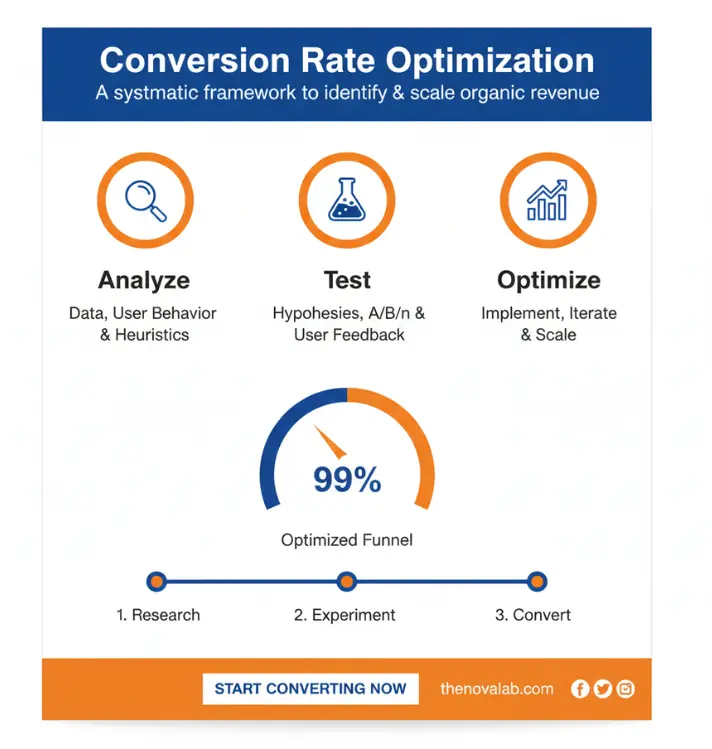
NovaLab conversion rate optimization infographic showing analyze, test, and optimize stages to improve funnel performance and increase organic revenue
Download The PDF

Maintaining CRO Gains as SEO Scales

SEO success often leads to scale. More pages rank. More traffic arrives. More content is published. Without discipline, this growth introduces inconsistency.

CRO for SEO must scale with visibility. New pages should follow proven patterns rather than starting from scratch. Conversion paths should remain predictable. Trust signals should appear consistently.

When CRO is embedded into SEO workflows, performance improves steadily rather than fluctuating.

Aligning Teams Around Conversion-Focused SEO

One of the biggest challenges in CRO for SEO is alignment. SEO teams focus on rankings. Content teams focus on publishing. Product teams focus on features. Marketing teams focus on messaging.

When these teams operate independently, conversion performance suffers.

Conversion rate optimization for SEO creates a shared framework. Pages are evaluated based on how they serve users and support revenue and income. Decisions are guided by outcomes rather than isolated KPIs.

Alignment reduces friction and improves execution quality.

CRO for SEO as a Defensive Strategy

Algorithm updates, competitor changes, and user behavior shifts create constant pressure on rankings. CRO for SEO reduces dependence on traffic growth alone.

When conversion performance improves, the value of existing traffic increases. Rankings do not need to grow to support revenue growth. This creates resilience.

Websites that convert well are less exposed to volatility. CRO for SEO becomes a defensive strategy as well as a growth lever.

Preventing Future Conversion Decline

Conversion decline often happens gradually. Small changes accumulate. Content becomes cluttered. CTAs multiply. Pages lose clarity.

Conversion rate optimization for SEO includes regular reviews to prevent decay. Pages are audited for relevance, structure, and usability. Underperforming pages are corrected before losses compound.

Prevention is easier than recovery.

CRO for SEO as an Ongoing Discipline

Conversion rate optimization for SEO is not a project with an end date. It is an ongoing discipline that evolves with search behavior, competition, and business goals.

Data is reviewed regularly. Assumptions are challenged. Changes are tested. Successful patterns are reinforced.

This continuous process keeps SEO performance aligned with real-world outcomes.

When Conversion Rate Optimization for SEO Delivers the Highest Impact

CRO for SEO delivers the strongest returns when traffic exists but results lag behind. If rankings are stable and lead volume or sales remain flat, conversion work is often the fastest path to growth.

It is also effective after major SEO efforts. Once visibility is achieved, CRO ensures that gains translate into revenue and income.

Improving conversion rates increases the value of every organic visit.

How Novalab SEO Agency Approaches CRO for SEO

At Novalab SEO Agency, conversion rate optimization for SEO is integrated into every organic strategy.

The process begins with understanding how users arrive, what they expect, and where they hesitate. Pages are reviewed for intent alignment, structure, clarity, and friction. Opportunities are prioritized based on impact on revenue and income.

Execution focuses on measurable improvements. Changes are tested carefully. Results are monitored. Successful patterns are scaled.

CRO is not added after SEO. It is part of SEO.

The Business Case for Conversion Rate Optimization for SEO

SEO that does not convert limits growth. CRO without SEO limits scale. Together, they create a system that supports predictable performance.

Conversion rate optimization for SEO reduces waste, improves efficiency, and strengthens competitive position. It allows businesses to grow without relying solely on traffic increases or paid channels.

This makes CRO for SEO one of the highest leverage investments in organic growth.

Final Perspective

Conversion rate optimization for SEO closes the gap between visibility and results.

At Novalab SEO Agency, CRO for SEO is designed to turn organic traffic into revenue and income through clarity, intent alignment, and structured execution. It focuses on removing friction, supporting decisions, and guiding users toward meaningful actions.

SEO brings users to the door. Conversion rate optimization for SEO ensures they step inside.

Frequently Asked Questions About Conversion Rate Optimization for SEO

What is conversion rate optimization for SEO?

Conversion rate optimization for SEO is the process of improving how users who arrive through organic search complete meaningful actions on a website. These actions may include lead submissions, demo requests, purchases, or other outcomes tied to revenue and income. It focuses on intent alignment, page clarity, usability, and friction reduction rather than traffic volume alone.

How is conversion rate optimization for SEO different from traditional CRO?

Traditional CRO often focuses on paid traffic and isolated landing pages. Conversion rate optimization for SEO works across the full organic journey, including informational, commercial, and transactional pages. It improves how SEO traffic behaves after arrival while preserving rankings and search visibility.

Does conversion rate optimization for SEO affect rankings?

When done correctly, conversion rate optimization for SEO does not harm rankings. In many cases, it supports rankings by improving engagement, clarity, and user satisfaction. CRO for SEO avoids changes that weaken relevance signals and focuses on structure, messaging, and usability improvements.

When should a website invest in conversion rate optimization for SEO?

Conversion rate optimization for SEO is most effective when organic traffic already exists but conversions lag behind. If rankings are stable and traffic is growing but leads or sales remain flat, CRO for SEO is often the fastest path to increased revenue and income.

Can CRO for SEO work without increasing traffic?

Yes. Conversion rate optimization for SEO increases the value of existing traffic. By improving clarity, intent alignment, and conversion paths, businesses can generate more leads or sales without increasing rankings or visit volume.

Which pages benefit most from conversion rate optimization for SEO?

Service pages, category pages, comparison pages, and high-traffic informational pages often benefit the most. CRO for SEO focuses on pages that introduce users to solutions, support evaluation, or close actions.

How do you measure success in conversion rate optimization for SEO?

Success is measured through conversion rate improvements, assisted conversions, engagement metrics, and revenue or income impact from organic traffic. CRO for SEO looks beyond last-click attribution and evaluates the full organic conversion path.

Is conversion rate optimization for SEO a one-time project?

No. Conversion rate optimization for SEO is an ongoing discipline. Search behavior changes, competitors adjust, and websites evolve. Regular review and iteration are required to maintain and improve performance over time.

How long does it take to see results from CRO for SEO?

Some improvements produce results within weeks, especially usability or clarity fixes. Larger structural changes may take longer as search engines reprocess pages and users adapt. CRO for SEO is cumulative rather than instant.

Can conversion rate optimization for SEO reduce reliance on paid ads?

Yes. By improving how organic traffic converts, CRO for SEO increases the return from existing visibility. This often reduces the need to rely heavily on paid channels to meet revenue and income targets.

How does Novalab SEO Agency approach conversion rate optimization for SEO?

Novalab SEO Agency treats conversion rate optimization for SEO as a growth system. The process focuses on intent analysis, page structure, content clarity, usability, internal linking, and measurable outcomes tied to revenue and income. CRO is integrated directly into SEO strategy rather than handled separately.

Start Growing With The Novalab SEO Agency 

If you’re looking for an SEO agency that understands your goals and delivers real outcomes, The Novalab SEO Agency is ready to help.
We build strategies designed to grow your organic traffic, strengthen brand visibility, and convert visitors into loyal customers.

Contact our team today to request a free SEO audit or consultation.
Let The Novalab SEO Agency guide your business toward better rankings, more traffic, and consistent results.

Schedule a Free Call Paid SEO Audit

About Author

- Butrint Xhemajli

Novalab logo

Table of Contents

Let Novalab SEO Agency Drive Your Technical SEO Growth

Work with a technical SEO team that cares about your success. Book your strategy call now.

Reviews From Clients

If you want the unfiltered truth about Novalab SEO Agency, read what our clients say.Their reviews speak louder than we ever could.
Read Testimonials