
SEO Recovery After Algorithm Updates by Novalab SEO Agency
SEO recovery after algorithm updates is the process of restoring organic visibility when rankings, impressions, and traffic decline following changes in search engine algorithms. Google makes thousands of updates each year. Most pass unnoticed. But broad core updates, Helpful Content Updates, spam updates, and targeted quality updates can reshape rankings across entire industries within days. For SaaS companies that depend on organic search for pipeline, the impact of a significant update can be immediate and severe.
The visible impact is traffic loss. Pages that held strong positions for months or years drop without warning. Branded queries may hold steady while non-branded visibility collapses. The real impact is the lost pipeline. Demo requests decline, trial signups slow, and sales teams face a demand gap they cannot explain. For SaaS companies with high customer acquisition costs, an algorithm-driven traffic drop translates directly to revenue pressure.
Algorithm updates do not target websites randomly. They surface structural weaknesses, content gaps, technical inconsistencies, and trust issues that already existed. A site that relied on thin content to rank for competitive terms was already vulnerable. A domain with an unnatural link profile was already at risk. A SaaS platform with hundreds of outdated blog posts diluting topical authority was already losing ground. The update does not create the problem. It exposes it. That distinction matters because it changes how recovery should be approached.
Recovery requires understanding what changed, why visibility dropped, and how to rebuild search performance in a way that remains stable through future updates. Reacting to symptoms without identifying the root cause leads to short-lived fixes that collapse again the next time an update rolls out. Sustainable recovery means addressing the underlying issues that made the site vulnerable in the first place.
At Novalab SEO Agency, SEO recovery after algorithm updates is treated as a controlled recovery system. The goal is not short-term ranking gains but long-term organic stability tied directly to pipeline and revenue. Every action taken during recovery is measured against its impact on traffic quality, lead generation, and business outcomes rather than ranking position alone.
How Algorithm Updates Affect Organic Performance
Algorithm updates adjust how search engines evaluate pages and websites across multiple quality dimensions. Google’s core updates adjust broad evaluation systems that affect how relevance, quality, and trust are assessed across the entire index. The Helpful Content Update specifically targets sites with content that was written primarily for search engines rather than for users. Spam updates target manipulative link building, keyword stuffing, cloaked pages, and other policy violations. Quality updates focus on E-E-A-T signals, evaluating whether content demonstrates genuine experience, expertise, authoritativeness, and trustworthiness.
When an update rolls out, affected websites often experience ranking volatility across multiple keyword groups simultaneously, impression drops in Google Search Console, reduced crawl frequency from Googlebot, and unstable rankings that fluctuate daily without recovering to previous positions. Pages that previously ranked well may decline without any visible errors in Search Console or any changes made to the site. This creates confusion for teams that rely on organic traffic because the decline appears to happen without cause.
SEO recovery after algorithm updates starts with accepting that the update revealed gaps rather than caused them. The site was already vulnerable. The update simply changed the threshold at which those vulnerabilities affected rankings.
Signs That a Website Needs SEO Recovery
Not all traffic drops require recovery work. Some reflect seasonal demand changes, tracking implementation issues, or competitive movement. Recovery is necessary when a decline aligns with a confirmed Google update and affects core pages that drive business results.
Common signs include sudden ranking losses across multiple keyword groups rather than individual terms, significant drops in impressions and clicks in Google Search Console that correlate with known update dates, reduced visibility for category pages, product pages, or service pages that previously drove conversions, unstable rankings that fluctuate but fail to return to previous positions over two to four weeks, and declining conversion rates because remaining traffic no longer matches the intent your pages serve.
For SaaS companies, the clearest signal is a drop in organic-sourced demo requests or trial signups that correlates with a known Google update. If the organic pipeline declined while paid and direct channels remained stable, an algorithm-driven visibility loss is the most likely explanation.
Why Rankings Drop After Algorithm Updates
Ranking losses after algorithm updates typically result from misalignment with updated evaluation standards. Understanding the most common causes helps focus recovery efforts on the areas that matter most.
Content quality issues are the most frequent cause of post-update ranking losses. Pages that lack depth, fail to demonstrate genuine expertise, or provide information that is easily found on dozens of competing pages are deprioritized when updates raise the quality bar. The Helpful Content Update specifically targets sites where a significant portion of content was created primarily to attract search traffic rather than to help users. For SaaS companies, this often manifests as blog content that targets keywords without providing substantive value, product pages with thin descriptions, or landing pages that repeat marketing claims without explaining how the product works.
E-E-A-T deficiencies surface during core updates. Content without clear author attribution, content published by organizations without demonstrable expertise in the topic, and content that makes claims without supporting evidence lose ground when E-E-A-T evaluation thresholds increase. SaaS companies publishing content outside their area of genuine expertise are particularly vulnerable.
Search intent misalignment causes losses when updates refine how Google interprets what users want from specific queries. Pages may have historically ranked for queries they no longer satisfy. A page targeting “best project management software” that reads like a product page rather than a comparative evaluation may lose rankings when the update determines that users expect editorial-style comparison content for that query.
Technical issues, including slow page speed, rendering problems, conflicting canonical tags, broken internal links, and unstable Core Web Vitals, can all contribute to visibility loss when updates raise technical quality thresholds. Crawl budget inefficiency can also compound the impact by preventing Googlebot from reassessing important pages quickly enough to recover.
Backlink profile weaknesses surface when updates adjust how link signals are evaluated. Links from low-quality directories, reciprocal link schemes, or irrelevant sources that once passed value may be discounted or trigger negative evaluation when spam-focused updates roll out.
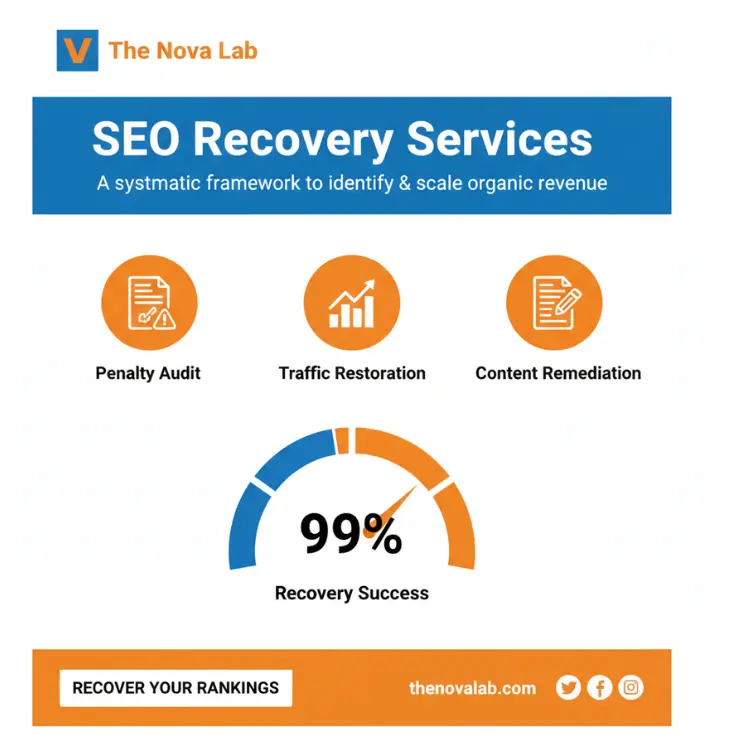
How Novalab Approaches SEO Recovery After Algorithm Updates
Novalab treats SEO recovery after algorithm updates as a structured, forensic process rather than a reactive scramble. Reacting quickly without proper diagnosis often causes further damage. Removing content, changing URLs, or rewriting pages without understanding the specific cause of the decline can delay recovery by months.
The process begins with impact and data analysis. Traffic is analyzed by page type, intent category, and keyword group using Google Search Console, Google Analytics, and tools like Ahrefs and SEMrush. Rankings are reviewed across categories rather than individual terms to identify patterns. The timing of the decline is correlated with known Google update dates to determine which update is responsible and what quality signals that update targeted. Indexation levels are checked to confirm whether pages lost ranking positions or were removed from the index entirely.
Affected page types are identified next. Updates rarely affect all pages equally. Some updates impact informational blog content. Others affect commercial product pages, comparison pages, or user-generated content sections. Identifying which page types lost visibility focuses recovery effort on the areas with the highest business impact rather than spreading effort across the entire site.
Search intent alignment is reviewed for every affected page. Rankings are compared against current search results to determine whether the intent behind target queries has shifted. Content is adjusted to match what users and Google now expect from each query type. For SaaS companies, this often means transforming product-focused pages into educational content or rebuilding comparison pages with more balanced, editorial-style coverage.
Content quality assessment evaluates affected pages against E-E-A-T criteria. Pages are assessed for depth, clarity, author expertise, factual accuracy, and usefulness. Recovery may involve expanding thin content, consolidating overlapping pages that were cannibalizing each other, removing low-value pages that diluted overall site quality, or adding a genuine expert perspective to content that previously lacked it.
Technical audit identifies and resolves issues that compound the impact of algorithm updates. This includes page speed optimization, Core Web Vitals improvement, canonical tag cleanup, internal linking restructuring, and crawl efficiency improvements that allow Googlebot to reassess priority pages more quickly.
Backlink profile review evaluates the quality, relevance, and risk profile of existing links. Toxic or manipulative links are identified for disavowal. Authority rebuilding through relevant, earned links replaces risk signals with trust signals that support recovery.
Recovery Timelines and Expectations
Recovery from algorithm updates is not instantaneous. The timeline depends on the severity of the issues, the type of update involved, and how quickly changes can be implemented and processed by Google.
For core updates, Google processes changes over multiple crawl cycles. Initial improvements in impression trends and ranking stability typically appear within four to eight weeks after implementing fixes. Meaningful traffic recovery often takes three to six months. Full recovery to pre-update levels, or beyond, typically occurs within six to twelve months for sites that address root causes comprehensively.
For Helpful Content Updates, recovery can be faster if the primary issue is content quality. Pruning low-value content, improving existing pages, and demonstrating stronger E-E-A-T signals can produce visible improvements within the next update cycle, which Google releases periodically.
For manual actions, which are penalties applied directly by Google’s human review team and communicated through Search Console, recovery requires submitting a reconsideration request after resolving the specific violation. Turnaround depends on the completeness of the cleanup and the review queue at Google.
Novalab sets realistic expectations at the start of every recovery engagement. Progress is measured through impression trends, ranking stability, crawl frequency changes, conversion recovery, and pipeline contribution rather than individual keyword positions. Temporary volatility during recovery is expected.
Preventing Future Algorithm Impact
SEO recovery should reduce future risk, not just restore previous performance. The most effective recovery programs leave the site stronger and more resilient than it was before the update hit.
Prevention requires maintaining clear content quality standards that ensure every page provides genuine value to its target audience. It requires controlled indexation that prevents low-value pages from diluting overall site quality. It requires consistent technical performance across Core Web Vitals, mobile responsiveness, and crawl efficiency. And it requires avoidance of tactics that rely on loopholes or manipulation rather than genuine relevance and authority.
For SaaS companies investing in generative engine optimization and answer engine optimization, algorithm recovery also creates an opportunity to build AI search visibility alongside traditional organic recovery. The same content quality, E-E-A-T signals, and technical improvements that support recovery from Google updates also support citation in ChatGPT, Perplexity, and Google AI Overviews. Recovery becomes an investment in both traditional and AI-powered search visibility simultaneously.
Start Growing With The Novalab SEO Agency
If you’re looking for an SEO agency that understands your goals and delivers real outcomes, The Novalab SEO Agency is ready to help.
We build strategies designed to grow your organic traffic, strengthen brand visibility, and convert visitors into loyal customers.
Contact our team today to request a free SEO audit or consultation.
Let The Novalab SEO Agency guide your business toward better rankings, more traffic, and consistent results.