
What is Conversion Rate Optimization?
Conversion Rate Optimization (CRO) is the process of improving your website so that more visitors take a desired action, such as making a purchase, filling out a form, or booking a consultation.
Instead of focusing only on attracting more traffic, CRO is about making your existing traffic more valuable. A website with strong optimization doesn’t just get visitors. It converts them into customers.
At its core, CRO is about understanding user behavior and removing the barriers that stop people from taking action.
Why CRO Matters for Business Growth
Many businesses invest heavily in SEO and paid advertising, but overlook what happens after users land on their website. This is where most revenue is won or lost.
If your site isn’t converting, increasing traffic will only increase costs, not results.
Conversion Rate Optimization improves performance by making every visitor more likely to convert. This leads to higher returns on marketing spend, lower acquisition costs, and stronger overall performance.
Most importantly, when CRO is done right, it directly supports business growth by increasing revenue and income, not just traffic.
How Conversion Rate is Calculated
Conversion rate is the percentage of users who complete a desired action on your website.
It is calculated using a simple formula:
Conversion Rate (%) = (Conversions ÷ Total Visitors) × 100
For example, if 1,000 people visit your website and 50 of them convert, your conversion rate is 5%.
This number becomes your baseline. From there, CRO focuses on improving it over time.
What is Considered a Good Conversion Rate?
There is no universal benchmark that applies to every business. Conversion rates vary depending on the industry, audience, and type of offer.
However, most websites fall within the range of 2% to 5%, while high-performing sites often exceed 5%.
The goal is not to chase a specific number, but to consistently improve your current performance. Even small increases in conversion rate can lead to significant revenue growth.
How Conversion Rate Optimization Works
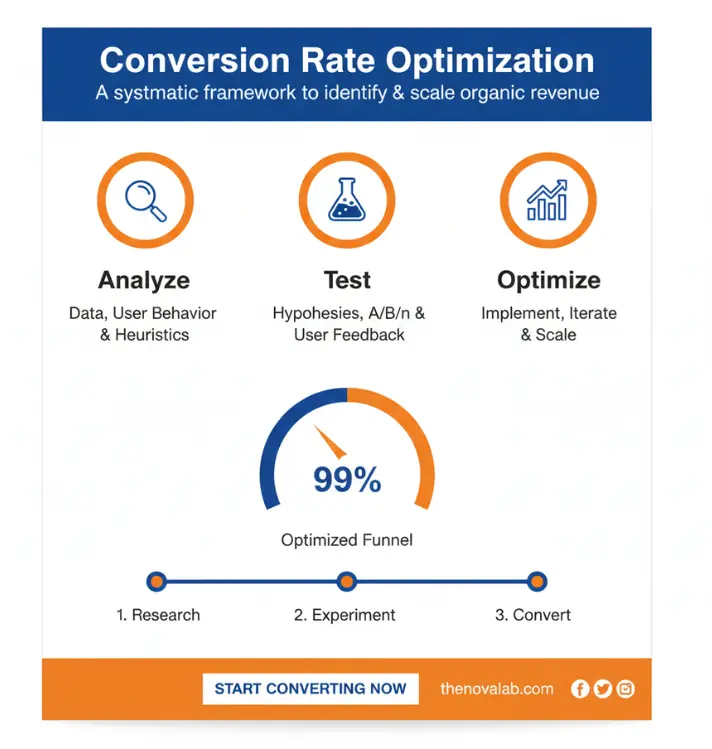
CRO is not guesswork. It is a structured, data-driven process that focuses on identifying problems and testing solutions.
It begins with defining clear goals, what actions you want users to take on your website. From there, you analyze user behavior using tools like analytics, heatmaps, and session recordings to understand how visitors interact with your pages.
Once patterns emerge, you identify friction points. These may include slow-loading pages, unclear messaging, confusing navigation, or poor mobile experience.
Based on these insights, you develop hypotheses for improvement. For example, simplifying a checkout process or rewriting a headline to better communicate value.
These ideas are then tested, often through A/B testing, where different versions of a page are compared to see which performs better. The results guide further improvements, making CRO an ongoing cycle of optimization.
Schedule a Free CallKey Factors That Influence Conversion Rate
The performance of a website depends on several interconnected elements. Design plays a major role, as users form impressions within seconds. A clean, intuitive layout builds trust and encourages engagement.
Speed is equally important. Slow-loading pages create friction and increase the likelihood that users will leave before converting.
Content and messaging are often the biggest drivers of conversion. Visitors need to quickly understand what you offer, why it matters, and what action they should take next. Strong copy focuses on benefits rather than features and communicates value clearly.
Trust also plays a critical role. Testimonials, reviews, and case studies help reduce uncertainty and build confidence in your product or service.
CRO vs SEO: Understanding the Difference
Search Engine Optimization (SEO) and Conversion Rate Optimization (CRO) serve different but complementary purposes.
SEO is focused on bringing users to your website by improving visibility in search engines. CRO takes over once the user arrives, ensuring that the visit leads to meaningful action.
Without SEO, you lack traffic. Without CRO, that traffic does not convert into results.
Businesses that combine both strategies effectively see the strongest growth.
Proven Strategies to Improve Conversion Rates
Improving conversions requires a combination of technical optimization and psychological understanding.
High-performing websites align their landing pages with user intent, ensuring that visitors immediately find what they are looking for. They remove unnecessary distractions and guide users toward a single, clear goal.
Testing plays a critical role in optimization. Small changes in headlines, visuals, or calls to action can produce measurable improvements when tested correctly.
Mobile optimization is no longer optional. With the majority of users browsing on mobile devices, a seamless mobile experience is essential for maintaining and increasing conversions.
Another key factor is reducing friction. Simplifying forms, minimizing steps in the checkout process, and making navigation intuitive all contribute to higher conversion rates.
Finally, social proof reinforces credibility. When users see evidence that others trust your business, they are more likely to take action themselves.
Common CRO Mistakes
One of the most common mistakes is relying on assumptions instead of data. Decisions based on guesswork often lead to ineffective changes.
Another issue is focusing too much on design while ignoring messaging and user psychology. Even a visually appealing website will fail if it does not clearly communicate value.
Many businesses also neglect mobile optimization, despite the growing dominance of mobile traffic. Additionally, unclear or weak calls to action can prevent users from taking the next step, even when they are interested.
How CRO Drives Long-Term Growth
CRO is not a short-term tactic. It is a long-term strategy that compounds over time.
As your website becomes more efficient at converting visitors, you generate more leads and sales without increasing your marketing spend. This creates a sustainable growth model where improvements continue to build on each other.
Ultimately, the purpose of CRO is simple: to turn existing traffic into measurable business results by increasing revenue and income.
Final Thoughts
Conversion Rate Optimization is one of the most effective ways to improve the performance of your website and marketing efforts.
Instead of constantly chasing more traffic, focusing on conversion allows you to unlock the full potential of what you already have.
A well-optimized website doesn’t just attract visitors. It turns them into customers, consistently and predictably.
Start Growing With The Novalab SEO Agency
If you’re looking for an SEO agency that understands your goals and delivers real outcomes, The Novalab SEO Agency is ready to help.
We build strategies designed to grow your organic traffic, strengthen brand visibility, and convert visitors into loyal customers.
Contact our team today to request a free SEO audit or consultation.
Let The Novalab SEO Agency guide your business toward better rankings, more traffic, and consistent results.
Frequently Asked Questions
What is conversion rate optimization for SEO?
Conversion rate optimization for SEO is the process of improving how users who arrive through organic search complete meaningful actions on a website. These actions may include lead submissions, demo requests, purchases, or other outcomes tied to revenue and income. It focuses on intent alignment, page clarity, usability, and friction reduction rather than traffic volume alone.
How is conversion rate optimization for SEO different from traditional CRO?
Traditional CRO often focuses on paid traffic and isolated landing pages. Conversion rate optimization for SEO works across the full organic journey, including informational, commercial, and transactional pages. It improves how SEO traffic behaves after arrival while preserving rankings and search visibility.
Does conversion rate optimization for SEO affect rankings?
When done correctly, conversion rate optimization for SEO does not harm rankings. In many cases, it supports rankings by improving engagement, clarity, and user satisfaction. CRO for SEO avoids changes that weaken relevance signals and focuses on structure, messaging, and usability improvements.
When should a website invest in conversion rate optimization for SEO?
Conversion rate optimization for SEO is most effective when organic traffic already exists, but conversions lag. If rankings are stable and traffic is growing but leads or sales remain flat, CRO for SEO is often the fastest path to increased revenue and income.
Can CRO for SEO work without increasing traffic?
Yes. Conversion rate optimization for SEO increases the value of existing traffic. By improving clarity, intent alignment, and conversion paths, businesses can generate more leads or sales without increasing rankings or visit volume.
Which pages benefit most from conversion rate optimization for SEO?
Service pages, category pages, comparison pages, and high-traffic informational pages often benefit the most. CRO for SEO focuses on pages that introduce users to solutions, support evaluation, or close actions.
How do you measure success in conversion rate optimization for SEO?
Success is measured through conversion rate improvements, assisted conversions, engagement metrics, and revenue or income impact from organic traffic. CRO for SEO looks beyond last-click attribution and evaluates the full organic conversion path.
Is conversion rate optimization for SEO a one-time project?
No. Conversion rate optimization for SEO is an ongoing discipline. Search behavior changes, competitors adjust, and websites evolve. Regular review and iteration are required to maintain and improve performance over time.
How long does it take to see results from CRO for SEO?
Some improvements produce results within weeks, especially usability or clarity fixes. Larger structural changes may take longer as search engines reprocess pages and users adapt. CRO for SEO is cumulative rather than instant.
Can conversion rate optimization for SEO reduce reliance on paid ads?
Yes. By improving how organic traffic converts, CRO for SEO increases the return from existing visibility. This often reduces the need to rely heavily on paid channels to meet revenue and income targets.
How does Novalab SEO Agency approach conversion rate optimization for SEO?
Novalab SEO Agency treats conversion rate optimization for SEO as a growth system. The process focuses on intent analysis, page structure, content clarity, usability, internal linking, and measurable outcomes tied to revenue and income. CRO is integrated directly into the SEO strategy rather than handled separately.