
Generative Engine Optimization Services
Search behavior has fundamentally changed. A growing share of B2B SaaS buyers now begin their research in AI-powered platforms rather than traditional search engines. When a VP of Marketing asks ChatGPT for the best account-based marketing platforms, or a CTO asks Perplexity to compare infrastructure monitoring tools, the AI does not return ten blue links. It synthesizes information from dozens of sources and delivers a direct, cited answer. The brands that appear in that answer capture attention. The brands that do not appear lose influence at the exact moment a buyer is forming their shortlist.
Generative engine optimization services address this shift by ensuring that a SaaS brand is visible, accurately represented, and cited within AI-generated answers across ChatGPT, Gemini, Perplexity, Claude, Copilot, and Google AI Overviews. This is not a future concern. Gartner has projected that traditional search volume will decline by 25 percent by 2026 as AI-powered answer engines absorb queries that previously drove clicks to websites. Research from Authoritas shows that LLM referral traffic has grown over 800 percent year-on-year for sites that actively optimize for AI citation. The window for first-mover advantage is narrowing, and the cost of inaction is increasing with every quarter.
Novalab SEO Agency provides generative engine optimization services built for SaaS companies that need their brand to appear where buyers actually look. The agency combines entity optimization, content structuring for AI comprehension, technical AI crawler access, authority reinforcement through third-party validation, and citation monitoring to build a systematic presence across every AI platform that influences SaaS purchasing decisions. This work connects directly to pipeline and revenue by positioning the brand at the point where buying decisions begin.
Why Generative Engine Optimization Services Matter for SaaS
SaaS companies have invested years building traditional SEO authority. Many rank on page one for their most important keywords. However, ranking on Google is no longer sufficient to capture demand. When AI platforms generate answers to buyer queries, they do not simply pull from the top-ranked Google result. They analyze content across dozens of sources, evaluate entity relationships, assess authority signals, and synthesize a response that may cite brands that do not rank first in traditional search at all.
This creates a dangerous gap. A SaaS company can hold the number one position on Google for its primary keyword and still be completely invisible in the AI-generated answers that buyers increasingly rely on. Testing consistently shows that fewer than 15 percent of pages ranking in the top three on Google are cited by ChatGPT or Claude when asked the same questions. The pages that are not cited typically lack structured answer blocks, clear entity definitions, or the third-party validation signals that large language models trust.
AI Search Is Not Experimental – It Is Mainstream
Nearly half of enterprise B2B buyers now use AI platforms for vendor research. This is not an early-adopter trend. It is mainstream behavior across procurement, IT leadership, marketing teams, and executive decision-makers. When a buyer asks an AI platform to recommend a SaaS solution, the platform draws on its training data and real-time web access to construct an answer. The brands it cites become the shortlist. The brands it omits are effectively invisible during the most critical phase of the buyer journey.
Generative engine optimization services ensure that a SaaS brand is among the sources that AI platforms trust, reference, and recommend. This is not about gaming AI systems. It is about building the signals, content, and authority that large language models use to determine which brands deserve to be cited.
Rankings and Citations Are Different Metrics
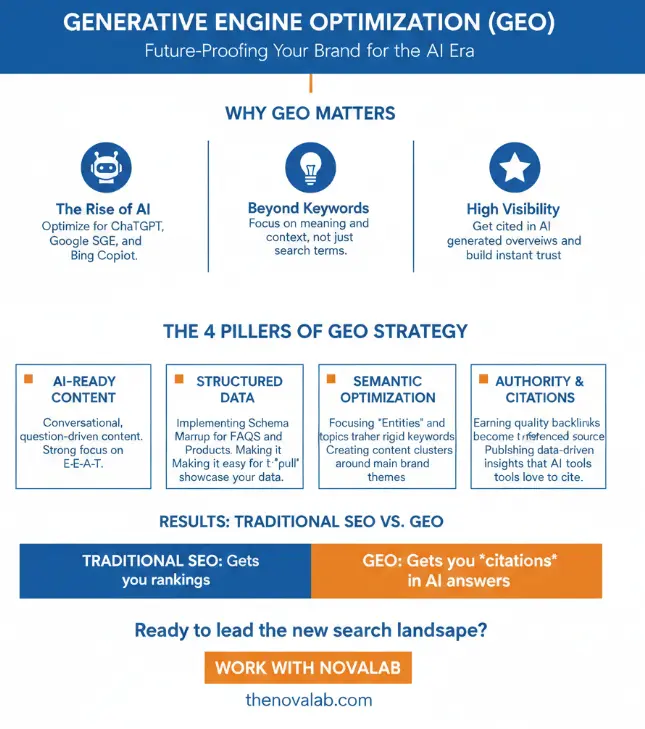
Traditional SEO success is measured by rankings, organic traffic, and click-through rates. Generative engine optimization success is measured by citation frequency, brand mention accuracy, and share of voice within AI-generated answers. A SaaS company can have strong traditional SEO and zero AI visibility. The reverse is also possible, though less common. Generative engine optimization services extend traditional SEO by adding the specific signals, structures, and authority patterns that AI platforms require to include a brand in their responses.
What Generative Engine Optimization Services Include
Generative engine optimization services cover the full scope of work required to make a SaaS brand visible, accurately represented, and cited within AI-generated answers. Novalab SEO Agency structures this work across five core pillars.
Entity Optimization
AI platforms understand the world through entities, which are the people, products, companies, and concepts that large language models recognize and connect. For a SaaS brand to be cited in AI answers, it must exist as a clearly defined entity that AI systems can identify, verify, and associate with specific categories, capabilities, and use cases.
Entity optimization ensures that the brand is consistently defined across the website, structured data, knowledge sources like Wikipedia and Wikidata, third-party review platforms, and industry publications. When entity signals are consistent across these sources, AI systems can confidently include the brand in relevant answers. When entity signals are fragmented, contradictory, or absent, AI systems default to competitors with clearer entity definitions.
Novalab SEO Agency audits entity clarity across all sources that AI platforms reference, identifies gaps and inconsistencies, and builds a reinforcement plan that strengthens entity recognition across the web.
Content Structuring for AI Comprehension
Content that ranks well in traditional search does not necessarily perform well in AI-generated answers. AI platforms favor content that explains topics directly, provides clear definitions, answers specific questions with verifiable claims, and maintains a logical structure that can be parsed and summarized accurately.
Generative engine optimization services restructure existing content and create new content specifically designed for AI comprehension. This includes adding structured answer blocks that directly address common buyer questions, using consistent terminology that aligns with how AI systems categorize the brand’s niche, providing supporting evidence such as statistics, citations, and named sources that AI platforms can verify, and organizing content in a hierarchical structure that AI systems can navigate predictably. This process also supports how to get cited in ChatGPT strategies by making important information easier for AI systems to identify and reference.
Content written primarily for persuasion or emotional engagement often performs poorly in AI-generated answers because AI systems prioritize factual clarity over promotional messaging. Novalab SEO Agency writes content that serves both human readers and AI comprehension, ensuring that every page communicates clearly to both audiences.
Technical AI Crawler Access
AI platforms operate their own web crawlers separate from Googlebot. ChatGPT uses GPTBot. Google AI products use Google-Extended. Anthropic uses ClaudeBot. Each crawler must be explicitly allowed in robots.txt for AI platforms to access and index the site’s content.
Many SaaS companies unintentionally block AI crawlers because their robots.txt was configured before these crawlers existed. This means AI platforms cannot access the site’s content, which makes it impossible for the brand to be cited in AI-generated answers regardless of content quality or authority strength.
Novalab SEO Agency audits robots.txt and server configurations to ensure that all relevant AI crawlers have access to the site’s public content. The agency also evaluates LLMs.txt implementation, a newer protocol that provides AI systems with a structured overview of what a site offers and which pages are most important for AI comprehension. This technical SEO for SaaS work is foundational to every generative engine optimization engagement.
Authority Reinforcement Through Third-Party Validation
AI platforms assess brand authority not only through backlinks but through the breadth and consistency of third-party mentions, reviews, citations, and references across the web. A SaaS brand that is mentioned in industry roundups, cited in analyst reports, reviewed on platforms like G2 and Capterra, and referenced in technology publications carries stronger authority signals for AI citation than a brand with equivalent backlinks but fewer third-party validations.
Generative engine optimization services strengthen these signals through coordinated link building services for SaaS, digital PR, review platform optimization, and strategic content placement on third-party sites that AI platforms treat as authoritative sources. Novalab SEO Agency identifies which third-party sources are most influential for AI citation in the client’s specific SaaS category and builds a reinforcement plan that systematically increases brand presence across those sources.
AI Citation Monitoring and Measurement
Traditional SEO analytics do not capture AI visibility. Google Analytics does not report on how often a brand is cited in ChatGPT responses. Search Console does not show share of voice in Perplexity answers. Generative engine optimization requires a different measurement framework that tracks brand mentions within AI-generated answers, citation frequency across different AI platforms, the accuracy of information that AI systems present about the brand, referral traffic from AI platforms, and pipeline attribution from AI-assisted buyer discovery.
Novalab SEO Agency monitors AI citations across ChatGPT, Gemini, Perplexity, Claude, and Copilot using systematic query testing that simulates the questions SaaS buyers ask during their research process. This data is reported monthly alongside traditional SEO metrics, giving clients a complete view of their visibility across both search paradigms.
How Generative Engine Optimization Differs From Traditional SEO
Traditional SEO and generative engine optimization share a common foundation but diverge in their objectives, success metrics, and optimization techniques.
Traditional SEO optimizes for ranking positions in a list of search results. The goal is to appear as high as possible on the page so that searchers click through to the website. Success is measured by rankings, organic sessions, and click-through rates. Generative engine optimization optimizes for inclusion and accuracy within AI-generated answers. The goal is to be cited by the AI platform as a trusted source when it synthesizes a response. Success is measured by citation frequency, mention accuracy, and share of voice within AI answers.
The key technical differences are significant. Traditional SEO relies heavily on exact keyword matching and topical relevance. AI platforms prioritize entity recognition, which means understanding what a brand is and how it relates to other entities in its category. Traditional SEO builds authority primarily through backlinks. AI platforms assess authority through a broader set of signals, including third-party mentions, review platform presence, knowledge graph entries, and consistency of information across sources. Traditional SEO optimizes for Googlebot. Generative engine optimization must also account for GPTBot, ClaudeBot, Google-Extended, and other AI-specific crawlers.
Novalab SEO Agency treats SEO and GEO as complementary disciplines. Traditional SEO provides the crawlable, indexable, authoritative foundation that AI platforms draw from. Generative engine optimization ensures that the foundation is structured, validated, and positioned for AI citation. The two work together, and the agency delivers both through an integrated strategy. This connects directly to Novalab’s answer engine optimization and AI Overviews optimization services.
How Novalab SEO Agency Delivers Generative Engine Optimization Services
Novalab follows a structured process that builds AI visibility systematically rather than through ad hoc tactics.
Phase 1: AI Visibility Audit
The engagement begins with a comprehensive audit of the brand’s current AI visibility. Novalab tests how ChatGPT, Gemini, Perplexity, Claude, and Copilot respond to queries relevant to the client’s SaaS category. The audit identifies whether the brand is cited, how accurately it is described, which competitors appear more frequently, and which content and authority gaps explain the current visibility level.
Phase 2: Entity and Content Strategy
Based on audit findings, Novalab builds an entity optimization and content strategy designed to close the visibility gaps. This includes defining the brand entity with consistent attributes across all sources, restructuring existing content for AI comprehension, creating new content specifically targeting the questions and comparisons that SaaS buyers ask AI platforms, and identifying third-party sources where brand presence needs to be strengthened.
Phase 3: Technical Implementation
Novalab configures AI crawler access, implements structured data for entity definition, adds LLMs.txt where appropriate, and ensures that the site’s technical infrastructure supports AI crawling and indexation. Developer task sheets specify every configuration change with exact implementation instructions.
Phase 4: Authority Building
The agency executes a coordinated authority reinforcement plan that includes link building from SaaS-relevant publications, digital PR placements, review platform optimization, and strategic content placement on third-party sites that AI platforms reference frequently. This work amplifies the signals that AI systems use to determine citation worthiness.
Phase 5: Monitoring and Optimization
Novalab monitors AI citations monthly, tracking changes in brand visibility across all major AI platforms. The agency identifies which content changes and authority improvements produced citation gains, which competitor movements affect positioning, and which new optimization opportunities have emerged. This ongoing monitoring ensures that AI visibility continues to improve as AI platforms evolve.
Generative Engine Optimization for SaaS Buyer Journeys
SaaS buyers use AI platforms at every stage of their purchase journey. At the awareness stage, they ask broad questions about problem categories. At the evaluation stage, they ask for product comparisons and recommendations. At the decision stage, they ask for specific information about pricing, implementation, and integration capabilities.
Generative engine optimization services ensure that a SaaS brand appears in AI answers at each of these stages. Awareness-stage visibility builds brand recognition early in the research process. Evaluation-stage visibility places the brand on the shortlist alongside or ahead of competitors. Decision-stage visibility provides the specific information that buyers need to move forward with confidence.
Novalab SEO Agency maps AI visibility to the SaaS buyer journey and creates content and authority strategies that address all three stages. This ensures that the brand does not just appear in AI answers once but accompanies the buyer throughout their entire research process, building familiarity and trust at every touchpoint. This is the same buyer-journey mapping approach Novalab applies across all SEO consulting for SaaS engagements.
Benefits of Generative Engine Optimization Services for SaaS
SaaS companies that invest in generative engine optimization services gain visibility in the channels where an increasing share of buying decisions begin. As AI-powered search continues to grow, brands with early AI visibility build compounding advantages that become increasingly difficult for competitors to replicate.
Citation in AI-generated answers builds brand credibility during the research phase when buyers are most open to new options. Unlike paid advertising, which stops when spending pauses, AI citations persist as long as the underlying content and authority signals remain strong. This creates a durable competitive advantage that supports pipeline generation over months and years rather than disappearing when a campaign ends.
AI visibility also reinforces traditional SEO performance. Pages that AI platforms cite tend to earn additional backlinks, social shares, and brand searches as buyers who encounter the brand in AI answers conduct follow-up research. This creates a virtuous cycle where AI visibility drives traditional SEO signals, which in turn strengthen the foundation that AI visibility depends on.
Why SaaS Companies Choose Novalab for Generative Engine Optimization
SaaS companies choose Novalab SEO Agency for generative engine optimization because the agency treats SEO as a systematic discipline connected to business outcomes rather than an experimental add-on. The agency has built generative engine optimization into its core service delivery alongside technical SEO, content strategy, and link building, ensuring that all organic growth activities reinforce AI visibility.
Novalab delivers developer-ready technical specifications, structured content strategies mapped to the SaaS buyer journey, and ongoing citation monitoring that connects AI visibility to pipeline and revenue. The agency works across all major AI platforms, including ChatGPT, Gemini, Perplexity, Claude, and Copilot, ensuring that visibility is not limited to a single platform but spans the full ecosystem of AI-powered discovery.
Generative Engine Optimization Services by Novalab SEO Agency
AI Visibility Audit – Novalab tests brand citations across ChatGPT, Gemini, Perplexity, Claude, and Copilot, identifying visibility gaps, accuracy issues, and competitive positioning.
Entity Optimization – The agency defines and reinforces brand entity signals across the website, structured data, knowledge sources, and third-party platforms to ensure consistent AI recognition.
Content Structuring for AI – Novalab restructures existing content and creates new content designed for AI comprehension, with structured answer blocks, clear definitions, and verifiable claims.
Technical AI Access – The agency configures AI crawler permissions, implements LLMs.txt, and ensures technical infrastructure supports AI crawling and indexation.
Authority Reinforcement – Novalab builds third-party validation through link building, digital PR, review platform optimization, and strategic content placement on AI-referenced sources.
Citation Monitoring – Monthly tracking of brand citations across all major AI platforms, connected to pipeline attribution and reported alongside traditional SEO metrics.
Start Growing With The Novalab SEO Agency
If you’re looking for an SEO agency that understands your goals and delivers real outcomes, The Novalab SEO Agency is ready to help.
We build strategies designed to grow your organic traffic, strengthen brand visibility, and convert visitors into loyal customers.
Contact our team today to discuss generative engine optimization services.
Let The Novalab SEO Agency guide your business toward better rankings, more traffic, and consistent results.
Frequently Asked Questions About Generative Engine Optimization Services
Q: What are generative engine optimization services? A: Generative engine optimization services ensure that a brand is visible, accurately represented, and cited within AI-generated answers across platforms like ChatGPT, Gemini, Perplexity, Claude, and Copilot. The work includes entity optimization, content structuring for AI comprehension, technical AI crawler access, authority reinforcement, and citation monitoring.
Q: How is generative engine optimization different from SEO? A: Traditional SEO optimizes for ranking positions in search result lists. Generative engine optimization optimizes for citation within AI-generated answers. The key differences include entity recognition over keyword matching, broader authority signals beyond backlinks, and the need to allow AI-specific crawlers access to content. GEO extends SEO rather than replacing it.
Q: Why do SaaS companies need generative engine optimization? A: A growing share of SaaS buyers use AI platforms for vendor research. Brands that are not cited in AI-generated answers lose visibility during the most critical phase of the buyer journey. Generative engine optimization ensures that the brand appears on the AI-generated shortlists that buyers rely on when selecting SaaS solutions.
Q: Which AI platforms does Novalab optimize for? A: Novalab optimizes for visibility across ChatGPT, Gemini, Perplexity, Claude, Copilot, and Google AI Overviews. Each platform has different citation behaviors and source preferences. The agency builds a cross-platform strategy that addresses the specific requirements of each.
Q: How is AI visibility measured? A: AI visibility is measured through systematic query testing that tracks brand citation frequency, mention accuracy, share of voice relative to competitors, referral traffic from AI platforms, and pipeline attribution from AI-assisted buyer discovery. These metrics are reported alongside traditional SEO data.
Q: How long does generative engine optimization take to show results? A: Initial visibility improvements from entity optimization and content restructuring typically appear within four to eight weeks as AI platforms recrawl and reprocess content. Authority reinforcement produces compounding improvements over three to six months. Ongoing monitoring ensures that visibility continues to grow as AI platforms evolve.