
Answer Engine Optimization Services by Novalab SEO Agency
A growing share of SaaS buyers no longer start their research in Google. They open ChatGPT, Perplexity, Gemini, Claude, or Copilot and ask a direct question. They type “what is the best marketing attribution platform for B2B” or “compare project management tools for remote engineering teams” and receive a synthesized answer that names specific products, explains their strengths, and often makes a direct recommendation. The brands cited in that answer become the shortlist. The brands omitted from it lose influence before the buyer ever visits a website.
This is a fundamentally different discovery mechanism than traditional search. Search engines return a list of links and let the buyer choose which to click. Answer engines return a single narrative that has already chosen which brands to include. The selection happens inside the model, based on signals that most SaaS companies have never optimized for. A brand can hold the number one position on Google for its primary keyword and still be completely absent from the AI-generated answer that a buyer reads first.
Answer engine optimization services address this gap by building the content structures, entity signals, technical access, and authority patterns that AI platforms evaluate when deciding which brands to cite. The work ensures that when a SaaS buyer asks an AI platform about the client’s product category, the brand appears in the answer with accurate positioning, clear differentiation, and a recommendation that supports pipeline generation.
Novalab SEO Agency provides answer engine optimization services for SaaS companies that need their brand to appear where buyers actually research. The agency builds systematic AI visibility across ChatGPT, Gemini, Perplexity, Claude, Copilot, and Google AI Overviews through entity optimization, content structuring for machine comprehension, AI crawler configuration, authority reinforcement, and ongoing citation monitoring. Every engagement connects AI visibility to the pipeline and revenue.
Schedule a Free CallWhy SaaS Companies Need Answer Engine Optimization Services
SaaS buying behavior has shifted faster than most marketing strategies have adapted. Research from multiple sources indicates that nearly half of enterprise B2B buyers now use AI platforms for vendor research. These buyers are not experimenting. They are using AI tools as their primary discovery mechanism because AI-generated answers save time, synthesize information from multiple sources, and provide direct recommendations that accelerate the evaluation process.
AI Answers Shape Shortlists Before Website Visits
When a buyer asks Perplexity to compare CRM platforms or asks ChatGPT to recommend a customer success tool, the AI constructs an answer that typically names three to five products with brief explanations of each. The buyer reads this answer, forms an initial impression, and then visits the websites of the brands that were mentioned. Brands that were not mentioned never receive that visit. The shortlist is formed inside the AI platform, and the website only gets a chance to convert visitors who were already pre-qualified by the AI’s recommendation.
This means that answer engine visibility is not a branding exercise. It is a pipeline prerequisite. A SaaS company that is invisible in AI-generated answers loses qualified buyers at the top of the funnel before any content, design, or sales effort has a chance to influence them.
Traditional SEO Does Not Guarantee AI Visibility
Testing consistently shows that fewer than 15 percent of pages ranking in the top three on Google are cited by ChatGPT or Claude when asked the same questions. The ranking factors that determine Google positions and the citation factors that determine AI mentions overlap but are not identical. Google evaluates pages primarily through keyword relevance, backlink authority, and user engagement signals. AI platforms evaluate content through entity recognition, structural clarity, factual consistency, and the breadth of third-party validation across the web.
A SaaS company with strong traditional SEO may have excellent keyword targeting and a powerful backlink profile, but lacks the entity clarity, structured answer blocks, and cross-platform brand mentions that AI systems use to determine citation worthiness. Answer engine optimization services close this gap by adding the specific signals that AI platforms require.
How Answer Engines Select Sources
Understanding how AI platforms choose which brands to cite is essential for building an effective optimization strategy. The selection process differs significantly from traditional search ranking.
Entity Recognition
AI platforms understand the world through entities, which are the companies, products, people, and concepts that large language models can identify and relate to each other. For a SaaS brand to be cited, it must exist as a clearly defined entity that the AI system can associate with a specific product category, set of capabilities, and target audience. When entity signals are fragmented or inconsistent across the web, AI platforms lack the confidence to cite the brand and default to competitors with clearer entity definitions.
Structural Clarity
Content with clear definitions, logical progression, and predictable structure is easier for AI systems to extract and reuse inside generated answers. Pages that open with a clear statement of what they cover, progress through supporting explanations, and conclude with specific outcomes allow AI platforms to synthesize accurate citations. Pages with scattered information, promotional language, or ambiguous claims create uncertainty that causes AI systems to skip the source entirely.
Factual Consistency
AI platforms evaluate whether a brand describes itself consistently across its own website and across third-party sources. When the product description on the homepage contradicts the positioning on a comparison page, or when third-party reviews describe the product differently than the brand’s own content, AI systems reduce confidence in the source. Consistent messaging across all touchpoints strengthens the trust signals that AI platforms use for citation decisions.
Third-Party Validation
AI platforms assess authority not only through backlinks but through the breadth of third-party mentions, reviews, and references across the web. A SaaS brand mentioned on G2, Capterra, Product Hunt, relevant subreddits, industry publications, and technology blogs carries stronger validation signals than a brand with equivalent backlinks but fewer third-party mentions. This validation layer is particularly influential for AI citation because it confirms that the brand is recognized beyond its own content.
E-E-A-T Signals
Experience, expertise, authoritativeness, and trustworthiness influence how AI systems evaluate source quality. Content that demonstrates real product knowledge, provides technical depth, carries author attribution, and maintains factual accuracy is more likely to be cited than content that relies on marketing superlatives or vague claims. These signals apply across all AI platforms because all large language models evaluate source credibility through similar trust heuristics.
What Answer Engine Optimization Services Include
Novalab SEO Agency structures answer engine optimization services across five core areas that together build systematic AI visibility for SaaS companies through an AI visibility audit for SaaS.
Entity Audit and Optimization
The engagement begins with an entity audit that evaluates how AI platforms currently perceive the brand. Novalab tests ChatGPT, Gemini, Perplexity, Claude, and Copilot with queries relevant to the client’s product category, including branded queries, unbranded category queries, comparison queries, and use-case queries. The audit reveals where the brand is cited accurately, where it is misrepresented, where it is absent, and which competitors appear more frequently.
Based on audit findings, Novalab builds an entity optimization plan that defines the brand with consistent attributes across the website, structured data, knowledge sources, review platforms, and industry publications. This ensures that every touchpoint reinforces the same entity definition, giving AI platforms the confidence to cite the brand accurately.
Content Structuring for AI Comprehension
Content that ranks well in traditional search does not necessarily perform well in AI-generated answers. AI platforms favor content that explains topics directly, provides clear definitions, answers specific questions with verifiable claims, and follows logical structures that can be parsed and summarized accurately.
Novalab restructures existing content and creates new content designed for AI comprehension. This includes adding structured answer blocks that directly address common buyer questions, using consistent terminology aligned with how AI systems categorize the brand’s niche, providing supporting evidence such as statistics and named sources that AI platforms can verify, and organizing content with predictable heading hierarchies that AI systems can navigate reliably.
The agency follows the same SEO content for SaaS standards applied across all engagements: paragraph-heavy prose, short sentences, high transition density, and professional third-person tone. Content is written to serve both human readers and machine comprehension simultaneously.
Technical AI Access Configuration
AI platforms operate their own web crawlers. ChatGPT uses GPTBot. Anthropic uses ClaudeBot. Perplexity uses PerplexityBot. Google AI products use Google-Extended. Each crawler must be explicitly allowed in robots.txt for the platform to access and index site content.
Novalab audits robots.txt and server configurations to ensure all relevant AI crawlers have access to public content. The agency also evaluates LLMs.txt implementation, a newer protocol that provides AI systems with a structured overview of the site’s most important pages. This technical SEO for SaaS work is foundational to every answer engine optimization engagement.
Authority Reinforcement
AI platforms assess brand authority through the breadth and consistency of third-party mentions across the web. Novalab identifies which external sources are most influential for AI citation in the client’s SaaS category and builds a reinforcement plan that systematically increases brand presence across those sources.
This includes coordinated link building services for SaaS, digital PR placements, review platform optimization on G2 and Capterra, strategic content placement on third-party sites, and brand mention monitoring to convert unlinked mentions into citations. Every authority signal strengthens the validation layer that AI platforms evaluate when deciding which brands to cite.
Citation Monitoring and Measurement
Traditional SEO analytics do not capture AI visibility. Novalab monitors AI citations through systematic query testing that simulates the questions SaaS buyers ask during their research process. The agency tracks brand citation frequency across ChatGPT, Gemini, Perplexity, Claude, and Copilot, including how to get cited in ChatGPT, measures the accuracy of information AI platforms present about the brand, evaluates share of voice relative to competitors, and monitors referral traffic from AI platforms.
Monthly reports present these metrics alongside traditional SEO data, giving clients a complete view of visibility across both traditional and AI-powered search. Pipeline attribution connects AI visibility to demo requests and trial signups, measuring the business impact of answer engine optimization.
Answer Engine Optimization and Featured Snippets
Answer engine optimization shares a significant overlap with featured snippet optimization. Featured snippets are the answer boxes at the top of Google search results that provide a direct answer extracted from a single source. The content structure that earns featured snippets, including clear definitions, concise process explanations, and direct answers to specific questions, is the same structure that answer engines use to select sources for AI-generated responses.
For SaaS companies, this dual optimization creates a compounding effect. A page structured to earn a featured snippet for “what is marketing attribution” is also more likely to be cited by ChatGPT or Perplexity when a user asks the same question inside an AI tool. Optimizing for one channel reinforces the other, which means answer engine optimization delivers value across both traditional and AI-powered surfaces simultaneously.
The Role of FAQ Content in Answer Engine Optimization
FAQ sections play a central role in answer engine optimization because they mirror the question-and-answer structure that AI systems are fundamentally designed around. Every interaction a user has with an AI tool is a question followed by an answer. FAQ content maps directly to this interaction pattern.
Well-written FAQ answers are often extracted and reused almost directly inside AI-generated responses, especially when they explain processes, conditions, comparisons, or definitions with enough detail to stand alone as useful responses. For SaaS companies, FAQ sections on product pages, feature pages, and service pages address the specific questions that buyers ask during evaluation, including pricing models, implementation timelines, integration capabilities, data security, and comparison with alternatives.
The key is substance. FAQ answers that provide one-sentence responses or redirect to other pages are ignored by AI systems. Answers that explain the topic completely in two to four sentences with enough specificity to be cited as a standalone fact are the most effective format for answer engine citation. Novalab implements FAQ schema markup on every page with a question-and-answer section, including schema markup for AI search, which provides AI systems with structured signals about the content’s format and purpose.
How Novalab Delivers Answer Engine Optimization Services
Phase 1: AI Visibility Audit
Novalab tests how ChatGPT, Gemini, Perplexity, Claude, and Copilot respond to queries relevant to the client’s SaaS category. The audit identifies current citation frequency, accuracy of brand descriptions, competitor positioning in AI answers, and the content and authority gaps that explain the current visibility level.
Phase 2: Entity and Content Strategy
Based on audit findings, Novalab builds an entity optimization and content strategy that closes visibility gaps. This includes defining the brand entity consistently across all sources, restructuring existing content for AI comprehension, creating new content that addresses unanswered buyer questions, and identifying third-party sources where brand presence needs strengthening.
Phase 3: Technical Implementation
Novalab configures AI crawler access, implements structured data for entity definition, deploys LLMs.txt where appropriate, and ensures the technical infrastructure supports AI crawling and indexation. Developer task sheets specify every configuration change.
Phase 4: Authority Building
The agency executes a coordinated authority reinforcement plan covering link building, digital PR, review platform optimization, and strategic content placement on platforms that AI systems reference frequently.
Phase 5: Monitoring and Optimization
Monthly citation monitoring tracks changes in brand visibility across all major AI platforms. The agency identifies which content changes and authority improvements produced citation gains, adjusts strategy based on competitive movements, and ensures visibility continues improving as AI platforms evolve.
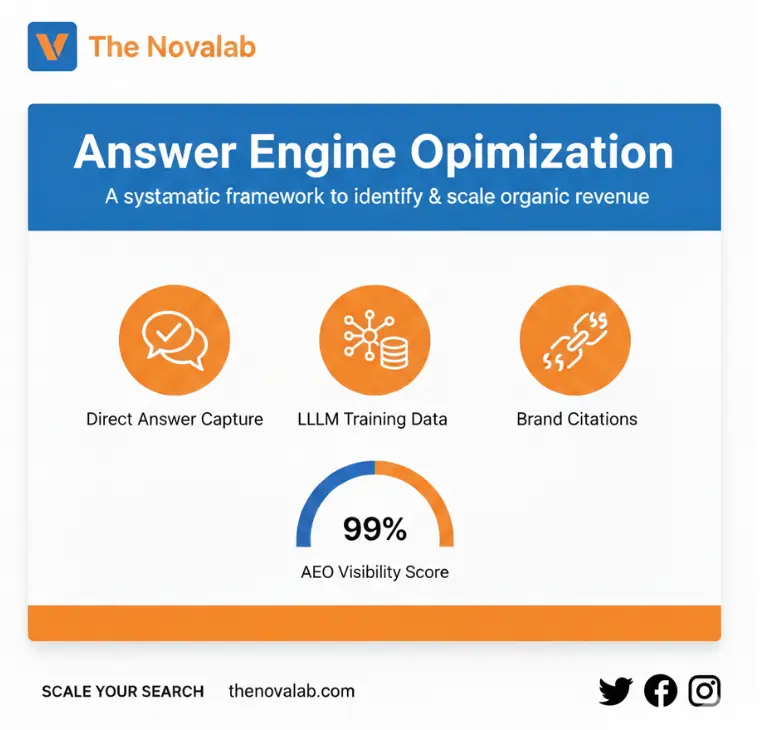
Answer Engine Optimization, GEO, and Traditional SEO
Answer engine optimization, generative engine optimization services, and traditional SEO serve different but interconnected purposes. Traditional SEO builds the crawlable, indexable, authoritative foundation that all search platforms draw from. Generative engine optimization ensures that the foundation is structured for citation in AI-synthesized responses, with particular emphasis on Google AI Overviews. Answer engine optimization focuses specifically on being cited and recommended across the full ecosystem of AI-powered answer platforms, including ChatGPT, Perplexity, Claude, Copilot, and voice assistants.
The fundamentals are shared across all three. Entity clarity, structured content, E-E-A-T signals, and technical AI crawler access support visibility across every platform. Novalab builds integrated strategies that treat these disciplines as layers of a single system rather than separate initiatives. This ensures that work done to improve traditional rankings also strengthens AI citation, and work done to improve AI visibility also reinforces traditional SEO performance. The agency also connects this work to AI Overviews optimization for complete coverage across every AI-powered surface where SaaS buyers research.
Benefits of Answer Engine Optimization Services for SaaS
SaaS companies that invest in answer engine optimization services gain visibility in the channels where an increasing share of buying decisions originates. Citation in AI-generated answers builds brand credibility during the research phase when buyers are most open to new options. Unlike paid advertising, which stops when spending pauses, AI citations persist as long as the underlying content and authority signals remain strong.
AI visibility also reinforces traditional SEO performance. Pages that AI platforms cite tend to earn additional backlinks, branded searches, and referral traffic as buyers who encounter the brand in AI answers conduct follow-up research. This creates a virtuous cycle where AI visibility drives traditional SEO signals, which in turn strengthen the foundation that AI visibility depends on.
Early movers gain a structural advantage. AI systems build confidence in sources over time based on consistency and continued validation. Brands that establish strong entity signals, comprehensive content coverage, and robust third-party mentions now will be harder for competitors to displace as the market matures and more companies begin optimizing for answer engines.
Why SaaS Companies Choose Novalab for Answer Engine Optimization
SaaS companies choose Novalab SEO Agency for answer engine optimization because the agency treats AI visibility as a systematic discipline connected to the pipeline and revenue rather than an experimental add-on. The agency has built answer engine optimization into its core service delivery alongside technical SEO, content strategy, and link building, ensuring that all organic growth activities reinforce AI visibility.
Novalab delivers developer-ready technical specifications, structured content strategies mapped to the SaaS buyer journey, and ongoing citation monitoring that connects AI visibility to the pipeline. The agency works across all major AI platforms, ensuring that visibility spans the full ecosystem of AI-powered discovery rather than being limited to a single platform.
Answer Engine Optimization Services by Novalab SEO Agency
AI Visibility Audit — Novalab tests brand citations across ChatGPT, Gemini, Perplexity, Claude, and Copilot, identifying visibility gaps, accuracy issues, and competitive positioning.
Entity Optimization — The agency defines and reinforces brand entity signals across the website, structured data, knowledge sources, and third-party platforms for consistent AI recognition.
Content Structuring — Novalab restructures existing content and creates new content designed for AI comprehension with structured answer blocks, clear definitions, and verifiable claims.
Technical AI Access — The agency configures crawler permissions for GPTBot, ClaudeBot, PerplexityBot, and Google-Extended, and implements LLMs.txt and structured data.
Authority Reinforcement — Novalab builds third-party validation through link building, digital PR, review platform optimization, and strategic content placement on AI-referenced sources.
Citation Monitoring — Monthly tracking of brand citations across all major AI platforms, connected to pipeline attribution and reported alongside traditional SEO metrics.
Start Growing With The Novalab SEO Agency
If you’re looking for an SEO agency that understands your goals and delivers real outcomes, The Novalab SEO Agency is ready to help.
We build strategies designed to grow your organic traffic, strengthen brand visibility, and convert visitors into loyal customers.
Contact our team today to request a free SEO audit or consultation.
Let The Novalab SEO Agency guide your business toward better rankings, more traffic, and consistent results.
Schedule a Free Call Paid SEO Audit
Frequently Asked Questions About Answer Engine Optimization Services
Q: What are answer engine optimization services? A: Answer engine optimization services ensure that a brand is visible, accurately described, and cited within AI-generated answers across platforms like ChatGPT, Gemini, Perplexity, Claude, and Copilot. The work includes entity optimization, content structuring for AI comprehension, technical AI crawler access, authority reinforcement through third-party validation, and ongoing citation monitoring.
Q: How is answer engine optimization different from SEO? A: Traditional SEO optimizes for ranking positions in search result lists. Answer engine optimization optimizes for citation within AI-generated answers. AI platforms evaluate entity recognition, structural clarity, factual consistency, and third-party validation rather than relying primarily on keyword relevance and backlink counts. Both disciplines share foundations and work together.
Q: Why do SaaS companies need answer engine optimization? A: Nearly half of enterprise B2B buyers now use AI platforms for vendor research. Brands not cited in AI-generated answers lose visibility during the most critical phase of the buyer journey. Answer engine optimization ensures the brand appears on the AI-generated shortlists that buyers form before visiting any website.
Q: How does Novalab measure answer engine optimization success? A: Novalab tracks brand citation frequency across ChatGPT, Gemini, Perplexity, Claude, and Copilot through systematic query testing. The agency measures citation accuracy, share of voice relative to competitors, referral traffic from AI platforms, and pipeline attribution from AI-assisted buyer discovery.
Q: How long does answer engine optimization take to show results? A: Initial visibility improvements from entity optimization and content restructuring typically appear within four to eight weeks as AI platforms recrawl and reprocess content. Authority reinforcement produces compounding improvements over three to six months. Ongoing monitoring ensures visibility continues growing as AI platforms evolve.
Q: How does answer engine optimization connect to generative engine optimization? A: Answer engine optimization and generative engine optimization are closely related disciplines. AEO focuses on citation across the full ecosystem of AI answer platforms including ChatGPT, Perplexity, and voice assistants. GEO focuses specifically on AI-synthesized responses with emphasis on Google AI Overviews. Novalab builds integrated strategies that cover both through a unified approach.