
Why Marketing Is an Investment, Not a Cost
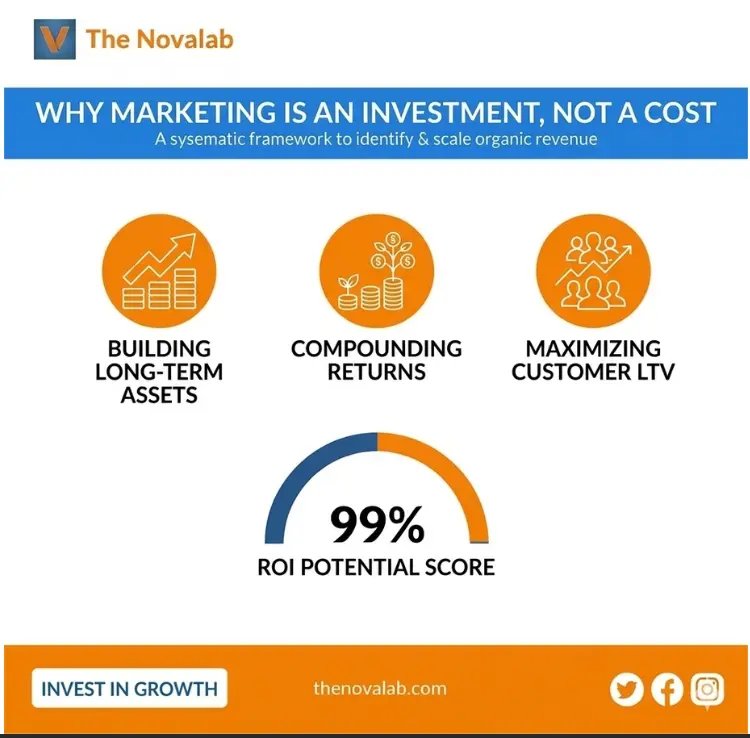
Many businesses still treat marketing like an expense that should be reduced first. That approach usually creates slower growth, lower visibility, and fewer opportunities to attract qualified customers. Marketing should be managed as an investment because it helps a company build awareness, generate demand, support sales, and create long-term business growth. When a business grows, it also means increasing revenue and income. Companies that invest in the right marketing strategy are more likely to see measurable returns over time.
Why businesses often see marketing as a cost
It is easy to understand why some business owners think this way. Marketing often requires upfront spending before results become visible. Paid ads, SEO, content creation, website updates, branding, and campaigns all need time, budget, and consistency.
When leaders only focus on short-term spending, marketing can look like a line item instead of a growth driver. But that view misses the bigger picture. The real question is not how much marketing costs. The real question is what return that investment can produce.
A business that stops investing in marketing may save money in the short term, but it often loses reach, lead flow, trust, and future sales momentum.
Why marketing is an investment, not a cost
Marketing becomes an investment when it is tied to clear business outcomes. A strong strategy does more than promote products or services. It helps a company reach the right audience, bring in qualified traffic, generate leads, improve conversion opportunities, and strengthen customer relationships.
Unlike a pure operating expense, marketing has the potential to create returns that continue over time. A useful blog post can bring in traffic for months. A well-optimized service page can attract leads consistently. A strong brand presence can improve conversion rates across multiple channels.
That is why smart companies do not ask whether they should invest in marketing. They ask how to invest in marketing in a way that supports measurable business growth.
The difference between a cost mindset and an investment mindset
A cost mindset usually sounds like this:
- How much can we cut from marketing this quarter?
- Can we pause SEO, content, or paid campaigns to reduce spending?
- Why are we paying for marketing before immediate results appear?
An investment mindset asks better questions:
- Which channels bring qualified traffic and leads?
- Which campaigns contribute to revenue and income?
- How can we improve return on marketing spend?
- What actions today will strengthen growth over the next 6 to 12 months?
This difference matters. Businesses that treat marketing as a cost often make reactive decisions. Businesses that treat marketing as an investment make strategic decisions based on performance, opportunity, and long-term returns.
How marketing supports business growth
Marketing plays a direct role in helping a company grow. It builds visibility in the market, helps potential customers find the business, and creates multiple paths to conversion.
A strong marketing strategy can help a business:
- increase brand awareness
- attract qualified website traffic
- generate more leads
- improve conversion rates
- support sales conversations
- retain existing customers
- strengthen trust and authority in the market
All of these outcomes contribute to business growth. When a business grows, it also means increasing revenue and income. That is why marketing should be viewed as a business investment connected to results, not as a disconnected expense.
Marketing creates value beyond immediate sales
One mistake many companies make is judging marketing only by short-term sales. Good marketing also creates long-term value that compounds over time.
For example, SEO can improve organic visibility month after month. Content marketing can answer customer questions before a sales conversation even starts. PPC campaign management can generate immediate demand while longer-term organic channels develop. A stronger website experience can help turn more visitors into inquiries.
These benefits do not always appear instantly, but they often create stronger and more sustainable returns than one-time tactics.
How to calculate marketing ROI
If you want to treat marketing like an investment, you need to measure it like one.
A simple marketing ROI formula is:
Marketing ROI = (Revenue generated from marketing – marketing cost) / marketing cost x 100
For example, if a business spends $5,000 on marketing and generates $20,000 in revenue attributed to those efforts, the ROI calculation looks like this:
($20,000 – $5,000) / $5,000 x 100 = 300% ROI
This does not mean every channel performs equally or that every result appears right away. But tracking ROI helps businesses understand where to invest more, where to optimize, and where to stop wasting budget.
Useful metrics to monitor include:
- qualified traffic
- lead volume
- customer acquisition cost
- conversion rate
- pipeline contribution
- revenue influenced by marketing
- customer lifetime value
The more clearly marketing is measured, the easier it becomes to see it as an investment instead of a cost.
A simple business example
Imagine two similar companies in the same market.
The first company cuts marketing whenever budgets get tight. Over time, its website traffic drops, brand visibility weakens, and lead flow becomes inconsistent. Sales teams have fewer opportunities, and growth slows down.
The second company keeps investing in SEO, content, paid campaigns, and website improvements with a clear performance strategy. It tracks lead quality, conversion rates, and revenue impact. Over time, it builds stronger visibility, a healthier pipeline, and more consistent growth.
The second company is not just spending money. It is investing in a system that produces demand and supports revenue and income.
Why cutting marketing first is often a mistake
When businesses face pressure, marketing is often one of the first budgets reviewed. That can be understandable, but it is often the wrong move if growth is the goal.
Cutting marketing aggressively can lead to:
- reduced visibility
- lower traffic
- fewer inbound leads
- weaker brand trust
- slower sales momentum
- lost market share to competitors
In many cases, businesses only realize the damage later, when the pipeline starts shrinking and recovery becomes more expensive.
A better approach is to improve efficiency, sharpen targeting, and focus investment on the channels with the strongest return.
How to make marketing investment work better
Not all marketing delivers strong returns. Investment only works when the strategy is clear and the execution is consistent.
To improve results, businesses should:
- define specific goals
- understand their ideal customers
- focus on channels that match buying intent
- create content that solves real customer problems
- optimize pages for search and conversions
- measure results regularly
- adjust strategy based on performance data
This is where experienced SEO and digital strategy support can make a real difference. For businesses that need technical SEO, content, link building, and conversion optimization managed together, a full service SEO agency can provide a coordinated organic growth program rather than disconnected tactics.
Final thoughts
Marketing is not just a cost on a spreadsheet. It is an investment in visibility, demand, trust, pipeline, and long-term business growth. Companies that understand this are in a stronger position to compete, attract better opportunities, and build sustainable results.
When a business grows, it also means increasing revenue and income. That is why marketing should be planned, measured, and improved like any other investment tied to performance.
If your business wants more qualified traffic, better leads, and stronger long-term growth, the answer is not to reduce marketing without a plan. The answer is to invest in the right strategy and make that investment work harder.
Start Growing With The Novalab SEO Agency
If you are looking for an SEO partner that understands your goals and connects organic visibility to measurable business outcomes, contact Novalab SEO Agency.