
Conversion Rate Optimization for SEO: Get More Results From the Traffic You Already Have
Conversion rate optimization for SEO is the process of improving how organic search visitors take action on your website. Those actions might include filling out a form, booking a demo, making a purchase, or signing up for an account. Most businesses spend heavily on rankings and traffic; however, far fewer invest in what happens after someone actually clicks through from Google.
That gap is where growth gets left behind.
Organic visitors arrive with real intent. They typed a specific query, found your page, and clicked. They already care about what you offer. But if the page is unclear, slow, or confusing, they leave. Your rankings hold steady, but your results stay flat.
At NovaLab SEO Agency, conversion rate optimization for SEO is a core growth discipline. Traffic alone is not the goal. Rankings alone are not the goal. Real growth happens when organic demand turns into revenue.
Schedule a Free CallWhy Conversion Rate Optimization for SEO Matters
Many websites show strong search visibility but weak lead flow or sales. The reason is simple. They invest in getting found but not in converting the people who show up.
Organic search is often called a top-of-funnel channel. But that label is misleading. In reality, many organic queries carry strong buying intent. People search for solutions, providers, pricing, comparisons, and next steps. They aren’t just browsing. They are evaluating.
Existing Traffic Already Contains Demand
When those high-intent searches lead to unclear or messy pages, demand goes to waste. Conversion rate optimization for SEO closes this gap. It makes sure your existing visibility produces real results instead of missed chances.
Why Organic Traffic Falls Short Without CRO
Low conversion rates from organic traffic are rarely a traffic quality problem. In most cases, the real issue sits on the page itself.
Common culprits include vague messaging that doesn’t match the search query, weak page structure that hides key info, slow load times, clunky mobile layouts, and forms with too much friction. Pages may rank because they hit the right keywords. But ranking well and converting well are two different things.
The Hidden Cost of Ignoring Conversions
Many SEO pages are long but unfocused. Visitors arrive, scan for a few seconds, and leave because they can’t tell what the page offers. They don’t know what to do next. Every exit like this is wasted potential.
Conversion rate optimization for SEO finds these barriers and removes them across all your organic entry points. The traffic is already there. The job is to stop losing it.
How CRO for SEO Differs From Standard CRO
Standard CRO usually targets paid traffic and standalone landing pages. Those pages do one job and nothing else. SEO pages are different. They sit within a larger site, connect through internal links, and serve users with varied intent levels.
Because of this, changes must boost conversions without hurting rankings. You can’t strip a page down to just a headline and a button. The content that earns the ranking has to stay intact.
Remove Friction Instead of Forcing Action
The mindset shift is important. Standard CRO asks, “How do we push users to convert?” Conversion rate optimization for SEO asks a better question: “How do we remove barriers for people who already want to act?” That single shift changes how pages are written, organized, and designed.
Search Intent Drives Everything
Every organic visit starts with a query. That query reflects a problem, a goal, or a decision stage. When the page doesn’t match that stage, conversions suffer. This happens even when rankings are strong.
Informational Intent
These users want clear answers. They are learning, not buying. Hard sales language pushes them away. Instead, these pages should educate and lead visitors deeper into your site.
Commercial Intent
These users are comparing options. They need structure, proof, and clear positioning. As a result, these pages should make evaluation easy and build confidence in your offer.
Transactional Intent
These users are ready to act. They expect speed, simplicity, and zero friction. Therefore, these pages should remove every barrier between intent and action.
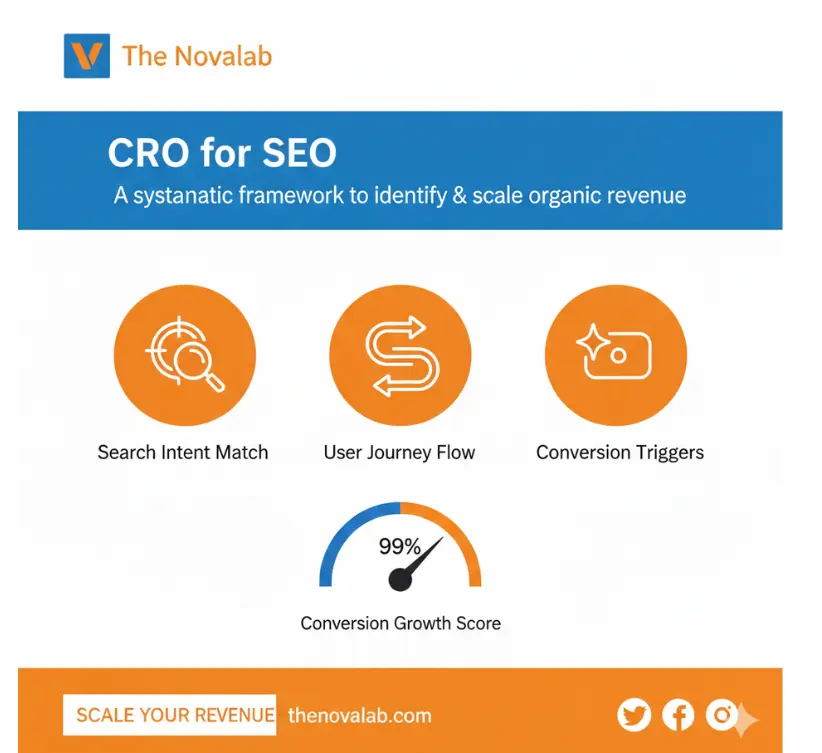
Conversion rate optimization for SEO aligns page structure, copy, and CTAs with each of these stages. When intent and page purpose match, conversions rise without any extra traffic.
Organic Visitors Are Not All the Same
People who find your site through search arrive at different points in their journey. Some are exploring a problem for the first time. Others are comparing options. Some are ready to buy today. Treating them all the same way leads to poor results across the board.
Each Page Type Needs Its Own Approach
A category page serves a different purpose than a comparison page. A service page works differently from a blog post. Each type needs its own conversion logic.
Conversion rate optimization for SEO respects this. It builds paths that match real behavior rather than forcing every page into the same template. At NovaLab, conversion paths are built around how users actually move through search. Not around generic funnels.
Keywords Directly Affect Conversion Performance
Keyword selection doesn’t just affect traffic. It affects conversions, too. Pages that target too many keywords at once attract mixed intent. Some visitors want info. Others want to buy. When a page tries to serve both equally, it usually serves neither.
Focused Mapping Produces Better Outcomes
Conversion rate optimization for SEO tightens how keywords map to pages. Each page targets users with compatible intent. This cuts confusion, lowers exit rates, and increases action.
Here’s something that surprises many teams: ranking for fewer but better-matched keywords often drives more revenue than broad visibility. Match quality beats match quantity every time.
First Impressions Decide Everything
Organic visitors scan fast. They look for instant proof that they’re in the right place. If that proof is delayed or missing, attention drops within seconds.
Build Pages That Help People Decide
Strong CRO for SEO uses clear headings, logical flow, and visible priorities. The opening section confirms relevance immediately. The next sections explain value. Supporting detail comes after. CTAs are visible but not aggressive.
At NovaLab, page structure supports decisions. Not just search engine crawlers.
Content That Converts Organic Visitors
Content that ranks well doesn’t always convert well. These are two different skills. Conversion-focused SEO content must be clear, relevant, and purposeful.
Each page should answer the core question behind the search. It should remove doubts. It should explain what happens next. Length matters far less than structure and clarity. A shorter, well-organized page often beats a longer one that buries the point.
Get More From What You Already Have
Conversion rate optimization for SEO often works by reorganizing existing content, not adding more. Moving key info higher, breaking up dense blocks, and sharpening CTAs can lift performance. Sometimes you don’t need a single new word. You just need a better order.
Calls to Action That Match the Moment
CTAs on SEO pages often fail because they ignore where the user is in their journey. Hard-sell CTAs on educational pages push people away. Meanwhile, weak CTAs on commercial pages leave leads sitting on the table.
Design CTAs Based on Readiness
Conversion rate optimization for SEO matches CTAs to intent. Informational pages guide visitors deeper. Commercial pages move them toward contact forms, demos, or purchases.
Placement matters just as much as wording. CTAs perform best where users naturally pause or reach a decision point. Pushing a CTA too early or burying it too deep both hurt results.
Trust Signals That Drive Action
Organic visitors often check several sites before picking one. Even if your page ranks first, people still need confidence before they act. Pages without trust signals lose out to competitors who show them clearly.
Where Trust Signals Belong
Clear business info, honest pricing, real reviews, case studies, and transparent process explanations all support confidence. But location matters. These signals need to appear where hesitation is most likely. Not buried in a footer nobody reads.
Conversion rate optimization for SEO reviews trust signals across all organic entry pages and positions them where they make the biggest impact.
Technical Problems Kill Conversions
Slow pages increase abandonment. Layout shifts break the reading flow. Broken elements reduce confidence. Technical performance has a direct effect on whether visitors convert.
Speed and Stability Matter
Core Web Vitals, mobile usability, and stable rendering all shape how users interact with your pages. In many cases, fixing technical issues lifts conversions without changing a single word of content. A faster, smoother experience keeps people engaged and builds the confidence they need to act.
Mobile Needs Its Own CRO Strategy
Most organic traffic comes from phones. Despite that, many sites still design conversion paths for desktop.
Mobile users scroll faster. They abandon sooner when friction appears. Forms need to be short and tap-friendly. Buttons need proper spacing. Text must be readable without zooming. Navigation must work on small screens.
Mobile Fixes Often Produce Fast Wins
Conversion rate optimization for SEO includes mobile-specific testing and fixes. Because the mobile baseline is usually poor, even small changes tend to produce quick, measurable gains.
Internal Linking Is a Conversion Tool
Most people think of internal links as an SEO tactic. In truth, they play a direct role in conversions too. Pages that rank but lead nowhere waste the chance that ranking created.
Guide Visitors Forward Naturally
Conversion rate optimization for SEO uses internal links to move visitors from informational content toward commercial pages. A reader who finishes an educational article should see a clear, relevant link to a related service page. That link supports progress without feeling forced.
When internal links create smooth forward paths, organic traffic produces more value. No extra rankings needed.
Snippets Must Match the Page
Titles and meta descriptions set expectations before anyone clicks. When the actual page fails to deliver on those expectations, visitors bounce right away.
CRO for SEO includes checking how pages appear in search results. Titles, descriptions, and page content must line up. When someone clicks expecting one thing and finds something else, trust breaks instantly. Fixing this alignment lifts both click-through rates and on-page conversions.
Forms Are the Final Hurdle
Forms sit between intent and action. A visitor who is ready to convert can still bail if the form creates friction.
Make Forms Clear, Not Just Short
Long forms, confusing labels, extra steps, and missing context all lower completion rates. Conversion rate optimization for SEO focuses on clarity. Users should know why the info is being requested and what happens after they hit submit.
Small form improvements often produce real gains. Fewer fields, clearer labels, and a visible confirmation step can make a noticeable difference.
Measuring CRO for SEO Takes a Different Lens
Measuring conversion rate optimization for SEO works differently from measuring paid traffic. Organic users rarely convert on their first visit. Many come back two, three, or four times before taking action.
If you use last-click attribution only, SEO looks less valuable than it really is. A user might find your brand through an informational search, come back through a branded query, and finally convert on a service page. Last-click gives all the credit to the final page and ignores everything else.
Assisted Conversions Tell the Full Story
Many organic pages influence conversions without closing them directly. A blog post introduces an idea. A comparison page narrows choices. A service page seals the deal. All three matter.
Conversion rate optimization for SEO tracks assisted conversions, session paths, and organic influence across visits. Without this picture, you might cut pages that are actually driving your pipeline. At NovaLab, measurement always ties back to real revenue.
Different Pages Have Different Jobs
Service pages, category pages, comparison pages, and educational content all serve different roles. Measuring them all the same way leads to bad decisions.
Entry Pages vs Decision Pages
Some pages introduce a problem. Others help compare options. Others close the sale. Each one has a specific job to do.
CRO for SEO checks whether each page performs its intended role. It doesn’t force direct conversions on every page. An article that guides a reader to your service page is doing its job perfectly, even if it never generates a form fill. Seeing this clearly prevents you from weakening pages that actually power your growth.
Build Conversion Paths for Organic Visitors
Many sites rank well but fail to guide people forward. Organic visitors often land on deep pages rather than the homepage. If those pages don’t offer clear next steps, visitors leave without going further.
Make the Next Step Obvious
Conversion paths can include contextual links, secondary CTAs, or related content that matches intent. The goal is not pressure. It’s clarity. Make the next step easy and obvious.
When paths are clear, organic traffic delivers more value. You don’t need more rankings. You just need to stop losing people who have already found you.
Common CRO Mistakes in SEO Campaigns
Many SEO campaigns underperform because of avoidable conversion errors.
One common problem is building pages for keyword coverage instead of clarity. These pages get long and confusing. Visitors can’t figure out the point, so they leave.
Another issue is a cluttered design. Pop-ups, banners, multiple forms, and competing CTAs create noise. When a page asks visitors to do five things at once, most do nothing at all.
Simplicity Wins
CRO for SEO reduces noise. Each page should have one clear primary action tied to intent. Secondary actions can support progress. But they should never compete with the main goal. When users know exactly what to do, they do it more often.
How to Test CRO Changes Without Hurting Rankings
Testing matters. But careless testing can damage rankings. Changes that lift conversions while tanking your traffic create net losses.
Safe Elements to Test
Layout changes, CTA wording and placement, trust signal positioning, form design, and visual hierarchy are all safe bets. These don’t alter the core content that earns your rankings.
However, removing large content blocks, changing headings aggressively, or rewiring internal links without careful review can cause instability. At NovaLab, every CRO test protects rankings first.
Give Tests Enough Time
Organic traffic fluctuates naturally. Short tests often produce misleading data. Conversion rate optimization for SEO needs enough volume and time for results to be meaningful. Patience is part of doing this right.
Scale Your Wins Across the Whole Site
When a CRO fix works on one page type, check if it applies elsewhere. A change that lifts conversions on one service page might work on all your service pages.
Turn One Win Into a System
Scaling needs documentation, templates, and clear standards. Without them, teams repeat the same fix on every page. CRO for SEO gets powerful when improvements become repeatable. Patterns that work get rolled out across similar pages. This creates compound gains that grow results much faster than fixing pages one at a time.
CRO Priorities Depend on Your Business Model
Conversion logic looks different for every type of business.
SaaS companies focus on demo requests, free trials, and product clarity. Service businesses focus on lead quality and consultation bookings. Marketplaces focus on user actions and reducing drop-off in multi-step flows.
Conversion rate optimization for SEO adapts to how your business makes money. Goals must reflect real outcomes. A SaaS company tracking PDF downloads is measuring the wrong thing if demo bookings actually drive revenue.
CRO for SEO on Large Websites
Big sites face unique challenges. As pages pile up, inconsistency creeps in. Conversion logic varies from section to section. Internal links get tangled. Some parts improve while others quietly decline.
Governance Keeps Things on Track
Conversion rate optimization for SEO at scale needs governance. Templates, standards, and rules keep conversion paths consistent. CTAs follow intent logic. Content stays structured.
Without governance, fixes stay isolated. At scale, systems beat one-off changes every time.
Handle Objections Before People Leave
Every conversion involves some hesitation. Users wonder if your product is right, if the price is fair, or what happens after they sign up.
Clarity Beats Persuasion
Advanced CRO for SEO addresses these concerns directly in the content. Instead of adding pressure, it adds clarity. Pages should explain who the service is for, who it isn’t for, what happens next, and what results look like.
Reducing doubt nearly always lifts conversions more than adding hype. People act when they feel informed. Not when they feel pushed.
CRO for SEO Protects You Against Volatility
Algorithm changes, new competitors, and shifting user habits all put pressure on rankings. CRO for SEO reduces your need to depend on traffic growth alone.
When conversions improve, your existing traffic becomes more valuable. Revenue can grow even when traffic stays flat. This creates a safety net. Sites that convert well feel less pain from ranking swings. CRO for SEO works as both a growth engine and a defensive shield.
Prevent Conversion Decline Over Time
Conversion rates don’t just improve and stay there. Small changes add up. Content gets cluttered. CTAs multiply. Pages slowly lose the clarity they once had.
Conversion rate optimization for SEO includes regular reviews to catch decay early. Pages get audited for relevance, structure, and usability. Problems get fixed before losses compound. Prevention is always cheaper than recovery.
How NovaLab Handles Conversion Rate Optimization for SEO
At NovaLab SEO Agency, conversion rate optimization for SEO is built into every organic strategy from day one. It is not an afterthought or an add-on.
The process starts with understanding how users arrive, what they expect, and where they hesitate. Pages are reviewed for intent match, structure, clarity, and friction. Opportunities are ranked by revenue impact.
Changes are tested carefully. Results are tracked closely. Winning patterns are scaled across similar pages. At NovaLab, CRO is not separate from SEO. It is part of how SEO gets done.
The Business Case: SEO Plus CRO Together
SEO that doesn’t convert limits growth. CRO without SEO limits scale. Together, they form a system that delivers predictable, lasting performance.
Conversion rate optimization for SEO cuts waste, boosts efficiency, and builds competitive strength. It lets you grow without relying only on traffic increases or paid ads. That makes it one of the highest-return investments in organic growth.
SEO Brings Visitors. CRO Makes Them Count.
Conversion rate optimization for SEO closes the gap between visibility and results. At NovaLab, the CRO for SEO turns organic traffic into revenue through clarity, intent alignment, and smart execution.
The focus is always the same: remove friction, support decisions, and guide visitors toward meaningful action. SEO brings people to the door. Conversion rate optimization for SEO makes sure they walk through it.
Frequently Asked Questions
What is conversion rate optimization for SEO? It improves how organic visitors complete valuable actions on your site. This includes leads, demos, purchases, and signups. The focus is on intent alignment, page clarity, and friction removal.
How is it different from standard CRO? Standard CRO targets paid traffic and standalone landing pages. CRO for SEO works across the full organic journey and protects rankings while improving results.
Does it affect rankings? When done right, it helps rankings. Better engagement, clearer content, and stronger user signals all support search performance.
When should you invest in it? It delivers the biggest gains when organic traffic exists but conversions lag. If rankings are solid but leads stay flat, CRO for SEO is often the fastest fix.
Can it work without more traffic? Yes. That is one of its biggest strengths. Better structure and clearer paths produce more results from the same visitor count.
Which pages benefit most? Service pages, category pages, comparison pages, and high-traffic articles tend to see the largest lifts. These are the pages closest to action or with the biggest ripple effect.
How do you measure success? Through conversion rate gains, assisted conversions, engagement data, and revenue impact. CRO for SEO tracks the full path, not just last-click numbers.
Is it a one-time project? No. Search behavior shifts. Competitors adjust. Sites evolve. Ongoing review and testing keep performance strong.
How fast do results appear? Some usability and clarity fixes show results within weeks. Larger changes take longer. The gains build over time and compound.
Does it reduce the need for paid ads? Yes. Better organic conversions increase the return on existing visibility. Many businesses lower ad spend without losing revenue as a result.
Schedule a Free Call Paid SEO Audit