
SEO Migration Services That Protect Rankings During Website Changes
A website migration is one of the highest-risk events in a SaaS company’s organic channel. Platform changes, domain moves, URL restructures, redesigns, and CMS migrations all alter the technical signals that search engines rely on to crawl, index, and rank content. When those signals break, rankings can drop within days. Pages that generated demos and trial signups can disappear from search results entirely. Backlinks that took years to earn can lose their value because the URLs they point to no longer resolve. Recovery from a poorly executed migration can take months, and some traffic losses never fully recover.
SEO migration services exist to prevent that outcome. The work covers every technical and content-level change that affects search visibility, from redirect mapping and metadata preservation to internal link audits and post-launch monitoring. The goal is not just to maintain rankings through the transition. The goal is to ensure that the new site launches with a stronger technical foundation than the old one.
Novalab SEO Agency provides SEO migration services built for SaaS companies that cannot afford to lose organic pipeline during a site change. The agency handles pre-migration audits, redirect planning, staging environment reviews, launch-day coordination, and post-migration monitoring. Every deliverable is structured for execution by development teams, with clear specifications that reduce implementation risk and accelerate recovery. The result is a migration that protects the search equity the business has built and positions the new site for stronger long-term growth in Google, ChatGPT, Gemini, Perplexity, Claude, and Copilot.
Schedule a Free CallWhy SEO Migration Services Matter for SaaS Companies
SaaS companies migrate websites more frequently than most businesses. Product evolution drives redesigns. Scaling teams outgrow their CMS. Acquisitions force domain consolidations. Rebranding triggers domain changes. Each of these events touches the technical infrastructure that search engines depend on to deliver organic traffic. Without SEO migration services managing the transition, the risk of traffic loss scales with the complexity of the change.
The stakes are higher for SaaS companies than for most other business types. Organic search often represents a significant share of the demo and trial pipeline. A 30 percent traffic drop after a migration does not just reduce page views. It reduces qualified leads entering the funnel, which affects pipeline projections, revenue forecasts, and CAC calculations for the quarter. For SaaS companies operating on tight growth timelines, that disruption can set the entire go-to-market plan back by months.
Rankings Are Earned Over Time and Lost in Hours
Search rankings reflect years of accumulated signals. Content relevance, backlink authority, internal linking structure, crawl history, and user engagement all contribute to a page’s position in search results. A migration that changes URLs without proper redirects severs the connection between those signals and the new pages. Search engines must then rediscover, recrawl, and re-evaluate every affected page from a weakened starting position.
The most common cause of post-migration traffic loss is redirect failure. A page that ranked first for a high-value SaaS keyword may drop to page 3 or disappear entirely if the redirect chain is broken, the redirect points to the wrong destination, or the redirect is implemented as a 302 temporary redirect instead of a 301 permanent redirect. SEO migration services prevent these errors by mapping every URL change before launch and validating every redirect after deployment.
SaaS Sites Have Complex Architectures
SaaS websites are not simple brochure sites. They contain product pages, feature pages, comparison pages, integration pages, pricing pages with regional variations, documentation hubs, help centers, changelog pages, blog archives, and landing pages from past campaigns. Many of these page types serve different stages of the buyer journey and target different keyword clusters. A migration that treats all pages equally, or worse, that drops low-traffic pages without evaluating their SEO contribution, can create gaps in the content architecture that weaken the entire site’s topical authority.
Novalab SEO Agency audits every page type before a migration begins. The agency evaluates each page’s traffic contribution, keyword rankings, backlink profile, internal linking role, and conversion value. This analysis determines which pages must be migrated with full redirect support, which pages should be consolidated, and which pages can be retired without SEO impact. The same structured approach Novalab applies to technical SEO for SaaS engagements governs the migration planning process.
What SEO Migration Services Include
SEO migration services cover every element that affects how search engines process a website transition. The scope extends from pre-migration baseline measurement through post-launch recovery monitoring. Each component addresses a specific category of migration risk.
Pre-Migration SEO Audit
The engagement begins with a comprehensive audit of the current site’s search performance. Novalab SEO Agency crawls the full site, documents every indexable URL, records current keyword rankings for all tracked terms, maps the internal linking structure, catalogs all inbound backlinks by destination URL, and benchmarks organic traffic at the page level. This baseline is the reference point against which post-migration performance is measured. Without it, there is no way to identify which pages lost visibility, which redirects failed, or which technical issues need immediate attention after launch.
The audit also identifies pre-existing SEO issues that the migration can resolve. Many SaaS sites carry legacy problems such as duplicate content, orphan pages, broken internal links, thin pages from old campaigns, and conflicting canonical tags. A migration is an opportunity to fix these issues as part of the transition rather than carrying them into the new site architecture.
URL Mapping and Redirect Planning
URL mapping is the most critical deliverable in any SEO migration. Every URL on the old site must be mapped to its corresponding URL on the new site. When URL structures change, which they almost always do during a CMS migration or redesign, every old URL needs a 301 permanent redirect to the most relevant new URL. This applies to service pages, product pages, blog posts, category pages, documentation pages, image URLs, PDF URLs, and any other indexable asset.
Novalab SEO Agency builds redirect maps that prioritize accuracy over speed. Each old URL is matched to the new URL that best preserves the original page’s topic, keyword targeting, and user intent. Generic redirects that send all old URLs to the homepage are never acceptable. They destroy the page-level relevance signals that search engines rely on, and they create a poor user experience for visitors arriving from bookmarks, backlinks, or cached search results.
For large SaaS sites with thousands of URLs, Novalab delivers redirect maps as structured spreadsheets with source URL, destination URL, HTTP status code, redirect type, and validation status. These spreadsheets serve as the implementation specification for the development team and the validation checklist for post-launch testing.
Metadata Preservation and Optimization
Metadata, including SEO titles, meta descriptions, heading structures, and image alt text often changes during a migration, sometimes intentionally and sometimes as an unintended side effect of template changes in the new CMS. Any unintended metadata change on a high-ranking page can affect its position in search results.
Novalab SEO Agency audits metadata on the staging environment before launch, comparing it against the production site to identify discrepancies. The agency flags missing titles, truncated descriptions, changed H1 tags, and lost alt text. Where the migration presents an opportunity to improve metadata, Novalab delivers optimized titles and descriptions that align with current keyword targets and Rank Math pixel-width limits.
Internal Link Audit and Repair
Internal links distribute authority across a site and help search engines understand content relationships. A migration that changes URL structures can break hundreds or thousands of internal links if the new templates reference old URLs. Broken internal links create dead ends for both users and crawlers, reducing the flow of authority to important pages and creating crawl waste.
Novalab SEO Agency audits internal links on the staging site before launch, identifies all broken references, and delivers a fix list for the development team. The agency also evaluates whether the new site’s internal linking structure is stronger or weaker than the old one. If the migration has reduced internal link coverage on high-priority pages, Novalab recommends additional links to restore or improve the previous level of support.
Structured Data and Schema Migration
SaaS sites often carry structured data, including organization schema, FAQ schema, breadcrumb schema, product schema, and review schema. A CMS migration can strip structured data if the new templates do not include the same markup. Lost structured data removes rich result eligibility and reduces the information that search engines can extract from the page.
Novalab SEO Agency compares structured data between the old site and the staging environment, identifies any markup that has been lost or changed, and provides implementation specifications for the development team. The agency also evaluates whether additional schema should be added to the new site to improve visibility in search results and AI-powered answer platforms.
Sitemap and Robots.txt Configuration
The new site must have a clean XML sitemap that includes all indexable URLs and excludes non-indexable pages. The robots.txt file must allow crawl access to all public pages and block access to staging environments, admin panels, and filtered URLs that should not be indexed. A common migration error is launching the new site with the staging robots.txt still in place, which can block search engines from crawling the entire site.
Novalab SEO Agency reviews the sitemap and robots.txt configuration on the staging environment before launch and again immediately after deployment. The agency confirms that search engines can access all critical pages and that no blocking rules are carried over from the development environment.
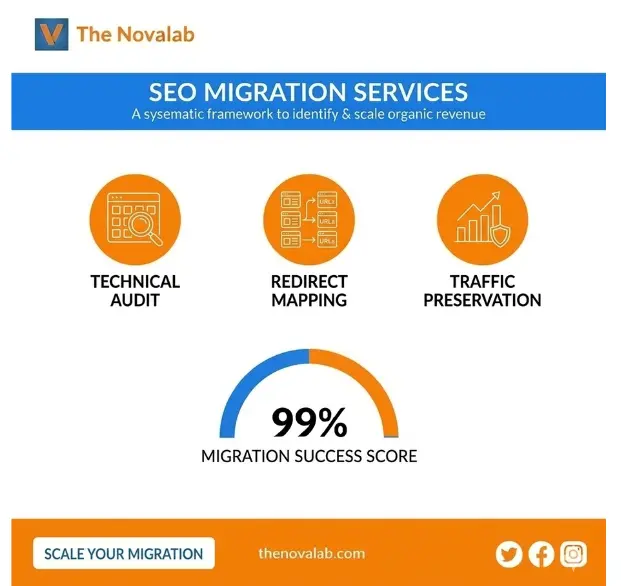
Types of Website Changes That Need SEO Migration Services
Different types of website changes create different categories of SEO risk. Novalab SEO Agency provides SEO migration services for every major migration scenario that SaaS companies encounter.
CMS and Platform Migrations
CMS migrations are the most common trigger for SEO migration services among SaaS companies. Moving from one content management system to another, whether from WordPress to Webflow, from a custom CMS to WordPress with Bricks Builder, or from any legacy platform to a modern stack, changes URL structures, template logic, metadata handling, schema output, image paths, and page speed characteristics.
Novalab SEO Agency has managed CMS migrations across multiple platform combinations. The agency evaluates the new CMS’s SEO capabilities before migration begins, identifies gaps that need plugin or custom development support, and ensures that every SEO element transfers cleanly from the old platform to the new one.
Domain Changes and Rebranding
A domain change affects every indexed URL simultaneously. Search engines must process the signal that the entire site has moved from one domain to another. This requires 301 redirects from every old URL to its new equivalent, a Change of Address submission in Google Search Console, updated sitemaps on the new domain, and monitoring of the index transition over several weeks.
Domain changes carry the highest risk of prolonged traffic loss because search engines must transfer authority signals from the old domain to the new one. Novalab SEO Agency plans domain migrations with a phased approach that includes pre-migration backlink inventory, redirect deployment, search console configuration, and daily monitoring during the transition period.
Site Redesigns
A redesign may not change the domain or CMS, but it can still affect SEO significantly. New templates may alter heading structures, remove content blocks, change internal linking patterns, modify page speed, or reorganize the site navigation. These changes can shift how search engines evaluate page relevance, topic coverage, and content quality.
Novalab SEO Agency reviews redesign mockups and staging builds from an SEO perspective before the new design goes live. The agency identifies design changes that could affect rankings and provides recommendations for preserving SEO value without compromising the new design direction.
HTTPS Migrations
Moving from HTTP to HTTPS is a relatively straightforward migration, but it still requires redirect implementation for every URL and verification that all internal references, canonical tags, and sitemap URLs use the HTTPS protocol. Mixed content issues, where HTTPS pages load HTTP resources, can trigger browser security warnings and affect user experience.
Site Mergers and Domain Consolidations
SaaS companies that acquire other products or companies often need to merge multiple websites into a single domain. This type of migration combines the challenges of domain changes, URL restructuring, and content consolidation. Pages from acquired domains must be redirected, duplicate content must be resolved, and the merged site must maintain a coherent information architecture.
Novalab SEO Agency has managed domain consolidation projects that involve hundreds of redirects, content deduplication decisions, and authority preservation across multiple source domains. The agency builds redirect and content consolidation plans that protect the strongest SEO assets from each source domain while creating a unified site structure on the target domain.
How Novalab SEO Agency Delivers SEO Migration Services
Novalab SEO Agency follows a phased process that covers pre-migration, launch, and post-migration stages. Every phase produces deliverables that the development team can execute directly, reducing interpretation risk and implementation delays.
Phase 1: Pre-Migration Audit and Planning
The first phase establishes the baseline and defines the migration plan. Novalab crawls the current site, benchmarks performance, maps URLs, audits metadata, reviews internal links, catalogs structured data, and identifies pre-existing issues. The output is a migration plan that specifies every redirect, every metadata preservation requirement, and every technical configuration that must be in place before launch.
This phase also includes staging environment review. Novalab audits the new site in its staging state, comparing it against the old site across every SEO dimension. Issues found on staging are documented and assigned to the development team for resolution before launch.
Phase 2: Launch-Day Coordination
On launch day, Novalab SEO Agency coordinates with the development team to verify that redirects are active, robots.txt is correctly configured, sitemaps are submitted, canonical tags are in place, and no blocking rules are preventing crawl access. The agency performs real-time validation of critical redirects and flags any issues that need immediate attention.
Phase 3: Post-Migration Monitoring and Recovery
The first two to four weeks after launch are the highest-risk period. Search engines begin recrawling the site, processing redirects, and re-evaluating rankings. Novalab SEO Agency monitors index status, crawl activity, organic traffic, keyword rankings, and Search Console error reports daily during this period. Any anomalies are investigated immediately.
Post-migration monitoring continues for eight to twelve weeks. The agency tracks recovery curves for priority keywords, identifies pages that have not recovered as expected, and recommends corrective actions. This extended monitoring window ensures that issues which emerge gradually, such as slow re-indexing of deep pages or authority dilution from redirect chains, are caught and resolved before they become permanent losses.
Common Migration Mistakes That Destroy Rankings
SEO migration services exist because the same categories of mistakes recur across nearly every migration that is not managed with SEO oversight. Understanding these mistakes helps SaaS companies appreciate why migration planning must begin months before the launch date.
Launching Without Redirects
The most damaging mistake is launching a new site without redirect implementation. Every old URL that returns a 404 error instead of a 301 redirect loses its accumulated ranking signals. Backlinks pointing to those URLs pass no authority to the new site. Users arriving from search results, bookmarks, or external links land on error pages. Recovery requires search engines to rediscover the content organically, which can take months.
Redirecting Everything to the Homepage
A common shortcut is redirecting all old URLs to the new homepage rather than mapping each one to its most relevant new page. This preserves the technical redirect but destroys topical relevance. Search engines recognize that a redirect from a detailed feature page to a generic homepage does not represent an equivalent content match. The ranking value of the original page is largely lost.
Blocking Search Engines on Launch
Staging environments typically include robots.txt rules that block search engine crawling. If those rules are not removed before launch, the new site remains invisible to search engines. This mistake can go undetected for days or weeks if no one checks crawl access immediately after deployment.
Dropping Content During Redesign
Redesign projects often consolidate or remove content that stakeholders consider outdated or low-value. Without SEO input, these decisions may eliminate pages that rank for valuable keywords, earn backlinks, or serve as internal linking hubs. Novalab SEO Agency evaluates every page proposed for removal against its SEO contribution before approving the change.
Ignoring Page Speed Changes
A new CMS or design can introduce page speed regressions through larger images, heavier JavaScript, additional third-party scripts, or slower server response times. Since page speed is a ranking factor and directly affects user experience, speed regressions can compound other migration losses. Novalab flags speed issues on the staging environment and provides optimization recommendations before launch.
Benefits of Professional SEO Migration Services
SaaS companies that invest in professional SEO migration services protect the organic pipeline they have built and position the new site for stronger performance. The benefits are measurable and directly tied to business outcomes.
Ranking preservation means that the pages generating demos, trials, and signups continue to appear in search results through the transition. Redirect accuracy means that backlink authority transfers to the correct new pages rather than being lost or diluted. Faster recovery means that the inevitable short-term ranking fluctuation resolves within weeks rather than months. Cleaner architecture means that the new site launches with resolved legacy issues, stronger internal linking, and updated structured data, giving it a better technical foundation than the old site.
For SaaS companies, these benefits translate directly to a protected pipeline, maintained CAC efficiency, and uninterrupted organic growth. A well-executed migration can even improve organic performance by resolving issues that the old site had accumulated over years of incremental changes. This is the same outcome-focused approach Novalab applies across all SEO consulting for SaaS engagements.
Why SaaS Companies Choose Novalab for SEO Migration Services
SaaS companies choose Novalab SEO Agency for migration work because the agency combines deep technical SEO expertise with an understanding of SaaS business metrics. Most migration providers treat the work as a technical checklist. Novalab treats it as a business-critical event that affects pipeline, revenue, and growth trajectory.
The agency delivers developer-ready specifications rather than high-level recommendations. Redirect maps are structured spreadsheets, not paragraph-form suggestions. Metadata audits include exact character and pixel counts. Staging reviews produce prioritized task lists with severity ratings. Every deliverable is designed for the development team to execute without ambiguity.
Novalab also connects migration work to the broader SEO strategy. A migration is not an isolated event. It is an inflection point where the site’s technical SEO foundation can be strengthened, where content strategy gaps can be addressed, and where international SEO architecture, such as hreflang implementation, can be properly configured from the start. Novalab ensures that the migration supports all of these dimensions, not just redirect accuracy.
SEO Migration Services by Novalab SEO Agency
Pre-Migration SEO Audit — Novalab benchmarks current performance across every indexable URL, documenting traffic, rankings, backlinks, metadata, internal links, and structured data to establish the baseline for recovery measurement.
URL Mapping and Redirect Planning — The agency maps every old URL to its best-matching new URL and delivers redirect specifications as structured spreadsheets ready for development implementation.
Staging Environment Review — Novalab audits the new site in staging, comparing it against the production site across all SEO dimensions and delivering a prioritized fix list before launch.
Launch-Day Coordination — The agency validates redirects, crawl access, sitemap submission, and canonical configuration in real time on launch day.
Post-Migration Monitoring — Novalab tracks index status, rankings, traffic, and Search Console errors daily for the first month and weekly for an additional eight to twelve weeks, investigating and resolving any anomalies.
Get Started with SEO Migration Services
SaaS companies planning a website migration need SEO support from the earliest stage of the project. The longer migration planning proceeds without SEO input, the more decisions get locked in that are difficult or impossible to reverse after launch. Redirect mapping, URL structure decisions, content consolidation plans, and CMS configuration choices all affect search performance. These decisions should be informed by SEO data from the beginning.
Novalab SEO Agency helps SaaS companies plan, execute, and monitor website migrations that protect organic pipeline and set the new site up for stronger long-term growth. The work is precise, developer-ready, and connected to the business metrics that matter.
Start Growing With The Novalab SEO Agency
If you’re looking for an SEO agency that understands your goals and delivers real outcomes, The Novalab SEO Agency is ready to help.
We build strategies designed to grow your organic traffic, strengthen brand visibility, and convert visitors into loyal customers.
Contact our team today to request a free SEO audit or consultation.
Let The Novalab SEO Agency guide your business toward better rankings, more traffic, and consistent results.
Frequently Asked Questions About SEO Migration Services
Q: What are SEO migration services? A: SEO migration services cover the planning, execution, and monitoring required to protect a website’s search visibility during a transition. This includes pre-migration audits, URL mapping, redirect implementation, metadata preservation, staging reviews, launch-day coordination, and post-migration monitoring. The goal is to maintain rankings, traffic, and backlink authority through the change.
Q: Why do SaaS companies need SEO migration services? A: SaaS companies depend on organic search for demos, trials, and pipeline. A migration that breaks redirects, drops content, or alters technical signals can reduce organic traffic for months. SEO migration services prevent that loss by ensuring every element that affects search visibility is planned, implemented, and validated before and after launch.
Q: What types of migrations need SEO support? A: Every type of website change that alters URLs, content, or technical infrastructure needs SEO migration support. This includes CMS and platform migrations, domain changes, site redesigns, HTTPS migrations, URL restructures, and domain consolidations after acquisitions. The level of risk varies by migration type, but all require redirect planning and post-launch monitoring.
Q: How early should SEO be involved in migration planning? A: SEO should be involved from the earliest stage of migration planning. URL structure decisions, content consolidation plans, and CMS selection all affect search performance. Changes that are easy to address during the planning phase become difficult or impossible to fix after launch. Novalab recommends beginning SEO migration work at least eight to twelve weeks before the target launch date.
Q: How long does it take to recover rankings after a migration? A: With proper SEO migration services, most SaaS sites see ranking stabilization within two to four weeks and full recovery within six to twelve weeks. Without SEO support, recovery can take six months or longer, and some traffic losses may never fully recover. The speed of recovery depends on the quality of redirect mapping, the accuracy of technical implementation, and the crawl frequency of the domain.
Q: What happens if a migration goes wrong? A: If a migration is executed without proper SEO planning, common consequences include ranking drops across the site, loss of backlink authority, deindexation of important pages, broken user journeys from external links, and reduced organic pipeline. Novalab provides post-migration recovery services for SaaS companies experiencing these issues, but prevention through proper planning is always more effective than remediation.