How Novalab Helped Screendragon Grow Across Search and AI
Client: Screendragon
Industry: Enterprise SaaS and Workflow Automation
Website: screendragon.com
Audience: Enterprise marketing teams, global brands, creative agencies, in-house agencies, and marketing operations leaders
The Goal
Screendragon came to us with a clear objective: strengthen its organic search presence and reach more enterprise buyers through Google.
The company already had a strong product and an established position in the market. Its platform helps marketing teams and agencies manage projects, resources, approvals, budgets, campaigns, and content operations through one connected system.
The challenge was making sure Screendragon appeared when potential customers searched for those solutions.
The goal was not to attract traffic simply to report a larger number. We wanted Screendragon to reach people actively searching for marketing resource management, agency management, workflow automation, content operations, and resource planning software.
This meant improving the technical foundation of the website, helping important pages rank more consistently, and creating a clearer path from Google Search to Screendragon’s commercial pages and demo requests.
The Situation
When we first reviewed Screendragon’s website, it was already receiving organic traffic and had authority within its industry. However, its search performance did not reflect the strength of the brand or the quality of its platform.
The website was visible in Google, but many important pages were not performing as well as they could.
A large number of URLs were not indexed. Some internal links passed through redirects, while other pages were affected by canonical tags, noindex directives, broken links, or crawl restrictions.
Website performance was another issue. Slow loading times and heavy JavaScript made important pages less efficient, especially on mobile devices.
We also found commercial pages with missing or ineffective titles and meta descriptions. Some pages had unclear heading structures, broken images, missing alternative text, or content that did not fully communicate the value of Screendragon’s solutions.
None of these issues existed in isolation. Together, they made it more difficult for Google to crawl the website, understand its most important pages, and rank them consistently.
Screendragon did not need a completely different direction. It needed a cleaner foundation and a clearer connection between its website, its products, and the searches potential customers were making.
The Problems We Found
The initial SEO audit showed that Screendragon had a strong website, but too many technical signals were working against it.
The website had 382 indexed pages, while 817 URLs were not indexed. Some of those exclusions were intentional, but others were preventing useful pages from appearing in Google Search.
We found pages affected by redirects, noindex directives, canonical issues, broken links, crawl restrictions, and “Crawled – currently not indexed” statuses.
Metadata was another area holding the website back. Many pages had title tags or meta descriptions that were missing, too long, too short, or not aligned closely enough with search intent.
Hundreds of images were missing alternative text, and some pages contained broken or unnecessarily large image files. Internal links did not always point directly to their final destinations, and important product and solution pages were not connected strongly enough.
Website speed also needed attention. The mobile version of the homepage had a performance score of 35, with slow loading times and heavy JavaScript execution.
More content alone would not solve these issues.
Before Screendragon could increase its organic visibility, the website needed a cleaner technical structure, stronger indexation signals, clearer commercial pages, and a better connection between its content and buyer intent.
Our Approach
We treated Screendragon’s SEO as one connected growth system.
Instead of focusing only on keywords or publishing more content, we started by improving how the website worked for search engines and users.
The first priority was removing the technical barriers that were limiting organic performance. Once the foundation was stronger, we could improve page relevance, internal structure, search-result presentation, authority, and visibility across both traditional and AI-powered search.
Building a Cleaner Technical Foundation
We began by repairing broken links, reducing unnecessary redirects, and updating internal links so they pointed directly to their final destinations.
Canonical tags, noindex directives, sitemap URLs, and robots.txt rules were reviewed to make sure Google received clear and consistent instructions.
Broken and inaccessible pages were repaired or redirected. Pages that no longer provided value were handled correctly, while valuable pages were kept accessible to users and search engines.
We also cleaned up technical inconsistencies that were creating unnecessary work for Google.
This gave search engines a clearer path through Screendragon’s website and allowed them to focus more attention on its important product, solution, and content pages.
Helping Important Pages Get Indexed
One of the clearest problems in the initial audit was the difference between the number of indexed and excluded pages.
We reviewed the reasons behind each major exclusion instead of treating every URL in the same way.
Pages affected by incorrect noindex tags or unclear canonical signals were corrected. Broken and inaccessible URLs were repaired or redirected. Pages that Google had crawled but decided not to index were improved through stronger content, better internal links, and clearer search intent.
The sitemap was also cleaned so it focused on URLs that were valuable, accessible, and ready to appear in search.
By reducing unnecessary crawl noise, we made it easier for Google to understand which parts of Screendragon’s website mattered most.
Improving Website Performance
The website’s loading experience was limiting both users and search engines.
The mobile version of the homepage had slow loading times, while heavy JavaScript execution affected both mobile and desktop performance.
We improved server response, reduced unnecessary scripts, optimized large files, and addressed CSS and JavaScript resources that were blocking pages from loading efficiently.
Images were compressed and converted into more suitable formats where appropriate. Caching, compression, and lazy loading were also improved.
The aim was not simply to improve a technical score. It was to make the website feel faster and remove friction for someone arriving from Google and trying to understand Screendragon’s platform.
Making Commercial Pages Easier to Understand
Once the technical foundation was cleaner, we turned our attention to the pages responsible for explaining and selling Screendragon’s solutions.
Titles and meta descriptions were rewritten to reflect the language and intent of Screendragon’s potential customers.
Instead of forcing keywords into every available space, we focused on making each search result clear. A potential customer should be able to understand what the page offers before clicking it.
The same approach was applied to the content itself.
Headings were reorganized, missing H1 tags were added, and unclear or duplicated page structures were corrected.
Product and solution pages were improved so visitors could understand what Screendragon offers, who the platform is designed for, and how it solves their operational challenges.
This made the pages easier for Google to interpret and easier for potential buyers to evaluate.
Connecting Content With Commercial Intent
Screendragon already had valuable products, solutions, and informational content. However, some of its most important pages were not connected strongly enough.
We improved internal linking between product pages, solution pages, blog articles, resources, and supporting content.
This helped Google understand the relationship between Screendragon’s different areas of expertise, including marketing resource management, agency operations, workflow automation, content operations, resource planning, creative approvals, and project management.
It also improved the user journey.
Someone arriving through an informational search could move naturally toward a relevant product or solution page instead of reaching the end of an article without a clear next step.
Internal links that passed through redirects were corrected, and unnecessary nofollow attributes were removed. This allowed authority to flow more naturally across the website and gave priority pages stronger internal support.
Improving Images and Structured Data
Images were another area where smaller problems had accumulated over time.
The audit found hundreds of images without alternative text, along with broken images and files that were larger than necessary.
We repaired broken files, compressed large images, and added descriptive alternative text where it provided useful context. This improved accessibility and helped search engines understand the visual content on each page.
Screendragon already had valid structured data, but its coverage was limited.
We expanded the use of appropriate schema across important page types, including company information, articles, breadcrumbs, and frequently asked questions.
This gave search platforms clearer information about Screendragon, its content, and how the website was organized.
Tracking What Actually Matters
Throughout the campaign, we tracked more than individual keyword positions.
We monitored organic clicks, impressions, average position, click-through rate, crawl health, indexation, website performance, commercial page visibility, internal linking, domain authority, backlinks, referring domains, and AI search visibility.
The purpose was to understand whether the work was moving Screendragon closer to real business outcomes.
Screendragon did not need random traffic. It needed visibility among enterprise teams and decision-makers who were actively researching the problems its platform solves.
The Results
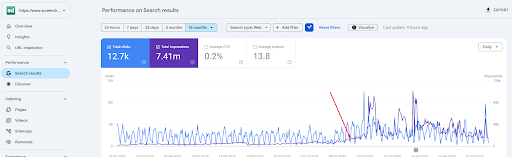
The full 16-month Google Search Console view shows a clear shift in Screendragon’s organic performance.
Across this period, the website generated 12.7K organic clicks and 8.5 million search impressions, with an average position of 12.1.
Before the SEO improvements began, organic visibility remained relatively low and stable. As the technical, content, and indexation work was implemented, the trend began to change.
From early 2026, Screendragon started appearing much more frequently in search results. Impressions increased sharply, clicks became stronger, and the website reached several new visibility peaks.
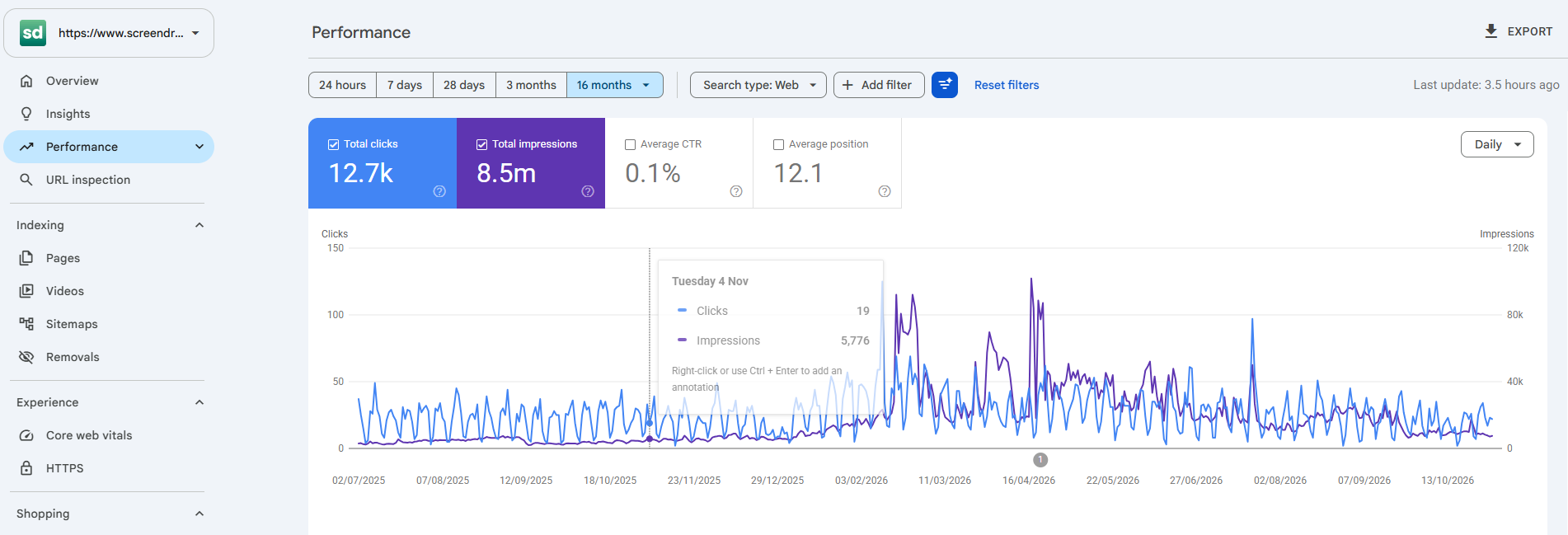
The graph shows that Screendragon was no longer maintaining the same limited level of organic discovery. It was building a much stronger search presence and appearing across a broader range of search queries.
This increased visibility created more opportunities to reach marketing teams, agencies, and operations leaders researching the problems Screendragon’s platform solves.
Comparing the Most Recent Six Months
The most recent six-month comparison shows the improvement more clearly.
During the previous six-month period, Screendragon generated 4.01K organic clicks and 1.02 million search impressions, with an average position of 31.
During the most recent six months, clicks increased to 5.96K, impressions reached 5.99 million, and the average position improved to 8.7.
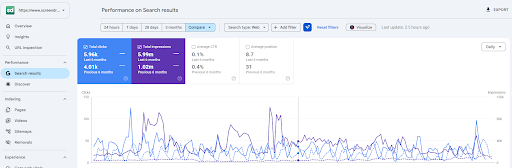
Organic clicks increased by 48.6%, while search impressions increased by approximately 487%.
Screendragon gained around 1,950 additional organic clicks and nearly five million additional search impressions compared with the previous period.
The improvement in average position was particularly important.
Screendragon moved from an average position of 31, beyond the first two pages, to an average position of 8.7 on the first page of Google.
The website was not only appearing more frequently. It was also appearing much closer to the top of the results, where potential customers were more likely to discover it.
CTR decreased from 0.4% to 0.1% while Screendragon’s visibility expanded across millions of additional impressions.
This gives us a clear opportunity for the next stage of the campaign: improving high-impression pages and search snippets so that more of this expanded visibility becomes qualified organic traffic.
Growing Beyond Traditional Google Search
Organic rankings were only one part of Screendragon’s growth.
The way enterprise buyers research software is changing. Potential customers now use Google AI Overviews, AI Mode, ChatGPT, Perplexity, Gemini, and other AI-powered platforms to discover products, understand categories, and compare solutions.
This made it important for Screendragon to be visible not only in traditional search results but also in the answers generated by these platforms.
We improved the way Screendragon’s expertise, products, and use cases were presented across the website.
Important explanations were made clearer, related pages were connected more effectively, and structured data was expanded to help search and answer engines understand the company.
The focus was not on writing content specifically for robots. It was on providing clear and useful answers that people could understand and AI platforms could confidently retrieve and reference.
AI Visibility Growth
Over the most recent six-month period, Screendragon’s presence across AI-powered search platforms increased significantly.
Google AI Overview citations increased by 151, bringing the total to 216 citations across 36 pages. The number of Screendragon pages appearing in these results increased by 21.
Screendragon also recorded 140 responses in Google AI Mode, an increase of 55, with visibility expanding across 40 pages.
The company began appearing in additional AI platforms as well. Screendragon gained new visibility in ChatGPT and Perplexity, while Grok recorded 23 responses across seven pages.
These results show that Screendragon’s content was becoming more understandable and useful beyond traditional search results.
The company was no longer relying only on standard Google rankings to be discovered. Its content was also appearing during AI-assisted research, when potential buyers were asking broader questions about marketing operations, agency management, workflow automation, and resource planning.
This matters because enterprise SaaS buyers often spend a long time researching before contacting a provider.
Being mentioned during that early research stage gives Screendragon more opportunities to become part of the buyer’s consideration process.
Building a Stronger Authority Profile
Screendragon’s authority also grew during the same six-month period.
Domain Rating increased from 57 to 67, while URL Rating improved from 14 to 16.
The website reached 325K backlinks, gaining approximately 60.3K backlinks during the period.
The number of referring domains grew by 520, bringing the total to 957 referring domains.
This growth gave Screendragon a stronger authority base for competing across valuable enterprise SaaS searches.
The backlink work was not about collecting random links.
The focus was on strengthening relevant signals around Screendragon’s products, expertise, research, and position within the marketing and agency operations market.
A stronger referring-domain profile helped search engines recognize Screendragon as a more established and trusted source within its category.
This supported the wider improvements in rankings, traditional search visibility, and AI discovery.
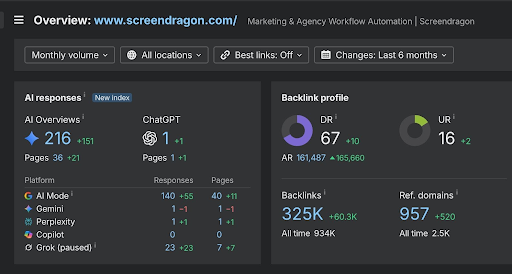
six-month period.
The combination of organic search growth, AI visibility, and stronger domain authority is important.
Search impressions show that more people can discover Screendragon. Improved rankings place the company closer to the top of Google. AI citations introduce the brand during AI-assisted research, while stronger authority gives the website a better foundation for competing over the long term.
Together, these improvements created more ways for potential buyers to find and evaluate Screendragon.
Why the Campaign Worked
There was no single change responsible for Screendragon’s growth.
The campaign worked because the technical foundation, content, internal structure, authority, and search intent were improved together.
Technical problems were addressed so search engines could crawl the website more efficiently. Indexation was cleaned so Google could focus on valuable pages. Commercial pages were improved so their purpose was clearer, while internal links connected useful content with products and solutions.
At the same time, stronger authority signals supported Screendragon’s ability to compete for valuable searches.
Clearer content and structured data also made the website easier for AI-powered platforms to understand and reference.
The work remained focused on the people Screendragon wanted to reach.
We were not trying to attract everyone. We wanted Screendragon to appear in front of enterprise marketing teams, agencies, operations leaders, and decision-makers actively researching the problems its platform solves.
Once the technical foundation, content, authority, and buyer intent began working together, Screendragon’s organic presence had room to grow across both traditional and AI-powered search.
Final Takeaway
Screendragon already had the product, expertise, and market experience needed to compete. Our job was to make sure its organic search presence reflected those strengths.
We corrected the technical foundation, improved indexation, strengthened commercial pages, connected related content, optimized website performance, expanded structured data, and improved Screendragon’s authority profile.
As a result, organic clicks increased by 48.6%, while search impressions grew by approximately 487%.
Screendragon’s average Google position improved from 31 to 8.7, moving its average visibility onto the first page of Google.
Google AI Overview citations increased by 151, reaching 216 citations across 36 pages.
Domain Rating increased from 57 to 67, backlinks reached 325K, and the number of referring domains grew to 957.
Screendragon is now easier to discover across traditional Google Search and AI-assisted research platforms.
The website also has a stronger authority base for competing across marketing resource management, agency operations, workflow automation, content operations, and resource planning searches.
Growth here does not only mean more rankings, impressions, backlinks, or AI citations. It means creating more opportunities to reach qualified enterprise buyers, enter their consideration process, generate pipeline, and increase revenue and income through organic search.
For enterprise SaaS companies competing in complex markets, Screendragon’s results show what can happen when technical SEO, useful content, authority building, and AI visibility work together.
Ready to strengthen your organic search performance?
Contact Novalab SEO Agency to discuss how we can build an SEO system that supports qualified traffic, pipeline, revenue, and long-term growth.