
Core Web Vitals Optimization Services
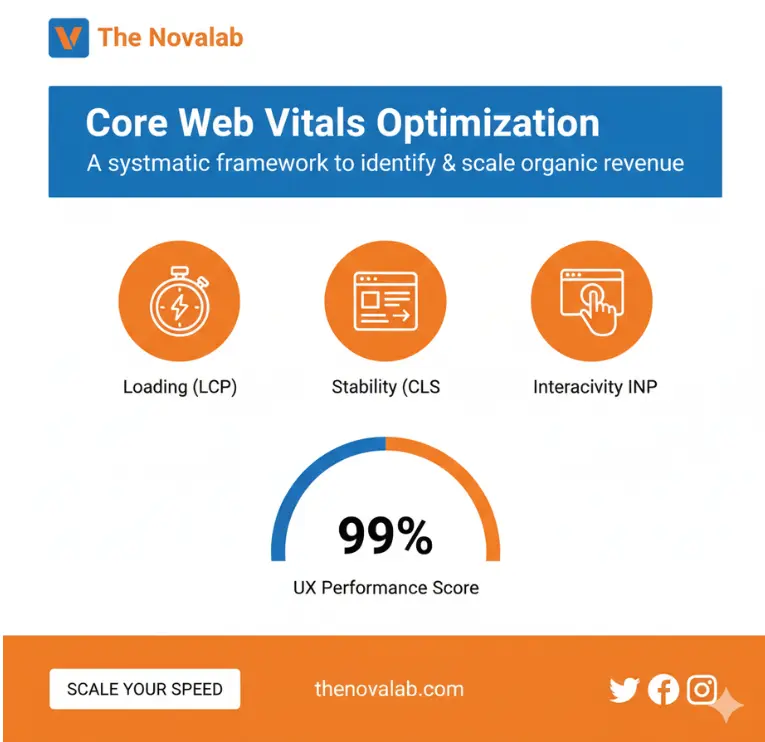
Google evaluates every indexed page against three performance metrics that measure loading speed, interactivity, and visual stability. These metrics, known as Core Web Vitals, became an official ranking signal in 2021 and remain part of Google’s page experience evaluation in April 2026. A SaaS website that fails Core Web Vitals thresholds faces a measurable disadvantage in search rankings, especially in competitive categories where content quality and backlink profiles between competitors are similar. Beyond rankings, poor Core Web Vitals scores directly affect user behavior. Slow pages increase bounce rates. Unresponsive interfaces reduce form submissions and demo requests. Layout shifts cause accidental clicks and erode trust.
Core Web Vitals optimization services address these issues through structured technical work that identifies the root causes of poor performance and applies targeted fixes across the page templates, asset delivery, and code architecture that drive each metric. The goal is not just to pass a Lighthouse test. The goal is to deliver a measurably faster, more stable experience on every page that matters to the business.
Novalab SEO Agency provides core web vitals optimization services built for SaaS companies running on WordPress, Bricks Builder, and other modern CMS platforms. The agency audits real-user performance data alongside lab testing results, prioritizes fixes by business impact, and delivers developer-ready task sheets that connect every optimization to its expected effect on LCP, INP, and CLS. This work supports stronger rankings in Google, better user engagement, and higher conversion rates from organic traffic arriving through Google, ChatGPT, Gemini, Perplexity, Claude, and Copilot.
What Core Web Vitals Measure and Why They Matter for SaaS
Core Web Vitals consist of three metrics that together represent the most critical aspects of user experience on a web page. Google evaluates these metrics using real-user data collected from Chrome users through the Chrome User Experience Report (CrUX). This means that Core Web Vitals scores reflect how actual visitors experience the site, not just how the site performs in a lab environment. For SaaS companies, where organic landing pages must convert visitors into trial signups, demo requests, and pipeline, every millisecond of delay and every layout shift has a measurable cost.
Largest Contentful Paint (LCP)
Largest Contentful Paint measures the time it takes for the largest visible content element to render on screen. This is typically a hero image, a headline block, or a primary content section. Google considers an LCP of 2.5 seconds or less as good. An LCP between 2.5 and 4 seconds needs improvement. An LCP above 4 seconds is rated poor.
LCP is the metric that most directly affects perceived load speed. When a visitor arrives on a SaaS product page from organic search, the first impression is shaped by how quickly the main content appears. A slow LCP creates the perception that the entire site is slow, which increases the likelihood that the visitor will return to search results and click a competitor. For SaaS companies, this means lost demos and lost pipeline.
Common causes of poor LCP on SaaS sites include unoptimized hero images served in legacy formats like PNG or JPEG instead of WebP or AVIF, slow server response times (high TTFB), render-blocking CSS and JavaScript that delays the critical rendering path, and large web font files that delay text rendering. Novalab SEO Agency diagnoses the specific LCP bottleneck on each page template and delivers targeted fixes rather than generic speed optimization recommendations.
Interaction to Next Paint (INP)
Interaction to Next Paint replaced First Input Delay (FID) as a Core Web Vital in March 2024. INP measures the latency of all user interactions throughout a page visit and reports the worst interaction, providing a more comprehensive picture of page responsiveness than FID did. Google considers an INP of 200 milliseconds or less as good. An INP between 200 and 500 milliseconds needs improvement. An INP above 500 milliseconds is rated poor.
INP matters for SaaS landing pages because these pages typically include interactive elements: pricing toggles, feature tabs, comparison filters, FAQ accordions, and call-to-action buttons. When a visitor clicks a demo request button, and nothing happens for half a second, the experience feels broken. That delay can cost a conversion. SaaS sites are particularly vulnerable to INP problems because they often load heavy JavaScript bundles, multiple analytics and tracking scripts, live chat widgets, A/B testing tools, and marketing automation tags that compete for main thread execution time.
Novalab SEO Agency audits JavaScript execution on every critical page template, identifies long tasks that block the main thread, and recommends specific changes: deferring non-critical scripts, code-splitting large bundles, removing unused JavaScript, and moving heavy processing off the main thread. The agency delivers these recommendations as developer task sheets with priority rankings based on expected INP improvement.
Cumulative Layout Shift (CLS)
Cumulative Layout Shift measures how much visible content moves unexpectedly during the page load and throughout the user session. Google considers a CLS score of 0.1 or less as good. A CLS between 0.1 and 0.25 needs improvement. A CLS above 0.25 is rated poor.
Layout shifts are one of the most frustrating user experiences on the web. A visitor reading a SaaS feature description may lose their place when an ad, image, or dynamically loaded element pushes the text down. A visitor about to click a pricing CTA may accidentally click a different link when the layout shifts at the wrong moment. These experiences erode trust and reduce conversion rates.
Common causes of CLS on SaaS sites include images and videos without defined width and height attributes, dynamically injected content such as cookie banners and promotional bars, late-loading web fonts that cause text to reflow (flash of unstyled text, or FOUT), and third-party embeds like video players or chat widgets that load without reserved space. Novalab SEO Agency identifies every source of layout shift on priority pages and provides specific fixes, including dimension attributes, font-display strategies, and content reservation techniques.
How Core Web Vitals Affect SaaS Rankings and Conversions
Core Web Vitals are a confirmed Google ranking signal, but their weight relative to other factors deserves honest framing. They are not the most powerful ranking factor. Content relevance, backlink authority, and search intent alignment carry more weight. However, in competitive SaaS categories where multiple pages target the same keyword with similar content quality and authority, Core Web Vitals can act as a tiebreaker. The site with better page experience scores earns the ranking advantage.
The more significant impact of Core Web Vitals for SaaS companies is on conversion rates rather than rankings alone. Research from Google’s Chromium team has shown that pages meeting Core Web Vitals thresholds see 24 percent fewer page load abandonments. For SaaS companies, where each organic visitor represents potential pipeline, a 24 percent reduction in abandonment translates directly to more demo requests, more trial signups, and more revenue from the same traffic volume.
Core Web Vitals also affect crawl efficiency. Pages that load faster and respond more quickly are easier for search engine crawlers to process. This means more pages get crawled per crawl session, which improves indexing speed for new and updated content. For SaaS companies that publish frequently, whether blog content, documentation updates, or new feature pages, faster crawling means faster visibility in search results. This connects Core Web Vitals work to the broader technical SEO for SaaS framework that Novalab applies across engagements.
Core Web Vitals Optimization Services Novalab Provides
Novalab SEO Agency delivers core web vitals optimization services through a structured process that moves from measurement through implementation to validation. Every step produces actionable deliverables designed for development teams to execute.
Technical Audit and Performance Benchmarking
The engagement begins with a comprehensive performance audit that combines lab testing and real-user data analysis. Novalab uses PageSpeed Insights, Lighthouse, Google Search Console’s Core Web Vitals report, and CrUX data to establish baseline scores for LCP, INP, and CLS across all critical page templates.
The audit goes beyond surface scores. Novalab identifies the specific technical root causes behind each metric failure. For LCP, the agency traces the critical rendering path from server response through resource loading to final paint. For INP, the agency profiles JavaScript execution to find long tasks and main thread bottlenecks. For CLS, the agency maps every source of layout instability across the page lifecycle.
The output is a prioritized audit report that ranks every issue by severity, expected improvement impact, and implementation effort. High-impact pages, such as the homepage, pricing page, product pages, and top-performing blog posts, receive the most detailed analysis. This ensures that optimization effort concentrates where it will generate the most business value. Broader SEO audit services can identify how these performance issues interact with indexing, content, and other technical SEO problems.
LCP Optimization
LCP optimization targets the full rendering pipeline from server to screen. Novalab SEO Agency addresses the most common LCP bottlenecks on SaaS sites through a combination of server-side and client-side improvements.
Server response time (TTFB) optimization includes evaluating hosting configuration, CDN setup, caching policies, and database query performance. For WordPress sites running Bricks Builder, Novalab reviews object caching, page caching, and server-side rendering configuration to reduce time-to-first-byte below 800 milliseconds.
Resource delivery optimization includes converting images to next-generation formats (WebP and AVIF), implementing responsive image markup with srcset attributes, preloading the LCP element using the fetchpriority attribute, eliminating render-blocking CSS through critical CSS extraction and deferred loading of non-critical stylesheets, and optimizing web font loading with font-display swap and optional preloading.
These changes are delivered as a developer task sheet specifying the exact files, elements, and configurations that need to change, along with expected LCP improvement for each fix.
INP Optimization
INP optimization requires reducing JavaScript execution time and freeing the main thread to respond to user interactions without delay. This is often the most technically complex area of Core Web Vitals work because SaaS sites rely heavily on JavaScript for analytics, tracking, personalization, and interactive UI elements.
Novalab SEO Agency audits every script loaded on critical pages, categorizes each by function (essential, deferrable, removable), and recommends a loading strategy that prioritizes user-facing interactivity over background data collection. Common interventions include deferring tag manager execution until after the page is interactive, lazy-loading chat widgets and support tools, code-splitting large JavaScript bundles so only the code needed for the current page loads, removing unused JavaScript from legacy features or retired A/B tests, and moving heavy computation to web workers that run off the main thread.
For SaaS companies running multiple marketing and analytics tools, INP optimization often requires negotiation between marketing requirements and performance goals. Novalab helps teams make informed trade-offs by quantifying the INP cost of each script so stakeholders can make data-driven decisions about which tools to keep, defer, or remove.
CLS Optimization
CLS optimization focuses on ensuring that every element on the page has a predictable position from the moment it first renders. Novalab SEO Agency addresses layout stability through a combination of HTML attribute fixes, CSS adjustments, and loading strategy changes.
The most common CLS fixes for SaaS sites include adding explicit width and height attributes to all images and video elements, reserving space for dynamically injected content such as cookie consent banners and promotional bars using CSS min-height or aspect-ratio, implementing font-display swap with optional font preloading to prevent late font rendering from causing text reflow, and reserving space for third-party embeds like video players and chat widgets using CSS container sizing.
These fixes are individually small but collectively significant. A CLS improvement from 0.3 to 0.05 can meaningfully reduce accidental clicks, improve reading experience, and increase the likelihood that visitors complete their intended action on the page.
Mobile Performance Optimization
Mobile traffic represents the majority of organic visits for most SaaS websites, and Google’s Core Web Vitals evaluation uses mobile performance as the primary assessment. Mobile devices have less processing power, less memory, and often operate on slower network connections than desktop devices. This means that performance issues visible on desktop are amplified on mobile, and issues invisible on desktop may only appear on mobile.
Novalab SEO Agency tests Core Web Vitals performance across multiple device profiles and network conditions, including throttled 4G connections that simulate real-world mobile browsing. The agency identifies mobile-specific issues such as oversized images served to small screens, JavaScript execution that overwhelms mobile processors, and touch interaction delays caused by main thread congestion. Mobile optimization ensures that the Core Web Vitals improvements hold across the full range of devices that visitors use to access SaaS landing pages.
The Novalab Core Web Vitals Process
Step 1: Measure and Prioritize
Novalab identifies the pages that drive the most organic traffic, pipeline, and revenue. The agency then measures Core Web Vitals performance across those pages using both lab tools and real-user data. This allows the team to prioritize optimization work on the pages where improvements will have the greatest business impact rather than optimizing the entire site uniformly.
Step 2: Diagnose Root Causes
For each underperforming page, Novalab traces each metric failure to its technical root cause. This goes beyond the generic recommendations that tools like PageSpeed Insights provide. The agency identifies the specific images, scripts, stylesheets, fonts, and server configurations that drive each metric below threshold. This precision ensures that development effort is directed at changes that will produce measurable improvement.
Step 3: Deliver Developer Task Sheets
Novalab produces structured task sheets for the development team. Each task includes the page or template affected, the metric it addresses (LCP, INP, or CLS), the specific technical change required, the expected improvement, and the priority ranking. These task sheets are designed for immediate execution without additional interpretation or research by the development team.
Step 4: Validate and Monitor
After implementation, Novalab validates improvements by re-running lab tests and monitoring real-user data in Google Search Console’s Core Web Vitals report. The agency confirms that each change produced the expected improvement and identifies any regressions introduced by the fixes. Ongoing monitoring continues for four to eight weeks to ensure that scores stabilize and that subsequent content or code changes do not reintroduce performance issues.
Core Web Vitals for SaaS Sites Running WordPress and Bricks Builder
Many SaaS companies run their marketing sites on WordPress with Bricks Builder, a combination that offers design flexibility but can introduce performance challenges if not optimized carefully. Bricks Builder generates clean HTML, but the themes, plugins, and third-party integrations layered on top can degrade Core Web Vitals scores through render-blocking resources, excessive DOM size, and JavaScript overhead.
Novalab SEO Agency has deep experience optimizing WordPress and Bricks Builder sites for Core Web Vitals. The agency evaluates the full stack, including hosting environment, caching plugin configuration, image optimization pipeline, font loading strategy, plugin overhead, and theme-level code efficiency. Specific WordPress optimizations include configuring object caching and page caching for optimal TTFB, auditing plugin load impact and deactivating or replacing plugins that degrade INP, implementing critical CSS extraction so above-the-fold content renders without waiting for the full stylesheet, configuring lazy loading for below-the-fold images while ensuring the LCP image loads with high priority, and setting up a CDN for static asset delivery to reduce latency for geographically distributed visitors.
These optimizations connect directly to the broader WordPress SEO services that Novalab performs for clients, ensuring that Core Web Vitals improvements are part of a cohesive technical foundation rather than isolated fixes.
Measuring Core Web Vitals: Lab Data vs. Field Data
Understanding the difference between lab data and field data is essential for effective Core Web Vitals optimization. Lab data comes from tools like Lighthouse and PageSpeed Insights that test a page under controlled, simulated conditions. Lab data is useful for diagnosing issues and measuring the impact of specific changes, but it does not reflect real-user experience because it uses a single device profile and network speed.
Field data comes from real users visiting the site in production, collected through the Chrome User Experience Report (CrUX) and reported in Google Search Console. Field data reflects the actual distribution of user experiences across different devices, networks, and geographic locations. Google uses field data, not lab data, for its ranking evaluation. This means a site can score well in Lighthouse but still fail Core Web Vitals in Google Search Console if real users on slower devices or connections experience poor performance.
Novalab SEO Agency uses both data sources throughout the optimization process. Lab data guides diagnosis and fixes validation. Field data confirms that improvements translate to real-user experience and ranking benefit. The agency monitors CrUX data in Search Console’s Core Web Vitals report to track the 28-day rolling assessment that Google uses for ranking purposes, ensuring that improvements reach the threshold where they influence search performance.
Benefits of Core Web Vitals Optimization for SaaS Companies
SaaS companies that invest in core web vitals optimization services gain advantages across rankings, user engagement, and conversion performance. Pages that meet all three Core Web Vitals thresholds earn a page experience advantage in Google’s ranking algorithm, which compounds with other SEO improvements in content quality, backlink authority, and technical architecture. Faster pages also reduce bounce rates. Visitors who see content load quickly are more likely to stay, scroll, read, and engage with calls to action. For SaaS landing pages that target bottom-of-funnel keywords, this translates directly to more demo requests and trial signups from the same volume of organic traffic.
Improved INP scores mean that interactive elements respond instantly. Pricing calculators, feature comparison tools, and demo request forms work without perceptible delay. This removes friction from the conversion path and increases the percentage of visitors who complete their intended action. CLS improvements eliminate the frustrating experience of content shifting during interaction. Visitors can read, scroll, and click without unexpected interruptions. This builds trust and supports the professional impression that SaaS buyers expect from a software provider’s website.
Beyond direct conversion impact, Core Web Vitals optimization improves crawl efficiency for search engines. Faster, lighter pages allow Google to crawl more pages per session, which accelerates the indexing of new content. For SaaS companies that publish SEO content for SaaS regularly, this means new articles and feature pages reach search results faster. Larger sites can also use crawl budget optimization services to concentrate crawler attention on high-value URLs.
Why SaaS Companies Choose Novalab for Core Web Vitals Optimization
SaaS companies choose Novalab SEO Agency for Core Web Vitals work because the agency combines technical performance expertise with an understanding of SaaS business metrics. Most speed optimization providers treat performance as a standalone technical project. Novalab treats it as a component of a broader SEO consulting for SaaS strategy that connects page speed to pipeline and revenue.
The agency delivers developer-ready specifications rather than generic recommendations. Every task sheet specifies the exact change, the affected template, the target metric, and the expected improvement. Development teams can execute without additional research or interpretation. Novalab also connects Core Web Vitals work to the client’s broader SEO priorities, ensuring that performance optimizations align with content strategy, SEO migration services, and technical SEO improvements.
Core Web Vitals Optimization Services by Novalab SEO Agency
Performance Audit and Benchmarking — Novalab audits Core Web Vitals using lab tools and real-user CrUX data, establishing baseline scores and identifying root causes for every metric failure across critical page templates.
LCP Optimization — The agency reduces Largest Contentful Paint through server response improvements, image optimization, render-blocking resource elimination, and critical rendering path refinement.
INP Optimization — Novalab reduces Interaction to Next Paint by auditing JavaScript execution, deferring non-critical scripts, removing unused code, and restructuring loading strategies to free the main thread.
CLS Optimization — The agency eliminates layout shifts through dimension attributes, content reservation, font loading strategies, and third-party embed containment.
Mobile Performance — Novalab tests and optimizes across device profiles and network conditions to ensure Core Web Vitals thresholds are met on mobile, where Google’s ranking evaluation is focused.
Ongoing Monitoring — Post-implementation monitoring tracks real-user data in Search Console to confirm that improvements hold and to catch regressions from code or content changes.
Start Growing With The Novalab SEO Agency
If you’re looking for an SEO agency that understands your goals and delivers real outcomes, The Novalab SEO Agency is ready to help.
We build strategies designed to grow your organic traffic, strengthen brand visibility, and convert visitors into loyal customers.
Contact our team to discuss your SEO goals.
Let The Novalab SEO Agency guide your business toward better rankings, more traffic, and consistent results.
Frequently Asked Questions About Core Web Vitals Optimization Services
Q: What are Core Web Vitals? A: Core Web Vitals are three Google performance metrics that measure loading speed (LCP), interactivity (INP), and visual stability (CLS). Google uses real-user data for these metrics as a ranking signal in its search algorithm. Pages that meet all three thresholds earn a page experience advantage in competitive search results.
Q: How do Core Web Vitals affect SaaS SEO? A: Core Web Vitals serve as a ranking tiebreaker in competitive SaaS categories where content quality and authority are similar between competing pages. More significantly, poor scores increase bounce rates, reduce form submissions, and lower demo request conversions. Optimizing Core Web Vitals improves both rankings and conversion rates from organic traffic.
Q: What are the Core Web Vitals thresholds? A: Google rates LCP as good at 2.5 seconds or less, INP as good at 200 milliseconds or less, and CLS as good at 0.1 or less. Pages that exceed these thresholds in the needs improvement or poor ranges may face ranking disadvantages and will deliver a weaker user experience that reduces conversions.
Q: What causes poor Core Web Vitals on SaaS sites? A: Common causes include unoptimized images in legacy formats, slow server response times, render-blocking CSS and JavaScript, heavy analytics and tracking scripts that block the main thread, images and embeds without defined dimensions, late-loading web fonts, and excessive third-party widget overhead. SaaS sites are particularly vulnerable due to the number of marketing and analytics tools they typically load.
Q: How does Novalab optimize Core Web Vitals for SaaS? A: Novalab audits performance using both lab tools and real-user CrUX data, identifies root causes for each metric failure on priority pages, and delivers developer task sheets with specific fixes ranked by expected impact. After implementation, the agency validates improvements and monitors real-user data to confirm that scores meet thresholds and hold over time.
Q: How long does Core Web Vitals optimization take to show results? A: Lab scores improve immediately after implementation. Real-user field data in Google Search Console updates on a 28-day rolling basis, so ranking benefits typically appear within four to six weeks after fixes are deployed and verified by real users. Novalab monitors field data throughout this period to confirm improvements.