
Enterprise SEO Audit: The Complete Guide to Large-Scale SEO Success
If your website has tens or even hundreds of thousands of pages, chances are your traffic isn’t growing as it should. Rankings fluctuate unpredictably, competitors keep overtaking your positions, and despite investing heavily in SEO, the results don’t match the effort. The reason is simple: large scale websites require specialized strategies. A basic SEO audit won’t uncover the depth or scale of the issues. You need an Enterprise SEO Audit that addresses complexity, scale, and coordination across teams, which is different from SEO consulting for SaaS on a smaller site.
At Novalab SEO Agency, we specialize in Enterprise SEO Audits for large organizations. We’ve worked with sites ranging from 50,000 to over a million pages, uncovering hidden issues that were blocking growth. This guide breaks down exactly what an Enterprise SEO Audit entails, why it’s essential, and how to execute one effectively.
What This Guide Covers
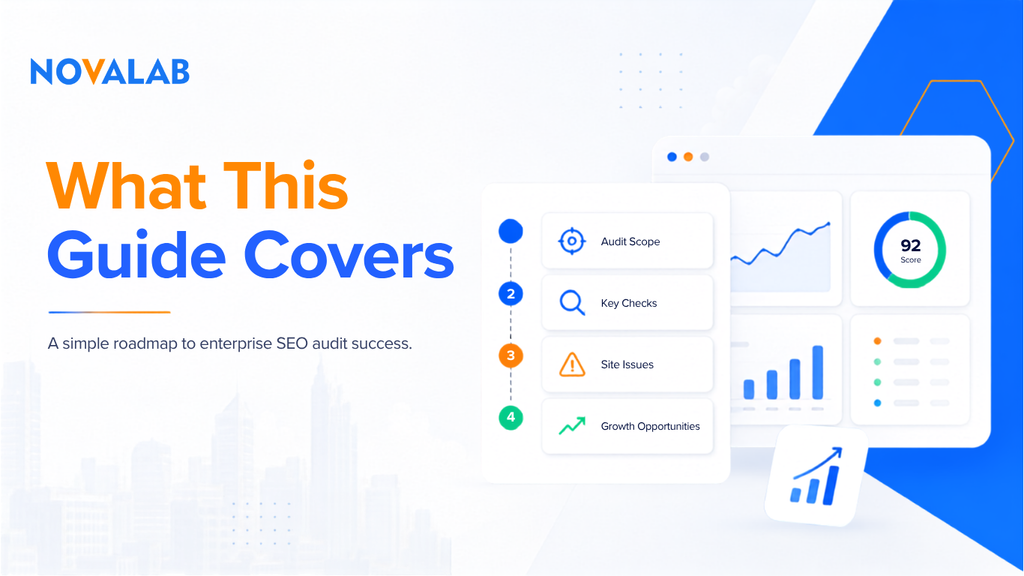
- Clear definition of an Enterprise SEO Audit
- Why enterprise sites need specialized audits
- Key differences from standard SEO audits
- Critical elements every Enterprise SEO Audit must examine
- Common problems in large-scale websites
- How Novalab SEO Agency approaches enterprise audits
- Practical steps to conduct your own audit
- Real results from enterprise-level optimization
- Real results from enterprise-level optimization
What Is an Enterprise SEO Audit?
An Enterprise SEO Audit is a comprehensive examination of large, complex websites. It analyzes technical health, content quality, site structure, and performance at scale. Basic audits may spot-check a handful of pages, but enterprise audits are built to systematically evaluate thousands, or even millions, of URLs, templates, and content types so you can see what is truly holding back organic performance. A free SEO audit tool cannot replace that depth.
The goal is simple: identify everything preventing your site from reaching its full potential, technical errors, content gaps, structural problems, performance bottlenecks, and missed opportunities that quietly limit rankings, indexing, and conversions. In practice, enterprise sites usually aren’t “broken” in one obvious way. They’re slowed down by many small issues repeated across templates, regions, categories, and legacy systems, and that repetition is what makes enterprise auditing essential.
Think of it as a full medical checkup for your website. Instead of asking how things feel, an enterprise audit runs diagnostics across every system, measures what’s happening at scale, and surfaces the hidden issues that reduce crawl efficiency, waste authority, and stall organic growth (which means increasing revenue and income over time).
How Enterprise Audits Differ from Standard Audits
A standard SEO audit works fine for smaller websites because the site structure is usually simple enough to review manually and fix quickly. But when you’re managing hundreds of thousands of pages across multiple templates and teams, manual review becomes incomplete and unreliable. Enterprise audits are designed for scale, so they combine automation, intelligent sampling, and structured evaluation to find patterns, prioritize the highest-impact problems, and create fixes that can be deployed across entire site sections.
Enterprise SEO Audits use automated crawling to examine your pages consistently, then apply data sampling and segment-based analysis to identify where issues cluster, by template, by region, by directory, by product type, or by content category. This makes it possible to move beyond “here’s a list of problems” into “here are the specific templates and sections causing the problem, and here’s how much impact fixing them will create.” At Novalab, we combine automation with expert analysis to detect issues, but humans interpret the findings in context and set priorities that align with your business goals, because at enterprise scale, what you fix first is often more important than what you fix eventually.
Why Enterprise Websites Need Specialized Audits
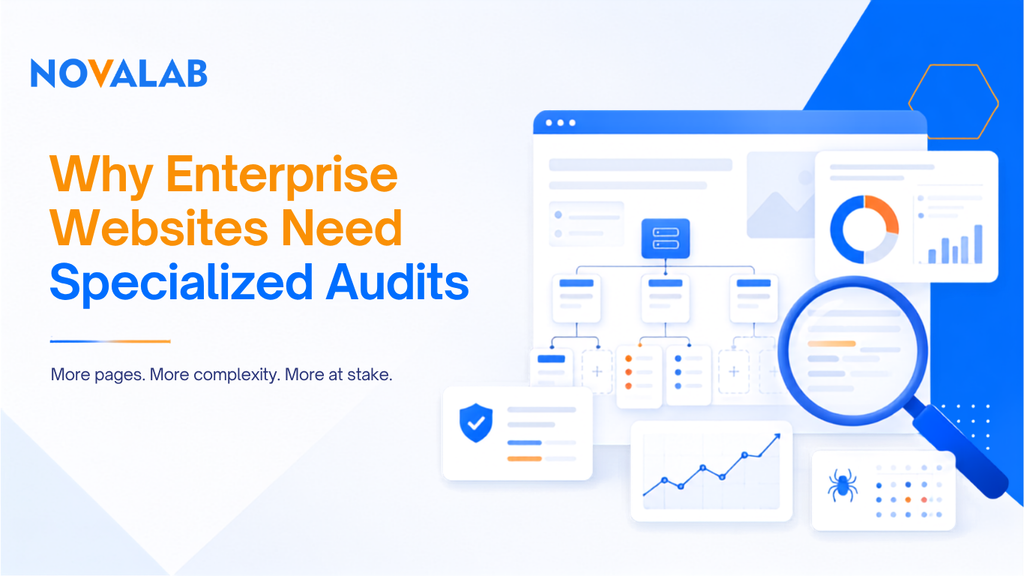
Large websites face unique challenges: more pages, more teams, more platforms, and more complexity layered over time. Enterprise sites often contain legacy code, technical debt, regional variations, different CMS rules, and multiple integrations that can unintentionally create indexing chaos. A small mistake can become a large problem when it’s repeated across thousands of URLs, and a hidden bottleneck in one template can drag down performance across an entire segment of the site, which is why technical SEO service has to cover templates, regions, and CMS rules together.
A specialized audit helps you prioritize thousands of issues effectively by separating “noisy” problems from problems that actually impact business outcomes. It identifies what matters most for revenue and income by connecting technical and content findings to crawl behavior, index coverage, ranking potential, and conversion paths. It also enables you to scale fixes efficiently across large architectures, coordinate changes across departments, and measure impact accurately across different regions or site sections. Without enterprise-level expertise, audits can become overwhelming lists that look impressive but don’t translate into clear next steps, or worse, they drive teams to spend months fixing low-impact items while major blockers remain untouched.
Critical Components of an Enterprise SEO Audit
Every Enterprise SEO Audit must examine the key areas that determine site health and growth. A complete site-wide audit focuses on consistency across templates, content types, languages, and regions, because enterprise performance is rarely determined by one page. It’s determined by what your systems produce repeatedly at scale.
Technical Infrastructure Analysis
A solid technical foundation supports everything else, and enterprise audits start here because technical friction affects crawling, indexing, speed, and user experience across the entire site. Server performance is one of the most overlooked enterprise constraints: even if your content is strong, unstable infrastructure during traffic peaks can cause slowdowns, timeouts, and crawling inefficiencies that reduce rankings over time. We’ve audited clients whose servers struggled during sales events, which triggered performance drops and indexing instability; after infrastructure improvements, they handled significantly higher traffic without slowdowns. Technical SEO for SaaS treats that infrastructure layer as ranking work, not a separate IT ticket.
Crawl efficiency is another major lever at enterprise scale because search engines operate with limited crawl budgets. If bots waste time crawling irrelevant URLs – such as parameter variations, filtered pages, session IDs, thin internal search results, or duplicate pagination. Your valuable content gets crawled less frequently and indexed more slowly. Enterprise audits identify where crawl paths are being wasted through log file analysis SEO and how to guide bots toward your highest-value content. Mobile performance also belongs in technical infrastructure because mobile traffic dominates most industries, yet enterprise sites often have hidden performance regressions within specific templates or regions. Finally, site architecture matters because a scalable, logical structure helps both users and search engines understand relationships between pages, while reducing internal friction that leads to orphaned pages and weak authority distribution.
Content Quality Assessment
Content variation is inevitable across large websites, but it must be managed systematically. Enterprise audits evaluate content depth, usefulness, and uniqueness across templates and content clusters so you can find weak areas that drag down perceived quality. Many enterprise sites have strong top-level pages but thin or repetitive supporting pages, and those weak sections can reduce overall trust signals, limit long-tail visibility, and waste crawl budget. Keyword research services show which of those thin sections still have demand worth expanding.
Duplicate content is especially common at scale due to product variants, category overlaps, pagination patterns, and URL parameters that create near-identical pages. When search engines see repeated content across many URLs, it can dilute relevance and make it harder for your best pages to rank. We’ve helped clients consolidate large volumes of duplicates, freeing crawl budget and strengthening index efficiency, which often unlocks meaningful growth. Content gaps are also a major missed opportunity: competitors’ ranking for topics you haven’t covered represents demand you’re not capturing. Gap analysis reveals where search intent exists, but your site doesn’t provide the right content. Content freshness is the final piece; outdated pages undermine authority, especially in fast-moving markets, and regular updates help protect ranking potential and user trust.
On-Page Optimization Review
Enterprise SEO success requires consistency in optimization, because even small errors can scale into thousands of problems. A proper audit evaluates title tags and meta descriptions at scale to uncover duplication, truncation, poor intent matching, and automation errors that reduce click-through rate. It also reviews header structure across templates to ensure your content is organized logically for users and search engines, which improves comprehension and supports better rankings. An on-page SEO agency for better rankings looks for that same consistency, then scales it across templates.
Internal linking is evaluated not only for quantity but for distribution, because enterprise sites often have authority concentrated on the homepage or a few top pages, while deeper pages struggle to rank. Audits identify where link equity gets trapped, where important pages are underlinked, and how navigation and contextual links can be improved. Image optimization is also reviewed as part of on-page work because uncompressed images and heavy scripts can quietly destroy performance, especially on mobile, which impacts both user experience and rankings.
Indexing and Crawlability Examination
Search engines must discover, index, and prioritize the right content, and enterprise sites frequently create conflicting signals that confuse bots. An enterprise audit examines robots.txt rules to ensure important directories aren’t being blocked and that low-value sections are being controlled properly. XML sitemaps are evaluated for accuracy, coverage, and cleanliness because messy sitemaps can waste crawl budget and slow down indexation.
Canonical tags are reviewed to ensure the correct pages are being consolidated and that canonicals aren’t accidentally pointing to the wrong URLs or creating loops. Noindex rules are also validated at scale to confirm that low-value pages are excluded intentionally and high-value pages aren’t being removed by accident. This part of the audit often reveals why “important pages aren’t ranking” even when the content looks fine, because the technical signals are telling Google not to prioritize them.
Performance and Core Web Vitals Analysis
User experience directly affects rankings, and at enterprise scale, performance problems usually come from templates, not one-off pages. Enterprise audits identify slow templates and the underlying causes, such as heavy JavaScript bundles, unoptimized media, render-blocking resources, or third-party scripts that degrade performance across sections of the site.
Core Web Vitals analysis focuses on metrics like Largest Contentful Paint, First Input Delay (or its modern measurement equivalents in many reporting tools), and Cumulative Layout Shift. The goal is not to “chase scores” but to remove friction that slows loading, delays interactions, or causes layout instability. Performance improvements compound through Core Web Vitals optimization services: they support better crawling, better engagement, better conversion rates, and ultimately stronger organic growth (meaning increasing revenue and income stably).
Backlink Profile Evaluation
Links remain central to SEO, but enterprise backlink profiles are often messy due to long domain history, PR cycles, and legacy campaigns. A proper audit evaluates link quality to identify toxic backlinks that create risk, as well as the overall distribution of authority across the site. It’s common for enterprise sites to have many links pointing to the homepage while important commercial or informational sections receive little direct authority support.
Competitor link analysis is included to identify where competitors are earning trust signals you’re missing, which can guide safer, more strategic link acquisition. Lost link recovery is also a meaningful lever at enterprise scale, reclaiming valuable lost backlinks can produce quick wins without new SaaS link building, especially when links were lost due to URL changes, migrations, or discontinued pages.
Schema and Structured Data Review
Structured data improves visibility and click-through rate by helping search engines understand your content and present it more richly in results. Enterprise audits review schema accuracy against Google’s standards, then examine coverage across templates to ensure the right markup is applied consistently where it matters most. This includes validating structured data regularly because schema errors often appear during template updates, migrations, or CMS changes.
At enterprise scale, structured data is not a “nice to have.” It’s a system that supports clarity, improves eligibility for enhanced results, and reinforces trust signals when implemented correctly and consistently.
Common Problems Found in Enterprise SEO Audits
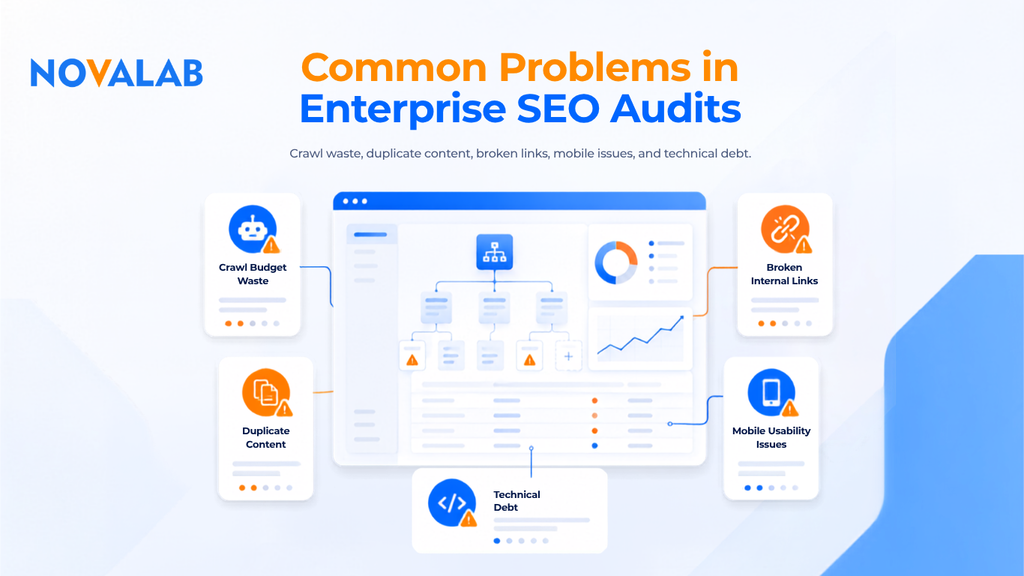
Our experience across hundreds of enterprise audits reveals patterns that repeat across industries. Crawl budget waste is one of the most common, where search engines spend time crawling non-essential pages instead of high-value content. Technical debt is another frequent limiter, outdated code and legacy systems can create performance and crawling inefficiencies that are difficult to spot without a structured audit.
Inconsistent implementation across teams is especially common on large sites, where different departments publish content or deploy templates without unified SEO standards. Duplicate content at scale often comes from pagination, parameters, and filters, creating thousands of near-identical URLs. Broken internal links also appear frequently, especially after migrations or category changes, which leads to lost link equity and poor user flow. Mobile issues are also widespread in enterprise environments because “responsive” does not always mean “usable,” and certain templates or checkout elements can fail silently on smaller screens.
These issues are typical for enterprise websites managing millions of URLs, and they’re exactly why the audit must be systematic and prioritized; otherwise, teams end up reacting instead of improving.
How Novalab SEO Agency Conducts Enterprise SEO Audits
Our process is built to create clarity and measurable improvement, not just documentation.
Step 1 focuses on discovery and goal setting, because the right audit depends on what the business is trying to achieve; traffic alone is not the goal if conversions, qualified leads, or revenue and income are the priority.
Step 2 is data collection, where we aggregate sources like Search Console, analytics platforms, crawl data, and backlink tools to build a complete picture.
Step 3 uses automated crawling and large-scale analysis to scan URLs for technical and structural errors and identify pattern-based issues that repeat across templates.
Step 4 is manual validation, where experts confirm the findings and separate real blockers from false positives and low-impact noise.
Step 5 prioritizes issues and builds a roadmap so teams know exactly what to tackle first and why it matters.
Step 6 turns the roadmap into stakeholder recommendations, assigning fixes across marketing, IT, and content teams so execution is realistic.
Step 7 establishes a measurement framework, defining KPIs and tracking impact over time so improvements are visible and decisions remain data-driven.
This structured process becomes the backbone of an enterprise-level SEO framework that scales, because execution is where audits succeed or fail.
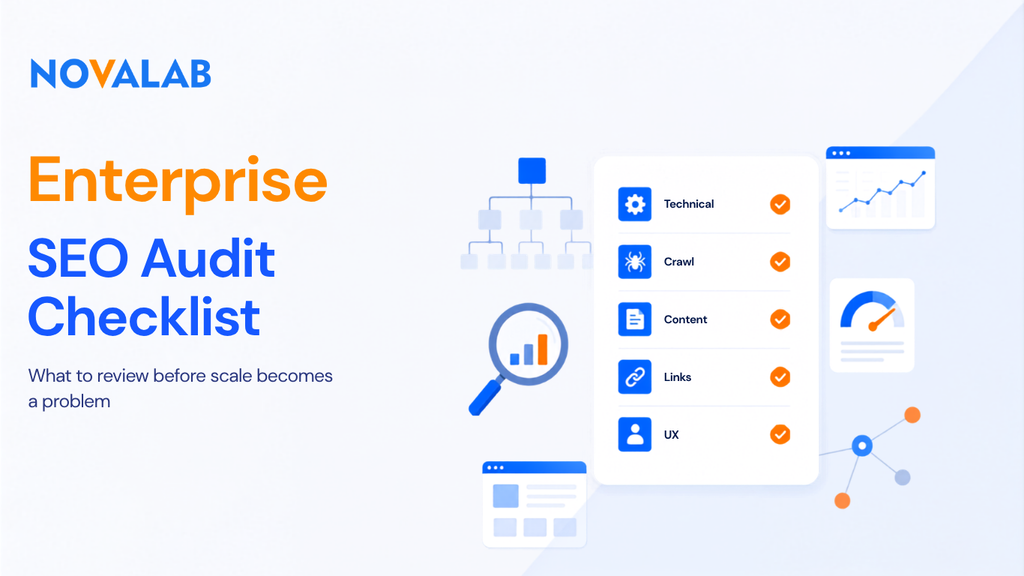
Enterprise SEO Audit Checklist
An enterprise checklist only works when it’s treated as a system, not a list. Technically, professional SEO audit services should confirm that servers are fast and stable, the site is mobile-friendly, HTTPS is enforced everywhere, redirects are clean, and legacy issues aren’t creating widespread errors. Crawling controls need to be accurate, meaning robots.txt rules align with strategy, sitemaps reflect the correct canonical URLs, and indexing signals aren’t conflicting.
The site’s structure should support both users and search engines with logical navigation, strong internal linking, and clear pathways to key content. Content must be unique, helpful, and kept updated so quality signals remain strong across all sections. Performance must meet Core Web Vitals targets at the template level, not just on a few pages, and mobile UX should be tested across devices to ensure key actions work smoothly. Schema should be validated and deployed across relevant templates consistently, while backlinks should be monitored to maintain a healthy profile and reduce risk from toxic links.
Real Results from Enterprise SEO Audits
Enterprise audits create results when they lead to scalable fixes, not isolated page edits. For a global e-commerce platform, consolidating tens of thousands of duplicate pages often frees crawl budget and strengthens category relevance. When combined with performance improvements, load times can drop dramatically, which improves user experience and supports stronger rankings, often translating into meaningful growth in organic revenue and income.
For SaaS companies expanding internationally, enterprise audits frequently uncover hreflang problems, localization gaps, and structured data inconsistencies that block regional performance. Fixing those issues with hreflang implementation service helps international traffic scale while improving conversions in new markets. For media publishers, index bloat is a common problem, too many low-value pages indexed, diluting crawl attention and reducing performance per page. Reducing low-value indexed pages and improving structure often increases traffic per page and strengthens monetization outcomes like ad revenue.
Enterprise SEO Audit vs. Ongoing SEO Management
An audit is a diagnosis. It identifies problems, reveals patterns, and builds a plan. Ongoing SEO is treatment: implementing fixes, maintaining quality, improving performance over time, and adapting to new technical changes and search behavior. Enterprise sites need both, because even a perfect audit becomes outdated if the site keeps changing without guardrails.
At Novalab, we typically conduct full audits annually and support them with quarterly health checks to keep performance stable, detect new issues early, and ensure progress continues across all regions and site sections.
How to Choose an Enterprise SEO Audit Provider
Choosing the right provider matters because enterprise audits must produce action, not paperwork. Look for partners with proven experience at your scale, deep technical and analytical capability, and an understanding of your business model and market realities. The best providers deliver prioritized recommendations that can actually be implemented by teams, with clear rationale and measurable expected impact.
Enterprise audits succeed when providers can translate complex findings into a practical roadmap, one that teams can execute without getting lost in “nice to fix” details that don’t move the needle.
Taking Action After an Enterprise SEO Audit
The audit only becomes valuable when it turns into coordinated execution. Start by reviewing findings with stakeholders so everyone agrees on priorities and understands what success looks like. Then create a timeline that splits work into phases, because enterprise changes often require sequencing, quick wins, mid-term fixes, and longer-term structural improvements.
Assign ownership clearly so every recommendation has accountability, especially when work spans marketing, engineering, and content teams. Track metrics tied to outcomes, not just tasks completed, including traffic quality, conversions, index coverage, and template-level performance. Schedule regular reviews so new issues don’t compound silently, and so the roadmap stays aligned with business goals as the site evolves.
Why Enterprise SEO Audits Matter More Than Ever
Competition for organic visibility is fiercer than ever, and large websites can’t win without systematic optimization. A professional Enterprise SEO Audit reveals hidden problems, removes inefficiencies, and creates measurable growth opportunities that scale across thousands of pages. Every problem uncovered is solvable, and every opportunity is attainable when the audit output is translated into a clear plan and executed consistently.
Regular audits turn complexity into clarity, improving visibility, conversions, and long-term revenue and income. At Novalab SEO Agency, we help enterprise companies uncover their full organic potential through data-driven, scalable SEO audits.
Start Growing With The Novalab SEO Agency in London
If you’re looking for a SaaS SEO agency that understands your goals and delivers real outcomes, The Novalab SEO Agency is ready to help.
We build strategies designed to grow your organic traffic, strengthen brand visibility, and convert visitors into loyal customers.
Contact our team today to request a free SEO audit or consultation.
Let The Novalab SEO Agency guide your business toward better rankings, more traffic, and consistent results.