
How to Measure SEO ROI for SaaS: A Practical Guide for 2026
Most SaaS teams know SEO drives traffic. Fewer know how to tie that traffic to revenue. Without a clear measurement framework, organic search stays a cost center on the CFO’s spreadsheet instead of a growth channel with a defensible return. This guide walks through exactly how to measure SEO ROI for SaaS, from the metrics that matter to the formulas you can put in front of a board, the same reporting bar a SaaS SEO agency should meet.
Why Standard SEO Metrics Fall Short for SaaS
Pageviews and keyword rankings are vanity metrics in isolation. A SaaS business runs on ARR, MRR, CAC, and churn. Your SEO reporting needs to speak that language or it will never earn serious budget, which is why SEO KPIs for SaaS companies start with revenue signals, not rank charts alone.
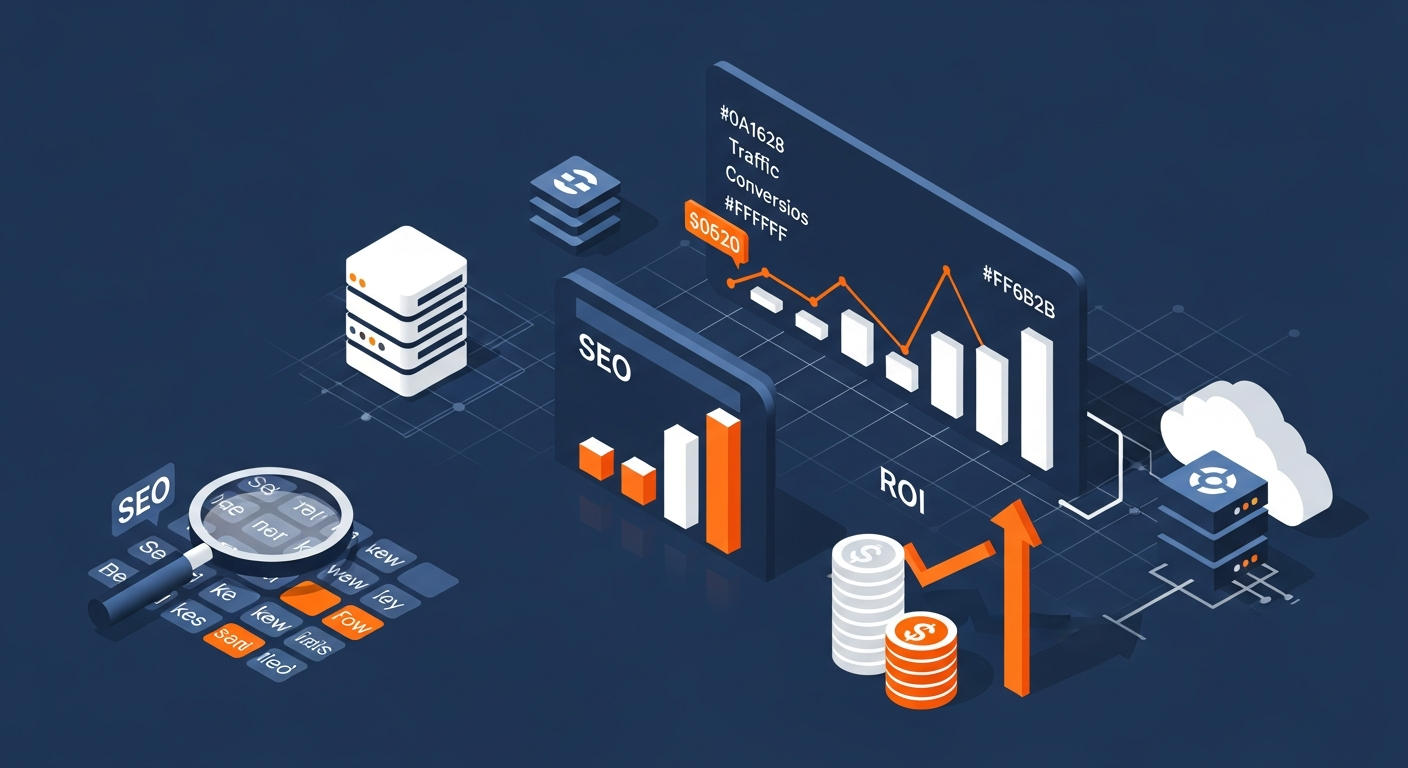
The core problem is attribution. A prospect might read three blog posts over two months, start a trial, and convert to a paid plan after a sales call. Last-click attribution gives zero credit to SEO. Multi-touch attribution models fix this, but they require clean data pipelines connecting your CMS, CRM, and product analytics from the start. That measurement design is a core deliverable inside SEO consulting for SaaS.
SaaS also has longer sales cycles than e-commerce. A blog post targeting a bottom-of-funnel keyword might generate a demo request six weeks after the first visit. If you measure SEO ROI in a 30-day window, you will always undercount its contribution to pipeline.
The SEO ROI Formula for SaaS Companies
The foundational formula is straightforward. SEO ROI equals revenue attributed to organic search minus the cost of SEO, divided by the cost of SEO, expressed as a percentage. The hard part is defining each variable accurately. Shared definitions for ARR, CAC, and GSC terms belong in an SEO abbreviations glossary so finance and marketing argue less about labels.
Revenue attributed to organic search should include the full contract value of customers whose first touch or assisted touch came from an organic visit. If your average contract value is $8,400 per year and organic search influenced 40 new customers last quarter, that is $336,000 in influenced ARR. Compare that against your total SEO spend, which includes agency fees, tool subscriptions, and internal team time, and you have a real ROI number.
For earlier-stage companies without enough conversion data, use a pipeline-based proxy. Track how many marketing qualified leads arrived via organic, multiply by your average MQL-to-close rate, and multiply again by average contract value. This gives you an expected revenue figure you can update as deals close. Commercial-intent coverage starts with Keyword research services that score buying stage, not volume alone.
Key Metrics to Track Across the Funnel
Measuring SEO ROI for SaaS requires tracking signals at every stage of the funnel, not just traffic at the top. Here are the metrics worth building dashboards around. Technical debt that blocks crawl and conversion still shows up first in an Enterprise SEO audit.
- Organic sessions by intent tier – separate informational, navigational, and commercial-intent traffic. Commercial-intent pages drive trials and demos. Informational pages build brand authority and reduce CAC over time when you publish through SEO content for SaaS.
- Organic-sourced trial starts and demo requests – connect Google Search Console data to your CRM using UTM parameters and first-touch tracking. Trial and demo URLs need the same care as blogs under SaaS content marketing.
- Organic-influenced pipeline value – tag every open deal in your CRM with an organic touchpoint if one exists in the session history. Authority that supports assisted pipeline often needs steady SaaS link building.
- Trial-to-paid conversion rate by acquisition channel – users who arrive through organic search often convert better because they found you while actively researching a problem. Knowing this ratio strengthens the case for SEO investment when you also keep technical SEO for SaaS from leaking sessions.
- Organic CAC vs. paid CAC – divide your total SEO spend by the number of new customers sourced or influenced by organic. Compare that figure to your paid CAC. This single comparison often makes the ROI argument for you.
- Churn rate segmented by acquisition channel – customers acquired through high-intent organic content frequently have lower churn because they enter the product with accurate expectations.
Setting Up the Right Attribution Model
Attribution is where most SaaS teams lose the thread. First-touch attribution credits SEO when a blog post was the first interaction before a trial. Last-touch credits whatever channel closed the deal. Neither tells the full story.
A linear or time-decay multi-touch model works better for SaaS. Linear attribution distributes credit evenly across every touchpoint in a conversion path. Time-decay gives more weight to touchpoints closer to the conversion event. Both models capture the compounding role that organic content plays across a multi-month buying journey.
Tools like HubSpot, Segment, and Amplitude can implement multi-touch attribution without custom engineering. The key is consistent UTM tagging on every organic landing page and a CRM integration that records session history at the contact level before it gets overwritten.
At Novalab, we build attribution frameworks as part of every SEO engagement. Clean measurement infrastructure is a prerequisite for proving ROI, not an afterthought. That is also how teams decide between a SEO agency vs in house SEO model for ownership of the data.
Frequently Asked Questions
How long does it take to see measurable SEO ROI for a SaaS product?
Most SaaS companies start seeing meaningful organic traffic growth within three to six months of consistent execution. Revenue attribution usually becomes clear within six to twelve months, depending on sales cycle length. Compounding returns build significantly in year two and beyond, which is why organic CAC drops over time compared to paid channels. For stage-by-stage expectations, see How long does SEO take for SaaS.
Should SEO ROI be measured separately for the blog versus product pages?
Yes. Blog content typically generates top-of-funnel traffic and assisted conversions. Product and feature pages tend to capture high-intent commercial searches and drive direct trial starts or demo requests. Tracking them separately lets you allocate content investment more precisely and report each page type’s contribution to MRR with accuracy.
What is a good SEO ROI benchmark for a SaaS company?
There is no universal benchmark, but a mature SaaS SEO program typically delivers a 5x to 12x return on investment over a 12-month period when measured against fully-loaded costs. Early-stage programs may show lower returns as domain authority builds. The more important benchmark is comparing organic CAC to paid CAC in your own business, since the gap usually widens in organic’s favor after 18 months of compounding content equity.
Start Measuring What Actually Moves Your ARR
SEO ROI for SaaS is measurable. It requires the right attribution setup, a multi-touch measurement model, and a reporting framework tied to revenue metrics rather than rankings alone. If your current SEO reporting stops at traffic, you are leaving a compelling business case unmade.
Novalab builds and executes SEO programs for SaaS companies that need to show ROI to their board, not just their marketing team. If you want a framework built around your CAC targets, pipeline goals, and ARR growth, Contact our team today.