
Multilingual SEO Services
SaaS companies that expand into new markets face a challenge that translation alone cannot solve. Buyers in different countries search differently. They use different phrases, evaluate products through different lenses, and respond to different positioning. A page that ranks well in English may carry zero relevance in German, French, or Spanish search results. Multilingual SEO services exist to close that gap. The goal is not simply to produce content in another language. The goal is to build pages that match real search demand in each target market, guide qualified visitors toward product evaluation, and support pipeline and revenue growth across regions.
Novalab SEO Agency delivers multilingual SEO services designed specifically for SaaS companies entering global markets. The agency combines localized keyword research, hreflang architecture, intent-driven content, and technical SEO to ensure that every language version of a site earns visibility where it matters most. That means ranking for the terms decision-makers actually type into Google, ChatGPT, Gemini, Perplexity, Claude, and Copilot when they evaluate software solutions in their own language.
Schedule a Free CallWhy Multilingual SEO Services Matter for SaaS Growth
Most SaaS companies begin international expansion with a translated version of their English site. Marketing teams hand content to a translator, publish the output, and expect organic traffic to follow. That approach almost always underperforms. Translation preserves meaning, but it rarely preserves search relevance. The keywords that drive traffic in one market may not align with how buyers phrase their queries in another. Search intent shifts across borders. A term that signals comparison shopping in the United States may carry informational intent in Germany. A product category name used in the United Kingdom may not exist in the French market at all.
Multilingual SEO services solve this by starting with search data rather than existing English content. The process begins with understanding how real users search for SaaS solutions in each target language. From there, keyword maps, page structures, and content strategies are built around verified demand rather than assumptions. This approach connects content to actual buyer behavior, which is the foundation of organic growth in any market.
Search Behavior Varies by Country and Language
A SaaS company selling project management software may find that English-speaking buyers search for “best project management tool for remote teams.” In Germany, the equivalent search may emphasize compliance, team hierarchy, or integration with local tools. In France, buyers may prioritize collaboration features and search with entirely different phrasing. These differences are not cosmetic. They reflect how buyers think, what they prioritize, and what kind of content they expect to find. Multilingual SEO services account for these differences by conducting independent keyword research in every target language rather than translating a single keyword list.
Novalab SEO Agency studies search patterns across markets before building any content. The agency maps keyword clusters to buyer intent stages, identifies gaps between the current site and local demand, and creates a content plan that addresses those gaps with purpose. This is the same intent-driven methodology Novalab applies to all SEO consulting for SaaS engagements, adapted for multilingual environments.
Translation Without SEO Leaves Revenue on the Table
A translated page may read well. It may convey the right product message. However, if nobody searches for the phrases on that page, it will not generate organic traffic. This is the core limitation of translation-only approaches to international expansion. Pages that are not optimized for local search terms become dead weight in the site architecture. They consume crawl budget, dilute internal linking signals, and produce no measurable return.
Multilingual SEO services prevent this outcome by treating every language version as a standalone SEO asset. Each page receives its own keyword targets, its own metadata, and its own content structure. The result is a multilingual site where every page earns its place in search results and contributes to the pipeline and revenue.
What Multilingual SEO Services Include
Multilingual SEO services cover the full scope of work required to make a website rank across languages and regions. This includes keyword research conducted in each target language, localized content creation, metadata optimization, technical SEO configuration, hreflang implementation, and ongoing performance monitoring. Each element serves a distinct purpose, and all of them must work together for the strategy to produce results.
Novalab SEO Agency structures multilingual SEO engagements around business priorities. The agency identifies which markets offer the strongest organic opportunity, which pages should be localized first, and which content formats will generate the most qualified traffic. This prevents the common mistake of localizing everything at once without a clear ranking strategy behind it.
Localized Keyword Research
Localized keyword research is the most critical component of multilingual SEO services. It determines what content to create, which terms to target, and how to structure each page for maximum relevance. This work starts with keyword research services. This process goes far beyond running English keywords through a translation tool. Each target language requires independent research using native-language keyword data, local search volume estimates, and competitor analysis within that specific market.
Novalab SEO Agency conducts keyword research for each language by analyzing search demand, intent signals, and competitive difficulty. The agency maps keywords to the SaaS buyer journey, distinguishing between awareness-stage queries, evaluation-stage comparisons, and decision-stage terms that indicate purchase readiness. This ensures that multilingual content addresses the full funnel rather than targeting only broad informational terms. The same approach powers Novalab’s SEO content for SaaS strategy across all client engagements.
Localized Content Creation
Content localization means more than writing the same page in another language. It means adapting the message, the structure, and the positioning to fit how buyers in that market evaluate SaaS products. In some markets, buyers respond to data-heavy comparisons. In others, they expect case studies and social proof. Content that ignores these differences will rank poorly and convert even worse.
Novalab SEO Agency creates localized content for each target market. Every page is written around verified keyword targets, structured for readability and on-page SEO performance, and positioned to guide the reader toward a clear next step. The agency follows the same content standards it applies to all SaaS service pages: paragraph-heavy prose, short sentences, high transition density, and a professional third-person tone that builds trust with B2B decision-makers.
Metadata Optimization Across Languages
Titles and meta descriptions control how a page appears in search results. In multilingual SEO, each language version needs its own optimized metadata. A direct translation of the English meta title will often exceed character limits, miss the local focus keyword, or fail to communicate the right value proposition for that market.
Novalab SEO Agency writes metadata for every localized page using Rank Math pixel-width guidelines. Meta titles stay within 580 pixels. Meta descriptions stay within 920 pixels. Each piece of metadata includes the target keyword, communicates the page topic clearly, and encourages the click. This level of precision across every language version is what separates effective multilingual SEO services from surface-level localization.
Hreflang Implementation and Technical Architecture
Hreflang tags tell search engines which version of a page to serve based on the user’s language and location. Incorrect hreflang implementation is one of the most common technical failures in multilingual SEO. That is why hreflang implementation service matters. Errors include missing self-referencing tags, inconsistent return links, conflicting canonical signals, and incomplete language coverage. Any of these mistakes can cause search engines to serve the wrong page to the wrong audience or suppress localized pages from indexing entirely.
Novalab SEO Agency audits and implements hreflang markup as part of every multilingual engagement. The agency ensures that every language version of every page has correct hreflang annotations, that canonical tags align with hreflang signals, and that the site architecture supports clean crawling across all language folders or subdomains. This technical foundation is essential for all other multilingual SEO work to produce results. For SaaS companies with complex site structures, this work connects directly to the technical SEO for SaaS framework Novalab applies across its client base.
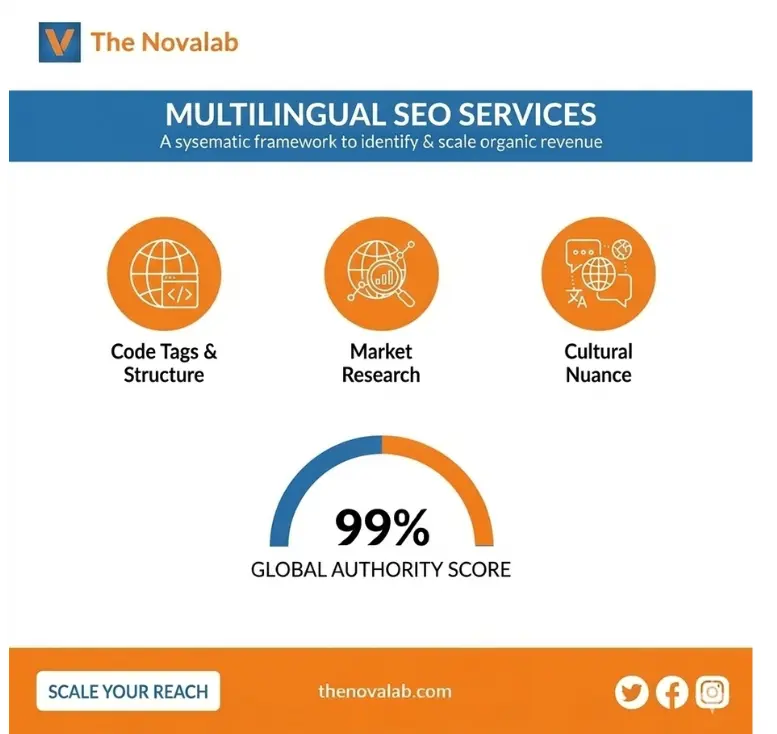
How Novalab SEO Agency Delivers Multilingual SEO Services
Novalab SEO Agency follows a structured process for multilingual SEO that starts with market prioritization and ends with measurable organic growth across target regions. The process avoids the common pitfall of localizing content without a clear SEO strategy. Instead, every step is guided by data, business goals, and the realities of how SaaS buyers search in each market.
Market Prioritization Based on Search Demand
Not every market deserves equal investment. Some regions show strong search demand for a SaaS category but intense competition from established local players. Others show moderate demand with weaker competition and higher conversion potential. Multilingual SEO services should begin with a market assessment that weighs search volume, keyword difficulty, competitive landscape, and revenue potential.
Novalab SEO Agency evaluates target markets using search data and competitive intelligence. The agency identifies which regions offer the strongest organic opportunity relative to effort, then builds a phased rollout plan that prioritizes high-impact markets first. This approach ensures that multilingual SEO investment produces returns early rather than spreading resources thin across too many languages at once. This mirrors the data-driven market selection methodology used in Novalab’s international SEO consulting practice.
Intent-Driven Content Strategy per Market
A multilingual content strategy should not replicate the English content plan in other languages. Each market has its own competitive landscape, its own content gaps, and its own buyer expectations. Content that ranks well in one language may target keywords that are already saturated in another market, or it may address questions that local buyers do not ask.
Novalab SEO Agency builds a separate content strategy for each target language. The agency identifies which topics represent the strongest ranking opportunities in that market, which content formats align with local buyer behavior, and which pages should be created, expanded, or consolidated. Every content plan maps directly to the buyer journey and supports pipeline generation rather than vanity traffic.
Site Structure and URL Architecture
Multilingual sites need a URL structure that supports language targeting without creating crawl confusion. The three most common approaches are country-code top-level domains (ccTLDs), subdomains, and subdirectories. Each option carries different implications for domain authority distribution, crawl efficiency, and management complexity.
For most SaaS companies, Novalab SEO Agency recommends subdirectories (example.com/de/, example.com/fr/) because they consolidate domain authority under a single root domain while still providing clear language signals to search engines. The agency configures URL structures, sets up proper internal linking between language versions, and ensures that navigation elements support both user experience and crawl efficiency.
Technical SEO for Multilingual Websites
Technical SEO is the infrastructure that makes multilingual content discoverable. Without correct technical implementation, even well-researched and well-written localized content will fail to rank. Multilingual websites introduce technical complexity that single-language sites do not face, including hreflang management, cross-language canonical conflicts, crawl budget allocation across language folders, and duplicate content risks from similar pages in related languages.
Crawl Budget Management Across Languages
Every language version of a page adds to the total URL count that search engines must crawl. For SaaS companies with hundreds of product pages, feature pages, and blog posts, multiplying that count by three or five languages creates a crawl budget challenge. Search engines may not crawl all pages frequently enough to keep indexed content fresh and accurate.
Novalab SEO Agency manages crawl budget for multilingual sites by ensuring clean sitemaps for each language, removing low-value or duplicate pages from the index, and optimizing internal linking so that high-priority pages receive the strongest crawl signals. This is crawl budget optimization services. This prevents the common scenario where localized pages sit unindexed for weeks or months after publication.
Canonical Tags and Duplicate Content Prevention
Languages that share vocabulary or grammatical structures, such as English and Afrikaans, or Spanish and Portuguese, can create near-duplicate content issues. Search engines may struggle to distinguish between similar pages if canonical and hreflang signals are not configured correctly. Conflicting signals can suppress both versions from ranking.
Novalab SEO Agency audits canonical tag implementation across all language versions to ensure that each page is self-canonicalized and that hreflang return tags are complete and consistent. This eliminates the most common source of multilingual indexing failures and ensures that every localized page has a clear path to the search results.
Schema Markup for Multilingual Pages
Structured data helps search engines understand page content and display rich results. For multilingual sites, schema markup should reflect the language and regional targeting of each page. Organization schema, FAQ schema, breadcrumb schema, and product schema should all be implemented in the correct language for each version.
Novalab SEO Agency implements JSON-LD structured data across all localized pages. FAQ sections on every multilingual service page include schema markup that helps search engines surface answers in featured snippets and AI-generated overviews. This increases visibility in both traditional search results and AI-powered answer engines like ChatGPT, Gemini, Perplexity, Claude, and Copilot.
On-Page SEO Across Languages
On-page SEO determines how well each page communicates its topic, relevance, and value to both search engines and users. In multilingual SEO, on-page optimization must be performed independently for each language version. Copying the English page structure and swapping in translated text produces weaker results than building each page around its own keyword targets and content goals.
Titles, Headings, and Content Structure
The SEO title should include the primary keyword for that language and market. H2 and H3 headings should support the page topic with semantically related terms. Body content should use the focus keyword at a natural density, incorporate related phrases, and maintain a clear structure that guides the reader from problem to solution to the next step.
Novalab SEO Agency writes all on-page elements, including titles, headings, body copy, and image alt text, for each language version independently. The agency does not translate English on-page elements. Instead, it builds each page from the ground up using localized keyword data and local content best practices. This produces pages that feel native to the target audience rather than translated artifacts.
Internal Linking Across Language Versions
Internal links serve two purposes in multilingual SEO. First, they help users navigate between related pages within their language version. Second, they help search engines understand the topical relationships between pages and distribute authority across the site. A multilingual site without a deliberate internal linking strategy will have isolated language silos that underperform in search.
Novalab SEO Agency builds internal linking maps for each language version. Every localized page links to related service pages, blog content, and commercial pages within the same language folder. Cross-language links are used sparingly and only where they serve a clear user need, such as linking to a resource that exists only in English. This structure mirrors the internal linking methodology Novalab applies to all SaaS SEO meaning engagements.
Benefits of Multilingual SEO Services for SaaS Companies
SaaS companies that invest in multilingual SEO services gain access to organic demand in markets that competitors often neglect. Many SaaS categories are dominated by English-language content, which means that non-English markets frequently have lower keyword difficulty and higher opportunity for organic growth. A SaaS company that builds localized, search-optimized content in three or four high-value languages can capture qualified traffic that English-only competitors miss entirely.
Multilingual SEO services also reduce dependency on paid acquisition in international markets. Paid channels like Google Ads and LinkedIn require ongoing spend in every region. Organic search, once established, continues to deliver qualified traffic without incremental cost per visit. For SaaS companies managing customer acquisition cost across multiple geographies, this creates a compounding advantage that strengthens over time. The long-term effect is lower CAC, stronger pipeline diversity, and more predictable revenue growth across regions.
Beyond traffic and pipeline, multilingual SEO builds brand credibility in local markets. A SaaS company that appears in native-language search results with well-written, relevant content signals professionalism and commitment to that market. Buyers are more likely to trust and evaluate a product that speaks their language than one that forces them to navigate a foreign-language site. This trust factor accelerates the evaluation cycle and improves conversion rates from organic traffic.
Why SaaS Companies Choose Novalab SEO Agency for Multilingual SEO
SaaS companies choose Novalab SEO Agency for multilingual SEO services because the agency understands both sides of the equation. On one side, Novalab understands how SaaS buyers research, compare, and select software. On the other side, Novalab understands how to build search-optimized content and technical infrastructure that performs across languages and regions. That combination is rare.
Most multilingual SEO providers come from a translation or localization background. They understand language but not SaaS growth metrics, buyer journeys, or pipeline attribution. Most SaaS-focused SEO agencies, on the other hand, operate only in English. Novalab bridges that gap by combining SaaS expertise with multilingual execution. The agency connects multilingual SEO performance to the metrics that matter: demo requests, trial signups, pipeline value, and revenue.
Novalab SEO Agency also integrates multilingual SEO into its broader service offering. Clients who need generative engine optimization services, answer engine optimization agency services, or AI overview optimization can extend those strategies across languages. This ensures that the brand is visible not only in traditional search results but also in AI-powered answer platforms across every target market.
Multilingual SEO Services by Novalab SEO Agency
Localized Keyword Research — Novalab identifies the search terms buyers use in each target language, maps them to the SaaS buyer journey, and builds keyword strategies that reflect real local demand rather than translated assumptions.
Search-Focused Content Creation — The agency creates localized service pages, landing pages, and supporting content that match local search intent, follow SaaS content best practices, and guide visitors toward demo requests, trials, and contact.
Hreflang and Technical Architecture — Novalab implements and audits hreflang tags, canonical signals, URL structures, and crawl configurations to ensure search engines serve the correct language version to the correct audience.
Metadata Optimization — Every localized page receives its own SEO title and meta description, written within Rank Math pixel-width limits and optimized for the target keyword in that language.
On-Page SEO per Language — Titles, headings, body copy, alt text, and internal links are built independently for each language version using local keyword data rather than translated English elements.
Performance Monitoring and Reporting — Novalab tracks organic rankings, traffic, and conversions for each language version separately, connecting multilingual SEO performance to pipeline and revenue outcomes.
Get Started with Multilingual SEO Services
SaaS companies expanding into international markets need more than translated pages. They need a search strategy built for each language, each market, and each stage of the buyer journey. Multilingual SEO services from Novalab SEO Agency deliver that strategy with the technical precision, content quality, and SaaS expertise required to turn global search into pipeline and revenue.
If the goal is to rank in more than one language, generate qualified traffic from international markets, and reduce dependency on paid acquisition across regions, Novalab SEO Agency is built for that work. The agency helps SaaS companies enter new markets with clear keyword strategies, localized content, and a technical foundation that search engines can understand. The result is stronger organic visibility, better lead quality, and sustainable growth across languages.
Start Growing With The Novalab SEO Agency
If you’re looking for an SEO agency that understands your goals and delivers real outcomes, The Novalab SEO Agency is ready to help.
We build strategies designed to grow your organic traffic, strengthen brand visibility, and convert visitors into loyal customers.
Contact our team today to request a free SEO audit or consultation.
Let The Novalab SEO Agency guide your business toward better rankings, more traffic, and consistent results.
Frequently Asked Questions About Multilingual SEO Services
Q: What are multilingual SEO services? A: Multilingual SEO services optimize a website for search visibility across multiple languages. This includes localized keyword research, content creation in each target language, hreflang implementation, metadata optimization, and technical SEO configuration. The goal is to rank for the terms that real users search for in their own language, not just translated versions of English keywords.
Q: How are multilingual SEO services different from translation? A: Translation converts text from one language to another while preserving meaning. Multilingual SEO services go further by researching how people actually search in each language, building content around those search patterns, and configuring the site architecture so search engines serve the correct version to the correct audience. Translation preserves the message. Multilingual SEO services make the message discoverable.
Q: Why do SaaS companies need multilingual SEO services? A: SaaS companies expanding internationally need organic visibility in every target market. Paid acquisition alone is expensive and unsustainable across multiple regions. Multilingual SEO services build a compounding organic channel that delivers qualified traffic, supports pipeline growth, and reduces customer acquisition cost over time. Buyers who find a product through native-language organic search are also more likely to trust the brand and convert.
Q: How does Novalab approach multilingual SEO for SaaS? A: Novalab starts with market prioritization based on search demand, competitive difficulty, and revenue potential. The agency then conducts independent keyword research in each target language, builds localized content strategies mapped to the SaaS buyer journey, implements hreflang and technical architecture, and monitors performance tied to pipeline and revenue. Every step connects search visibility to business outcomes.
Q: What technical SEO is required for multilingual websites? A: Multilingual websites require hreflang tags to signal language and regional targeting, clean URL structures that support language folders or subdomains, consistent canonical tags across language versions, proper crawl budget management, and structured data in each language. Errors in any of these areas can cause search engines to index the wrong pages or suppress localized content from appearing in results.
Q: How long does it take to see results from multilingual SEO services? A: Quick wins like metadata optimization and hreflang corrections can produce improvements within two to four weeks. Full content strategies across multiple languages typically take three to six months to generate meaningful organic traffic growth. After that initial period, results compound as domain authority builds and localized content earns rankings across target markets.