
Turn underperforming pages into search assets that rank, attract qualified traffic, and generate leads.
A page doesn’t usually underperform because it is missing its target keyword a few times.
When we analyze underperforming pages, we look deeper. The problem could be search intent mismatch, keyword cannibalization, weak internal authority, incomplete topic coverage, poor SERP positioning, technical issues, weak click-through rates, or Google simply ranking the wrong URL.
That is where Novalab’s on-page SEO work starts.
We analyze the page, the queries it already appears for, competing URLs, search results, internal links, technical signals, and business value before deciding what should actually change.
Understanding On-Page SEO
On-page SEO covers the elements of individual web pages that can be optimized to improve their organic search performance. Unlike off-page SEO, which focuses primarily on external signals such as backlinks, on-page SEO deals with the content, structure, relevance, internal relationships, and technical signals within your own website.
For SaaS websites, we cover this in more detail in our on site SEO for SaaS complete guide.
How Modern On-Page SEO Actually Works
How Modern On-Page SEO Actually Works
On-page SEO helps search engines understand what a page is about, which searches it should appear for, and how it relates to the rest of your website. But optimization today goes far beyond placing a target keyword in a title, H1, and opening paragraph.
A page can look perfectly optimized and still underperform.
Sometimes the content isn’t the problem at all. Google may be ranking another URL instead, the page may not match the dominant search intent, important internal links may be missing, or the page may already be getting visibility but failing to attract clicks.
That’s why effective on-page SEO starts with diagnosis, not optimization.
Before changing a page, we want to understand why it isn’t performing as expected. Once the problem is clear, the solution becomes much more focused – whether that’s improving the content, resolving competing pages, strengthening internal links, adjusting how the page targets the SERP, or fixing technical signals.
The goal isn’t to optimize everything. It’s to identify what is actually holding the page back and fix what matters.
Core Components of Expert On-Page Optimization
Effective on-page SEO isn’t about checking whether a keyword appears in the title, adding a few internal links, and improving a meta description.
The strongest pages bring search intent, content, technical signals, internal authority, and user experience together.
At Novalab, we optimize these elements based on what is actually limiting the page’s performance.
Search Intent and Keyword Alignment
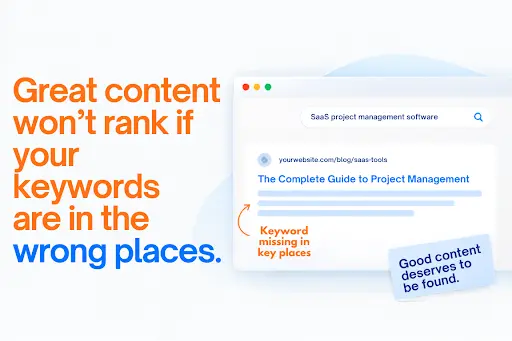
Keyword optimization starts with choosing the right page for the right search.
Before changing content, we analyze the search results to understand what users are looking for and what type of page Google is currently rewarding.
We then align the primary topic and related searches naturally across the title, headings, body content, links, and other relevant elements.
We don’t optimize around arbitrary keyword-density targets or force exact-match phrases into every section.
A well-optimized page should read naturally while making its subject and purpose unmistakably clear.
Content Quality and Information Gain
More content doesn’t automatically mean better SEO.
We look at whether the page satisfies the search intent, answers the important questions around the topic, and provides something genuinely useful beyond what already exists in the search results.
That can include original experience, expert commentary, first-party data, examples, screenshots, case studies, comparisons, or insights competitors haven’t covered.
Our SEO content writing services combine search demand with real expertise rather than simply rewriting what’s already ranking.
The goal isn’t to create the longest page. It’s to create a page worth ranking and referencing.
Technical On-Page Signals
Strong content can still underperform when technical signals make it harder for search engines to interpret the page correctly.
We review elements such as:
- Indexability and crawlability
- Canonical tags
- Heading structure
- HTML structure
- Structured data
- Duplicate or near-duplicate content
- URL structure
- Page-level technical issues
When we identify a problem, we don’t simply add it to an audit.
We determine whether it is actually affecting the page’s ability to be crawled, understood, indexed, or ranked and prioritize it accordingly.
Titles, Meta Descriptions, and SERP Performance
Titles and descriptions are often the first interaction someone has with your page in search.
We optimize them around relevance, search intent, differentiation, and click potential rather than rigid character-count rules.
Google may display different titles and snippets depending on the query, so where data is available, we also use Google Search Console to identify pages generating significant impressions but underperforming on clicks.
The objective is simple: clearly communicate what the page offers and give the right searcher a reason to choose it.
Internal Linking and Page Authority
Internal linking helps search engines discover pages, understand relationships between topics, and recognize which URLs matter most within a website.
We analyze which pages receive internal authority, which important pages are underlinked, the context and anchors surrounding those links, and whether the site’s architecture supports its highest-value pages.
For larger websites, we also look for orphan pages, excessive crawl depth, competing destinations, and opportunities to connect supporting content with commercial pages.
Internal links shouldn’t be added just because two pages mention the same keyword. They should reinforce meaningful relationships across the site.
Cannibalization and Competing Pages
Multiple URLs appearing for similar queries doesn’t automatically mean there’s a cannibalization problem.
We look deeper.
If Google repeatedly switches between URLs, ranks the wrong page, or distributes visibility across pages serving essentially the same intent, we analyze query-level performance, content overlap, internal links, historical rankings, and the purpose of each URL.
Depending on the evidence, we may recommend differentiating the pages, consolidating them, changing internal signals, repositioning one URL, or redirecting where appropriate.
The solution depends on the problem – not on a blanket rule that two ranking URLs must become one.
Images and Page Experience
Images should support the page rather than slow it down.
We optimize image formats, dimensions, compression, responsive delivery, filenames, and descriptive alt text where appropriate.
We also review how visual elements affect loading performance and the overall experience across desktop and mobile devices.
Alt text should accurately describe meaningful images for accessibility – not become another place to force keywords.
Page Performance and Core Web Vitals
Performance matters because slow or unstable pages create a worse experience and can affect organic search performance.
We look at real performance problems rather than chasing a perfect speed-test score.
That can include image delivery, unnecessary scripts, caching, rendering, layout shifts, server response times, and Core Web Vitals such as LCP, INP, and CLS.
The objective is a fast, stable page for real users – not simply a higher number in a testing tool.
Conversion Alignment
On-page SEO shouldn’t end when someone clicks the search result.
For commercial pages, we also consider whether visitors can quickly understand the offer, find the information they need, and take the next step.
A page ranking first for searches that never convert can be less valuable to the business than a page ranking fifth for a high-intent query that consistently produces qualified leads.
That’s why we connect on-page optimization with the actual business objective:
Search Visibility → Qualified Traffic → Conversion → Revenue
When Does Hiring an On-Page SEO Agency Make Sense?
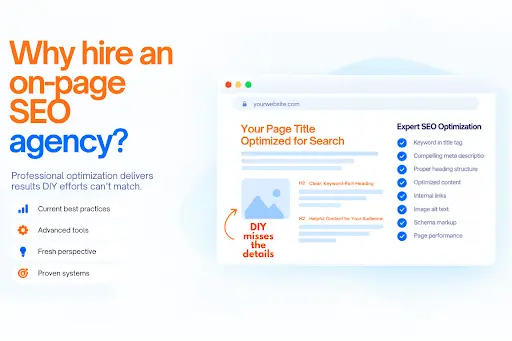
Not every website needs an SEO agency. Some on-page improvements can be handled internally, especially when the problems are straightforward.
An agency becomes more valuable when the challenge isn’t knowing what SEO is, but understanding what is actually preventing growth and what should be prioritized first.
You may need specialist support when important pages are stuck outside the top positions, Google is ranking the wrong URLs, several pages are competing for the same searches, or organic traffic is growing without producing enough qualified leads.
The same applies when your team has plenty of SEO data but no clear answer about what to do next.
Turning Search Data Into Decisions
Google Search Console, crawlers, rank trackers, and SEO platforms can surface hundreds or even thousands of potential opportunities and issues.
The difficult part is deciding which ones matter.
At Novalab, we use that data to answer practical questions:
- Which pages have the greatest opportunity right now?
- Which queries have genuine commercial value?
- Why is a page stuck despite already being optimized?
- Should an existing page be improved or should a new one be created?
- Are two URLs genuinely competing, or can they coexist?
- Which technical issues are actually affecting organic performance?
- Where should the team spend its time first?
This turns SEO from a list of recommendations into a prioritized strategy based on impact.
SEO Expertise Without Building a Larger Internal Team
Effective on-page SEO can require keyword and SERP research, content analysis, technical SEO, internal linking, Search Console analysis, implementation, and ongoing measurement.
For companies without all of those capabilities internally, working with a specialist agency provides access to them without building a separate internal function for every SEO discipline.
Our keyword research services connect keyword opportunities directly to the pages and search intents they should support rather than producing a standalone spreadsheet of keywords.
The value of an on-page SEO agency isn’t simply doing more SEO work. It’s helping your team identify the right work to do first.
Data, Automation, and Human SEO Expertise
SEO tools can collect enormous amounts of data. The advantage isn’t simply having access to that data – it’s knowing what to do with it.
At Novalab, we combine data from Google Search Console, crawling tools, rank tracking, competitor research, and other SEO platforms with our internal systems to identify patterns and opportunities faster.
This helps us surface issues such as ranking drops, cannibalization, weak internal linking, technical problems, content gaps, and pages with untapped search potential.
But tools don’t make the final decision.
Our SEO specialists review the evidence, determine what is actually affecting performance, and decide which actions deserve priority.
A Process Built Around Priorities
Large websites can produce thousands of SEO recommendations. Trying to fix everything at once rarely makes sense.
We prioritize work based on its potential impact on visibility, qualified traffic, conversions, and business value.
That means a commercially important page sitting in position eight may deserve attention before dozens of low-value pages with minor optimization issues.
Our process follows a simple cycle:
Analyze → Diagnose → Prioritize → Implement → Measure → Refine
Once changes are implemented, we monitor performance to understand what improved, what didn’t, and where the next opportunity exists.
The goal isn’t to produce the longest SEO audit. It’s to identify and execute the changes most likely to move the business forward.
Choosing the Right On-Page SEO Agency
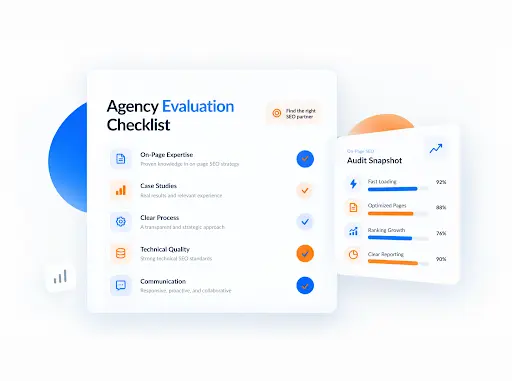
The right agency should be able to explain why a page isn’t performing, what they would change, and how they’ll measure whether those changes worked.
Before choosing a partner, look beyond promises of higher rankings and ask how they actually approach the work.
Look for Evidence, Not Just SEO Claims
A strong on-page SEO agency should be able to show how its work has affected real websites.
Look for case studies that explain the starting problem, the changes that were implemented, the timeframe, and the resulting impact on organic visibility, traffic, leads, or revenue.
A useful case study should tell you more than:
“We increased organic traffic by 200%.”
It should explain what changed and why it worked.
Understand How They Make SEO Decisions
Ask the agency to walk you through what happens when a page isn’t ranking.
Do they immediately recommend rewriting the content, or do they first investigate search intent, existing queries, competing URLs, internal links, technical signals, and SERP competition?
The strongest SEO recommendations should have a reason behind them.
If an agency recommends changing a title, consolidating two pages, creating new content, or redirecting a URL, they should be able to explain what evidence led to that decision.
Check Whether They Understand Your Business
Ranking improvements aren’t equally valuable.
An agency should understand which products, services, pages, and search queries matter commercially before deciding where to focus.
For a SaaS company, for example, increasing traffic to an informational article may be less valuable than improving visibility for a high-intent page that consistently generates demos or sign-ups.
The right SEO partner should understand the difference between more traffic and more valuable traffic.
Look at How They Measure Success
Rankings should be part of the measurement – not the entire measurement.
Depending on the business, reporting should connect SEO work with metrics such as:
Search Visibility → Organic Clicks → Qualified Traffic → Leads or Sign-Ups → Revenue
That makes it easier to determine whether on-page improvements are creating actual business value.
Make Sure Recommendations Can Be Implemented
Even excellent SEO recommendations have no value if they remain inside an audit document.
Before hiring an agency, understand who will implement the changes, how recommendations will be communicated to developers and content teams, and how completed work will be validated.
Our SEO consulting for SaaS is built around making the priorities, reasoning, and next steps clear to the teams responsible for implementation.
Good on-page SEO doesn’t end with identifying the problem. It ends with implementing the right solution and measuring what happens next.
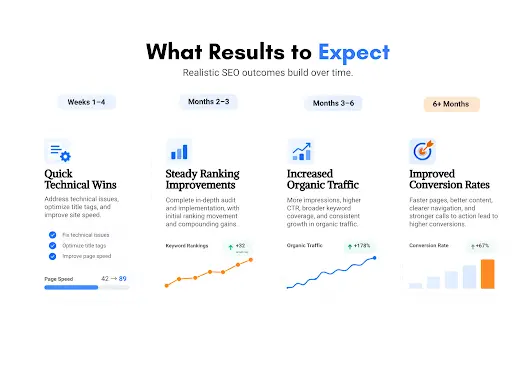
What Results to Expect From On-Page SEO
There is no universal timeline for on-page SEO.
How quickly a page responds depends on where it starts, the competitiveness of the search results, the site’s authority, technical condition, implementation speed, and the scale of the changes required.
Some fixes can produce measurable movement relatively quickly. Others need time to be crawled, reassessed, and supported by broader improvements across the website.
Instead of promising movement within an arbitrary number of weeks, we establish a baseline and measure what changes after implementation.
Search Visibility
We monitor impressions, keyword coverage, ranking movement, and which URLs Google is choosing for important searches.
This helps us determine whether the optimized page is becoming more relevant across its intended search landscape.
Organic Traffic and CTR
Better visibility should eventually translate into qualified clicks.
We monitor organic clicks and click-through rate alongside rankings to identify whether increased search exposure is actually bringing more visitors to the website.
Our work as an organic SEO agency goes beyond increasing impressions. The objective is to turn search visibility into meaningful organic growth.
Leads, Sign-Ups, and Revenue
Traffic alone isn’t the final measure of success.
For commercial pages, we want to understand what happens after the visitor arrives.
Depending on the business, that can mean monitoring:
- Demo requests
- Qualified leads
- Sign-ups
- Trials
- Purchases
- Revenue influenced by organic search
The closer SEO measurement gets to the actual business outcome, the easier it becomes to understand which improvements are creating value.
Compounding Performance
On-page SEO also creates a foundation for longer-term growth.
A better page can gain visibility across additional related searches, receive stronger internal support as the site grows, earn external references, and become more authoritative over time.
The objective isn’t a temporary ranking spike.
It’s sustained improvement across the pages that matter to the business.
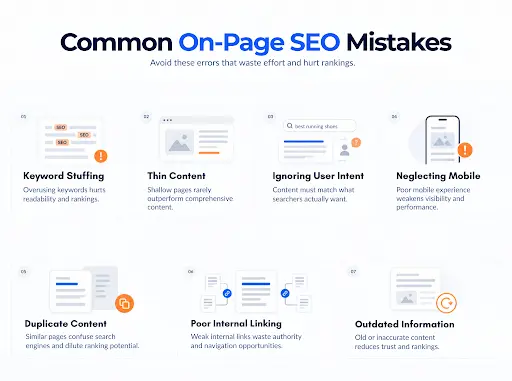
Problems We Actually Find During On-Page SEO Audits
The most important on-page problems aren’t always obvious from looking at the page itself.
These are some of the situations we investigate regularly.
Google Is Ranking the Wrong URL
Sometimes a supporting article ranks for a query that should lead to a commercial page.
We investigate search intent, internal linking, content positioning, competing URLs, and historical performance to understand why Google is choosing that page.
Two Important Pages Keep Competing
When two URLs repeatedly switch positions or appear for the same high-value searches, there may be an intent or positioning conflict.
Instead of automatically redirecting one page, we investigate the query-level data and determine whether the pages should be differentiated, consolidated, repositioned, or left alone.
Thousands of Impressions but Very Few Clicks
A page may already have visibility without generating meaningful traffic.
We investigate the queries producing those impressions, average positions, SERP features, titles, snippets, and search intent to understand where the disconnect exists.
Organic Traffic Is Growing but Leads Aren’t
More organic sessions don’t automatically mean better SEO performance.
If traffic increases without generating meaningful business results, we look at which queries are responsible for that growth and whether the landing pages align with commercial intent.
Important Pages Have Weak Internal Support
A high-value landing page can exist several clicks deep within a website while dozens of relevant pages fail to link to it.
We identify opportunities to create stronger contextual pathways between supporting content and commercially important URLs.
Content Ranks – Just Not for Valuable Searches
A page can rank for hundreds of queries and still contribute very little to the business.
We distinguish between visibility that looks impressive in an SEO report and visibility that can realistically contribute to qualified traffic, leads, and revenue.
The Novalab On-Page SEO Process
Our process is built around understanding the problem first, prioritizing the right opportunities, implementing the changes, and then measuring what happens.
1. Analyze
We combine crawl data, Google Search Console performance, rankings, SERP analysis, content, and existing site architecture to understand the current state.
This gives us a baseline before changes are made.
2. Diagnose
We determine why important pages aren’t performing as expected.
That may involve search intent, competing URLs, content gaps, internal linking, technical issues, weak SERP positioning, or several factors working together.
3. Prioritize
Not every SEO issue deserves the same attention.
We prioritize opportunities based on business value, search potential, existing performance, competitive difficulty, and implementation effort.
A high-intent commercial page close to the top positions may deserve attention before dozens of URLs with minor technical issues.
4. Implement
Once priorities are established, we execute or support the required changes.
That can include content optimization, titles and headings, internal links, schema, technical fixes, page consolidation, and other page-level improvements.
When broader structural issues are involved, our technical SEO for SaaS work connects those page-level findings with the wider site architecture.
5. Measure
After implementation, we monitor query and URL performance to understand what changed.
We compare the results against the original baseline rather than assuming that implementation automatically means success.
6. Refine
SEO doesn’t stop when the optimization is published.
Search behavior changes. Competitors change. SERPs change.
We use new performance data to determine what worked, what didn’t, and where the next opportunity exists.
Analyze → Diagnose → Prioritize → Implement → Measure → Refine
On-Page SEO for Google and AI Search
Search discovery is no longer limited to traditional search results.
People increasingly discover companies, products, services, and experts through AI-generated search experiences and answer engines.
That doesn’t mean traditional SEO should be replaced. It means pages need to communicate their information clearly enough to be understood across a broader search ecosystem.
Our on-page approach considers factors such as:
- Clear entity relationships
- Logical content structure
- Direct answers to important questions
- Original information and first-party evidence
- Expert attribution
- Structured data where appropriate
- Strong internal relationships between related topics
- Consistent company, product, and service information
- Resources worth citing or referencing
We don’t treat AI search optimization as a separate trick.
We build pages that are easier for search engines, AI systems, and people to understand, evaluate, and reference.
Why Companies Choose Novalab for On-Page SEO
Our approach combines technical SEO, content, search data, and commercial strategy rather than treating on-page optimization as a collection of isolated fixes.
SaaS and Technology Experience
We specialize in SEO for SaaS and technology companies, where organic visibility needs to contribute to sign-ups, demos, pipeline, and revenue – not just traffic.
Technical and Content Expertise
Many ranking problems sit somewhere between technical SEO and content.
Our team works across both rather than treating them as separate problems.
Data Before Assumptions
We use crawl data, Search Console, rankings, SERPs, competitor analysis, and site architecture before making significant recommendations.
We want evidence for why something should change.
Implementation-Focused SEO
An SEO recommendation has no impact until somebody implements it.
We design our recommendations around changes that can actually be executed, validated, and measured.
Organic and AI Search Visibility
Our approach considers traditional organic search alongside the changing ways companies are discovered and referenced through AI-powered search experiences.
What You Get With Novalab On-Page SEO
The exact scope depends on the website and engagement, but our on-page SEO work can include:
- On-page SEO audit
- Search intent analysis
- Keyword-to-URL mapping
- Google Search Console analysis
- Cannibalization analysis
- Content gap analysis
- Existing content optimization
- Title and heading optimization
- Internal linking recommendations
- Structured data recommendations
- Page-level technical fixes
- Competitor and SERP analysis
- Conversion alignment
- AI search visibility recommendations
- Implementation support
- Performance monitoring and reporting
You don’t receive a generic checklist containing every possible SEO improvement.
You receive prioritized recommendations based on what we believe can make the greatest difference to your website.
Frequently Asked Questions About On-Page SEO
What does an on-page SEO agency do?
An on-page SEO agency analyzes and improves the elements of individual website pages that influence organic search performance. This can include search intent, content, titles, headings, internal links, structured data, indexation signals, and page-level technical issues.
How long does on-page SEO take to work?
There is no fixed timeline. Some changes can affect search performance relatively quickly, while competitive searches may require sustained content, technical, and authority improvements. Existing rankings, competition, site authority, and implementation speed all influence how quickly results appear.
Can you optimize existing content?
Yes. In many cases, improving an existing URL makes more sense than publishing another page targeting the same topic.
We analyze the existing page’s performance before deciding whether it should be updated, expanded, repositioned, consolidated, or replaced.
Can Novalab fix keyword cannibalization?
Yes. We analyze query-level performance, competing URLs, intent, internal links, content overlap, and historical rankings before determining whether genuine cannibalization exists and what action makes sense.
Do you implement the SEO changes?
Novalab can provide recommendations, work alongside your internal development and content teams, or support implementation depending on the engagement.
What’s the difference between technical SEO and on-page SEO?
On-page SEO primarily focuses on optimizing individual pages and their content, while technical SEO looks more broadly at how search engines crawl, render, index, and understand the website.
In practice, the two frequently overlap.
Does on-page SEO help with AI search visibility?
Strong page structure, clear entities, authoritative information, original evidence, and easily extractable answers can make content easier for search and AI systems to understand and potentially reference.
We incorporate these considerations into our optimization process where relevant.
Final Thoughts
On-page SEO isn’t about making every page perfectly optimized according to a checklist.
It’s about understanding why an important page isn’t performing as well as it should and making the changes most likely to improve it.
Sometimes that means improving content. Sometimes it means fixing technical signals, strengthening internal links, resolving competing URLs, improving search intent alignment, or changing how a page is positioned in the search results.
At Novalab SEO Agency, we combine search data, technical analysis, content strategy, and business priorities to make those decisions.
Our focus isn’t simply more rankings.
It’s stronger visibility for the pages and searches that can contribute to qualified traffic, leads, sign-ups, and revenue.
If your important pages aren’t performing where they should, the first step isn’t adding more keywords.
It’s finding out why.
Start Growing With The Novalab SEO Agency in London
If you’re looking for a SaaS SEO agency that understands your goals and delivers real outcomes, The Novalab is ready to help.
We build strategies designed to grow your organic traffic, strengthen brand visibility, and convert visitors into loyal customers.
Contact our team today to request a free SEO audit or consultation.
Let The Novalab guide your business toward better rankings, more traffic, and consistent results.