
SEO for HR Tech Platforms by Novalab SEO Agency
HR tech products are rarely purchased without extensive research. Buyers need to understand compliance requirements, data handling practices, user experience, integration with existing HRIS and payroll systems, and vendor stability before committing. Search engines and AI tools are the first place they turn for answers, often weeks or months before they engage with a sales team.
SEO for HR tech platforms ensures your software appears during early research, evaluation, and final decision stages. Educational content helps buyers understand HR challenges like employee retention, compliance automation, or time tracking accuracy. Use case pages show how your platform fits real workflows for specific company sizes, industries, or team structures. Product and pricing pages capture demand when buyers are ready to request a demo or start a trial.
Without SEO, HR tech platforms rely heavily on paid ads, outbound sales, or partnerships. These channels scale with cost. Every additional lead requires additional spend. Organic search supports long-term visibility and predictable lead flow that compounds over time. For HR tech companies operating in competitive categories like applicant tracking, payroll automation, or performance management, organic search is the most efficient channel for building a sustainable pipeline at scale.
Schedule a Free CallHow HR Tech SEO Differs From Other SaaS SEO
HR tech SEO differs from general SaaS SEO because of data sensitivity, compliance expectations, buyer diversity, and the YMYL-adjacent nature of employment-related content.
HR platforms handle personal data, employment records, salary information, and performance evaluations. Buyers care deeply about trust, privacy, and reliability. Google applies higher scrutiny to content related to employment, financial data, and personal information through its E-E-A-T quality guidelines. This means HR tech content must demonstrate genuine expertise, transparent authorship, and factual accuracy to rank competitively. Vague messaging, unsubstantiated claims, or generic content perform worse in HR tech search than in most other SaaS verticals.
Compliance is a significant differentiator. HR tech buyers in different regions search for platforms that support GDPR compliance, SOC 2 certification, CCPA requirements, or industry-specific regulations like HIPAA for healthcare staffing or ITAR for defense contractors. SEO strategies that incorporate compliance-related keywords and content attract higher-intent buyers who are further along in their evaluation.
Another difference is audience diversity. HR tech platforms often target both technical buyers like IT directors evaluating security and integration architecture, and non-technical decision makers like HR managers evaluating usability and workflow fit. SEO strategies must balance clarity and depth to reach both groups without alienating either. Product pages need to address both the “does it integrate with our existing HRIS” question and the “will my team actually use this” question.
Search Behavior in the HR Tech Market
Search behavior for HR tech reflects structured buying processes with distinct stages that map directly to content strategy.
Early-stage searches focus on understanding problems. Buyers search for terms like “how to reduce employee turnover,” “best practices for remote onboarding,” or “what is an HRIS.” These are informational queries where the buyer is defining their problem and exploring whether technology can solve it. Content that ranks for these queries builds awareness and positions your brand as a knowledgeable resource before the buyer has identified specific vendors.
Mid-stage searches focus on comparison and evaluation. Buyers search for terms like “BambooHR vs Gusto,” “best ATS for startups,” or “HRIS with built-in payroll.” These are commercial queries where the buyer is actively comparing solutions and building a shortlist. Content that ranks for these queries captures demand at the moment the buyer is deciding which vendors to evaluate further.
Late-stage searches focus on conversion readiness. Buyers search for specific product names, pricing details, implementation requirements, and security specifications. These are transactional queries where the buyer has narrowed their options and is preparing to request a demo, start a trial, or present a recommendation to their team.
SEO for HR tech platforms maps content to each of these stages. This ensures that users encounter relevant, useful information throughout their research, which improves engagement, builds trust, and produces higher-quality leads that convert at better rates.
Common SEO Challenges for HR Tech Platforms
Many HR tech platforms struggle with SEO due to challenges that are specific to the HR software market.
Unclear positioning is the most common issue. Many HR tech platforms try to appeal to multiple audiences simultaneously, describing themselves as “all-in-one HR solutions” without clearly explaining which specific problems they solve best. This dilutes relevance in search because the content does not match the specific intent behind any single query. A platform that tries to rank for both “applicant tracking system” and “payroll software,” and “performance management tool” without creating dedicated, differentiated content for each category will struggle to rank for any of them.
Content overlap and keyword cannibalization create ranking instability. Blog posts, solution pages, and feature pages often target the same terms or address the same topics from slightly different angles. When multiple pages compete for the same keyword, search engines cannot determine which page should rank, and overall performance suffers. This is especially common in HR tech because many product features intersect across categories.
Technical issues frequently affect HR tech websites. Platforms with gated content areas, customer dashboards, knowledge bases, and dynamic application pages must ensure that search engines can access public marketing content without crawling private user data. Without clear indexation rules, robots.txt configuration, and canonical tag management, important marketing pages may be de-prioritized while irrelevant application pages consume crawl budget.
Thin content on product and feature pages is another persistent challenge. Many HR tech companies describe features with one-sentence bullet points and a screenshot rather than explaining what the feature does, who it benefits, how it compares to alternatives, and what outcomes it produces. This surface-level content cannot compete with competitors who provide comprehensive, educational product explanations.
Search Intent as the Foundation of HR Tech SEO
Search intent is the foundation of every effective SEO strategy for HR tech platforms. Not all searches signal readiness to buy, and treating all organic traffic equally leads to misaligned content, poor engagement metrics, and low conversion rates.
Informational intent reflects early research. Users want explanations of HR processes, technology concepts, or regulatory requirements. Content serving informational intent should educate thoroughly, build trust, and introduce your brand as a credible resource. Guides covering topics like “how to choose an HRIS,” “employee onboarding best practices,” or “HR compliance requirements by state” serve this purpose.
Commercial intent reflects active evaluation. Users want to compare tools, read reviews, and understand how different platforms handle specific requirements. Content serving commercial intent should provide clear comparisons, specific use case explanations, and honest assessments of where your platform excels. Comparison pages, alternative pages, and category-specific landing pages serve this purpose.
Transactional intent reflects readiness to act. Users search for specific product names, pricing, demo scheduling, or trial signup. Content serving transactional intent should provide a direct, frictionless path to conversion with clear calls to action, transparent pricing information, and reassurance elements like security certifications and customer proof.
SEO for HR tech platforms assigns clear roles to pages based on intent. Guides educate. Comparison pages evaluate. Product pages convert. This structure ensures traffic supports business goals rather than just accumulating sessions that never enter the pipeline.
Technical SEO Foundations for HR Tech Websites
Technical SEO is critical for HR tech platforms due to the intersection of public marketing content, private user data, and complex application architectures.
Crawl control and indexation management ensure that search engines can access marketing pages, blog content, and public resources without crawling customer dashboards, login areas, or application data. This requires careful robots.txt configuration, noindex directives on private pages, and canonical tag management that prevents duplicate content from diluting ranking signals.
Page speed and Core Web Vitals performance matter more for HR tech than many companies realize. HR professionals evaluating software expect reliable, fast-loading experiences. Slow marketing pages create an immediate negative impression about the platform itself. If the marketing site is slow, buyers assume the product is slow. Optimizing Largest Contentful Paint, Cumulative Layout Shift, and Interaction to Next Paint improves both search rankings and conversion rates.
Structured data implementation helps search engines understand the specific nature of your content. The SoftwareApplication schema defines your product for search engines. The organization schema establishes your company entity. The FAQ schema supports featured snippet and AI Overview visibility for common buyer questions. The Review and AggregateRating schema can surface social proof directly in search results.
Internal linking architecture connects product pages, feature pages, use case pages, comparison pages, and blog content into a coherent topical structure. For HR tech platforms with multiple product lines or modules, internal linking ensures that search engines understand the relationship between different offerings and can assign appropriate authority to each section of the site.
AI crawler access is an increasingly important technical consideration. Crawlers like GPTBot, PerplexityBot, and Google-Extended need explicit access through robots.txt to include your content in AI-generated answers. HR tech buyers increasingly use ChatGPT and Perplexity to research HR software options, and being cited in those AI responses requires that your content is technically accessible to AI systems.
Website Structure for HR Tech Platforms
A clear website structure helps both users and search engines understand your product’s full scope. Many HR tech websites grow organically without a defined hierarchy, mixing blog content, product pages, integration documentation, and support articles into a flat or confusing architecture.
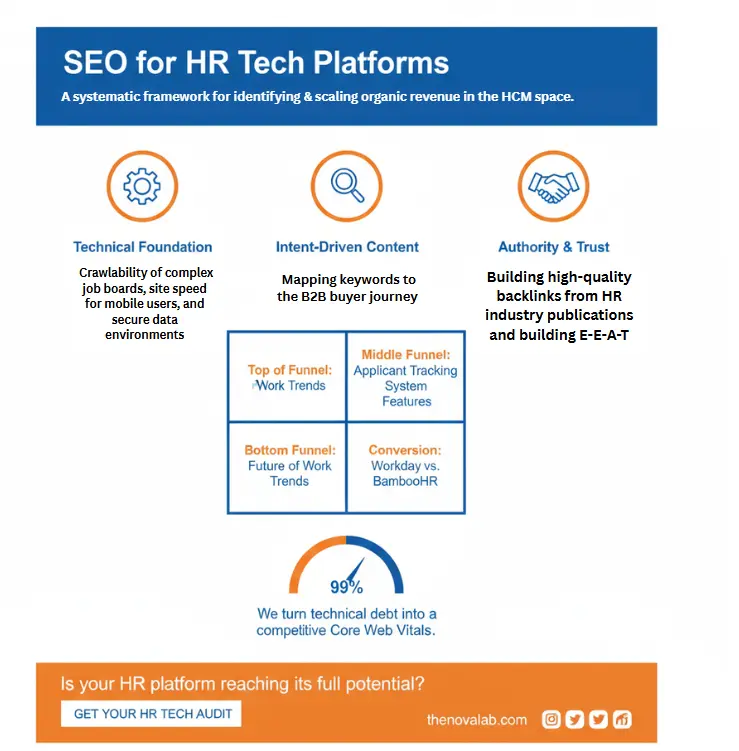
SEO for HR tech platforms introduces a structure based on purpose and buyer journey. Product pages explain core capabilities and map to primary category keywords like “applicant tracking system,” “HRIS software,” or “employee engagement platform.” Feature pages provide depth on specific functionality and target long-tail queries. Use case pages show applications by company size, industry, or role and capture mid-funnel commercial intent. Resource pages, including guides, templates, and benchmark reports, educate users and build topical authority. Trust pages addressing security, compliance, data handling, and certifications answer the questions that HR tech buyers must resolve before recommending a vendor.
Internal linking connects these areas logically, guiding users from research to evaluation to action. A blog post about “how to reduce time-to-hire” should link to the ATS product page. A comparison page covering “BambooHR alternatives” should link to relevant feature pages. A use case page for “HRIS for companies with 50-200 employees” should link to both the product overview and the pricing page.
Content Strategy for HR Tech SEO
Content is the primary driver of SEO for HR tech platforms. It must explain complex HR processes clearly without overwhelming the reader, demonstrate genuine expertise in HR technology, and serve the specific information needs of buyers at each stage of their evaluation.
Topic clusters are the most effective content architecture for HR tech SEO. A topic cluster centers on a pillar page that covers a broad category like “applicant tracking systems” and is supported by related pages covering subtopics like “ATS implementation best practices,” “ATS vs CRM for recruiting,” “how to evaluate an ATS for high-volume hiring,” and “ATS integration with HRIS platforms.” This structure builds topical authority that search engines reward with stronger rankings across the entire cluster.
Content topics should be drawn from real buyer questions rather than generic keyword lists. Effective HR tech content covers hiring workflows, employee lifecycle management, compliance requirements by region and industry, payroll automation, performance review processes, employee engagement measurement, and reporting and analytics capabilities. Each piece of content should explain how the platform supports these needs in practical terms with specific examples rather than abstract feature descriptions.
E-E-A-T signals are especially important for HR tech content. Google evaluates content about employment, payroll, and personal data with higher scrutiny. Content should be attributed to named authors with relevant HR or technology expertise. Claims about compliance, data security, or regulatory requirements should be specific and verifiable. Case studies and customer references strengthen trust signals for both search engines and human readers.
Building Authority in HR Tech Search
HR tech markets are competitive. Multiple platforms compete for the same category keywords, and large incumbents like Workday, BambooHR, and ADP often dominate top positions. Authority helps both search engines and users trust your platform enough to rank it and choose it.
SEO for HR tech platforms builds authority through consistent, deep coverage of core HR topics rather than occasional blog posts on trending subjects. A platform that publishes comprehensive content about its specific category, covering the topic from educational, comparative, and practical angles, builds stronger authority signals than a platform that publishes shallow content across many unrelated topics.
External authority signals reinforce on-site content. Backlinks from HR industry publications, guest contributions on workforce management blogs, mentions in HR tech review sites and directories, and citations in industry reports all strengthen the credibility signals that search engines evaluate. For HR tech companies, getting listed and reviewed on platforms like G2, Capterra, Software Advice, and HR-specific directories like SelectSoftware Reviews is both a conversion driver and an authority builder.
AI visibility is an emerging authority dimension for HR tech. Buyers increasingly use ChatGPT and Perplexity to research HR software options. Being cited in AI-generated responses when a user asks “what is the best HRIS for growing companies” provides both brand exposure and third-party validation. Answer engine optimization and generative engine optimization extend traditional authority building into AI-powered discovery channels that HR tech buyers are adopting rapidly.
Measuring SEO Performance for HR Tech Platforms
SEO performance for HR tech platforms should be measured beyond traffic volume. Visibility must connect to lead quality, pipeline contribution, and revenue impact to justify ongoing investment and guide strategic decisions.
Organic traffic by intent category reveals whether your content strategy is balanced. Tracking traffic to informational, commercial, and transactional pages separately shows whether you are building awareness, capturing evaluation-stage demand, and converting high-intent visitors. An imbalance, such as high informational traffic with low commercial traffic, reveals specific gaps in content strategy.
Conversion actions tied to organic traffic are the most direct measure of SEO impact. For HR tech platforms, this includes demo requests, trial signups, contact form submissions, and downloads of high-value resources like compliance guides or ROI calculators. Tracking these actions by landing page and keyword reveals which content produces pipeline and which produces only sessions.
Assisted conversions capture the full contribution of organic search. HR tech buyers often visit multiple pages across multiple sessions before converting. A buyer might discover your brand through a blog post about onboarding best practices, return through a comparison page, and convert through the pricing page. Attribution models that only credit the last touch undervalue the role of educational and comparative content in the pipeline.
Pipeline influence connects SEO directly to revenue. At Novalab SEO Agency, SEO performance for HR tech platforms is evaluated by its contribution to qualified pipeline, deal velocity, and customer acquisition cost. This ensures that every optimization decision is grounded in business impact rather than vanity metrics.
Scaling SEO as HR Tech Platforms Grow
As HR tech platforms grow, content volume increases, product lines expand, and organizational complexity makes SEO governance increasingly important. Without clear rules, SEO performance becomes unstable as new pages compete with existing ones, messaging drifts, and technical debt accumulates.
SEO for HR tech platforms defines guidelines for page creation that prevent keyword cannibalization and content overlap. Every new page should have a clearly defined target keyword, a distinct search intent it serves, and a mapped relationship to existing content through internal linking. Content updates should follow a regular cadence that keeps high-value pages current with the latest compliance requirements, product features, and market data.
Technical governance prevents the accumulation of crawl issues, broken links, orphaned pages, and duplicate content that erode performance over time. Regular audits identify and resolve issues before they affect rankings. As HR tech platforms add new product modules, integrations, or market segments, SEO governance ensures that the website architecture scales cleanly without creating structural problems.
Clear processes allow SEO to scale alongside product and team growth. When marketing, product, and engineering teams all understand how their actions affect organic performance, SEO becomes a sustainable growth channel rather than a fragile system that breaks whenever the website changes.
Who Needs SEO for HR Tech Platforms
SEO for HR tech platforms applies to any software company operating in the HR technology vertical. This includes platforms offering recruitment and applicant tracking systems, HRIS and HCM suites, payroll and benefits administration, performance management and employee engagement, workforce analytics and planning, learning management and development, time tracking and scheduling, and compliance and regulatory management tools.
Any HR tech company that depends on education, trust, and informed evaluation to acquire customers benefits from SEO as a core growth channel. If your buyers research extensively before engaging sales, if your sales cycle involves multiple stakeholders with different priorities, and if your market includes established competitors with strong organic visibility, SEO is not optional. It is the foundation of a sustainable acquisition strategy that reduces reliance on paid channels and builds compounding organic demand.
Start Growing With The Novalab SEO Agency
If you’re looking for an SEO agency that understands your goals and delivers real outcomes, The Novalab SEO Agency is ready to help.
We build strategies designed to grow your organic traffic, strengthen brand visibility, and convert visitors into loyal customers.
Contact our team today to request a free SEO audit or consultation.
Let The Novalab SEO Agency guide your business toward better rankings, more traffic, and consistent results.