
LLM SEO Optimization Services
Large language models do not rank web pages. They synthesize information from across the web and generate direct answers that name specific brands, explain their capabilities, and make recommendations. When a SaaS buyer asks ChatGPT which marketing automation platforms support multi-touch attribution, or asks Claude to compare customer success tools for mid-market companies, the model constructs a response by evaluating which brands it can explain clearly, has seen validated across multiple sources, and can recommend with confidence.
The brands that appear in these responses gain an advantage that traditional search rankings alone cannot provide. They are positioned as recommended solutions inside a narrative that the buyer reads before visiting any website. The brands that do not appear are excluded from the buyer’s consideration set at the moment when opinions are forming and shortlists are being built.
LLM SEO optimization services address the specific signals that large language models evaluate when deciding which brands to include in their generated responses. This is distinct from traditional SEO, which optimizes for ranking positions in a list of links. LLM SEO optimizes for inclusion within a synthesized answer, which requires entity clarity, structural content design, factual consistency across sources, third-party validation, and technical access for AI-specific crawlers.
Novalab SEO Agency provides LLM SEO optimization services for SaaS companies that need large language models to understand, accurately describe, and recommend their brand to B2B buyers when they ask about their product category. The agency builds systematic LLM visibility across ChatGPT, Gemini, Perplexity, Claude, and Copilot through structured content, entity reinforcement, AI crawler configuration, authority development, and ongoing citation monitoring connected to pipeline and revenue.
How Large Language Models Process Brand Information
Understanding how LLMs process content is essential for optimizing effectively. Large language models do not crawl and index pages like traditional search engines. They are trained on massive text datasets and, in the case of retrieval-augmented generation (RAG) systems like Perplexity and ChatGPT with browsing, they also access real-time web content through dedicated crawlers.
Training Data Influence
The foundation of every LLM’s knowledge comes from its training data. During training, the model processes billions of pages of text and learns patterns, associations, and entity relationships. A SaaS brand that is described consistently across its own website, review platforms, industry publications, and community discussions during the training data collection window becomes a recognized entity that the model can reference with confidence. A brand that is inconsistently described, rarely mentioned, or absent from authoritative sources lacks the training signal strength needed for citation.
This creates a compounding dynamic. Brands that build a strong web-wide presence now are encoded into the next training cycle. Brands that wait become harder to establish because competitors have already occupied the entity space within the model’s knowledge.
Retrieval-Augmented Generation
Modern LLM platforms increasingly supplement training data with real-time web retrieval. ChatGPT browses the web. Perplexity retrieves and cites live sources. Gemini accesses Google’s index. These retrieval systems use dedicated crawlers, including GPTBot, PerplexityBot, and Google-Extended, to access web content and incorporate it into generated responses.
For LLM SEO optimization, this means the content on the website right now directly influences the answers LLMs generate right now. Pages that are accessible to AI crawlers, structured for machine comprehension, and consistent with the brand’s entity definition across the web are more likely to be retrieved, processed, and cited.
Entity Association and Confidence
LLMs do not simply search for keywords and return matching content. They evaluate whether they can confidently associate a brand with a specific product category, capability set, and use case. Confidence increases when the brand is described consistently across multiple independent sources. Confidence decreases when descriptions conflict, when the brand appears in few authoritative contexts, or when the content is ambiguous about what the brand actually does.
LLM SEO optimization builds the entity associations and confidence signals that move a brand from “unknown” to “cited” within LLM-generated responses.
Why SaaS Companies Need LLM SEO Optimization
SaaS buying behavior is shifting toward AI-assisted research faster than most marketing strategies have adapted. The implications for SaaS companies are specific and measurable.
LLMs Are Replacing Early-Stage Research
The first step of SaaS evaluation used to be a Google search followed by clicking through several websites. Increasingly, that first step is a conversational query in an AI platform. The buyer receives a synthesized answer that explains the product category, names specific solutions, and often provides a direct recommendation. This answer replaces the browsing and comparison work that previously happened across multiple websites.
For SaaS companies, this means that the battle for buyer attention has moved upstream. The decision about which brands to evaluate is now made inside the LLM’s response before the buyer reaches any website. LLM SEO optimization helps strengthen the signals that can make a brand easier for these systems to understand and surface.
Model Knowledge Gaps Create Competitive Risk
LLMs can only cite brands they know. If a SaaS company has not built sufficient signal strength through web-wide mentions, consistent entity definitions, and AI-accessible content, the model may not have enough information to include it in generated answers. The model can instead default to competitors with stronger signals, even when another product may also fit the buyer’s needs.
This knowledge gap is not only a ranking problem. It is a recognition problem. LLM SEO optimization addresses it by strengthening the entity signals models use to recognize and understand a brand.
Citation Persistence Creates Compounding Advantage
Once an LLM associates a brand with a product category and begins citing it in responses, that association can persist across future interactions and model updates. Strong, consistent entity and authority signals make those associations easier to reinforce over time.
SaaS companies that invest in LLM SEO optimization early can build a stronger visibility foundation while competitors are still treating AI-assisted discovery as a secondary channel.
What LLM SEO Optimization Services Include
Novalab SEO Agency structures LLM SEO optimization across five interconnected areas.
Entity Audit and Definition
Every engagement begins with an entity audit that tests how major LLMs currently perceive the brand. Novalab queries ChatGPT, Gemini, Perplexity, Claude, and Copilot with the prompts that SaaS buyers in the client’s category actually use. The audit reveals whether the brand is cited, how accurately it is described, which competitors appear more frequently, and which entity signals are missing or inconsistent.
Based on findings, Novalab builds an entity definition strategy that establishes consistent brand descriptions across the website, structured data, knowledge sources like Wikipedia and Wikidata where applicable, review platforms, and industry publications. This consistency gives LLMs clearer information for identifying and describing the brand.
Content Optimization for LLM Comprehension
LLMs process content differently from traditional search crawlers. They parse meaning, evaluate logical structure, and extract explanations that can be reused inside generated answers. Content optimized for LLM comprehension uses clear definitions, predictable heading hierarchies, explicit answer blocks for common questions, and consistent terminology that aligns with how the model categorizes the brand’s niche.
Novalab restructures existing content and creates new content designed for LLM extraction. Every page follows a structure where each section opens with a clear statement, progresses through supporting explanation, and concludes with a specific outcome or recommendation. This predictable flow makes the content easier to interpret and reuse. The same SEO content for SaaS standards apply across search-focused content production.
Technical AI Crawler Access
LLM platforms that use retrieval-augmented generation depend on web crawlers to access content. Different platforms use different crawler identities and access rules, which means robots.txt, server configuration, and other technical controls need to be reviewed carefully.
Novalab audits robots.txt and server configurations to ensure relevant AI crawlers can access the content intended for discovery. The agency also reviews emerging AI-oriented site files and structured data where appropriate. This technical SEO for SaaS work strengthens the crawlability and machine-readable foundation behind AI visibility.
Authority and Validation Building
LLMs can evaluate brand authority through the breadth and consistency of third-party mentions across the web. A SaaS brand mentioned on review platforms, relevant communities, industry publications, and technology blogs has more external context available than a brand that appears only on its own website.
Novalab builds authority through coordinated link building services for SaaS, digital PR placements, review platform optimization, and strategic content placement on relevant third-party websites. These authority signals help strengthen the validation layer around the brand.
Citation Monitoring and Iteration
LLM visibility requires ongoing measurement through systematic query testing. Novalab monitors how the brand appears in LLM-generated answers across major platforms, tracking citation frequency, description accuracy, share of voice relative to competitors, and referral traffic from AI platforms. Monthly reports connect LLM visibility to pipeline and revenue where attribution data is available.
As LLM platforms update their models, training data, and retrieval systems, the optimization strategy adapts. Novalab identifies changes in citation patterns and adjusts entity reinforcement, content, and authority strategies accordingly.
LLM SEO vs. Traditional SEO
Traditional SEO and LLM SEO share a common technical foundation but diverge in their optimization targets and success metrics.
Traditional SEO optimizes for ranking positions in search results. Success is measured by keyword rankings, organic sessions, click-through rates, leads, and revenue contribution. The unit of optimization is usually the page, supported by relevance, authority, technical quality, and user experience.
LLM SEO optimizes for visibility within synthesized responses generated by large language models. Success can be measured through citation frequency, mention accuracy, share of voice, AI referral traffic, and pipeline attribution from AI-assisted discovery. The unit of optimization is often the entity as well as the individual page.
The two disciplines reinforce each other. Traditional SEO builds the crawlable, indexable, authoritative content base that AI systems can access and reference. LLM SEO ensures that content base is structured for machine comprehension and supported by consistent web-wide signals.
LLM SEO, GEO, and AEO
LLM SEO optimization, generative engine optimization services, and answer engine optimization agency services are closely related disciplines within the AI visibility ecosystem.
LLM SEO focuses on how large language models process and retrieve brand information. GEO focuses on visibility within generative search experiences and synthesized responses. AEO focuses on visibility across answer-oriented surfaces such as AI assistants, search answer features, and conversational interfaces.
The fundamentals are shared. Entity clarity, structured content, E-E-A-T signals, technical access, and third-party authority all support AI visibility. Novalab treats these as connected components of a broader organic strategy. This approach can also include AI Overviews optimization for brands targeting Google’s AI-generated search experiences.
How Novalab Delivers LLM SEO Optimization Services
Phase 1: LLM Visibility Audit
Novalab tests how ChatGPT, Gemini, Perplexity, Claude, and Copilot respond to queries in the client’s SaaS category. The audit identifies current citation status, description accuracy, competitor positioning, and the entity and content gaps that may explain visibility levels.
Phase 2: Entity and Content Strategy
Based on audit findings, Novalab builds an entity optimization and content strategy that addresses visibility gaps. This includes defining brand entity attributes consistently, restructuring existing content for LLM comprehension, creating new content targeting unanswered buyer prompts, and mapping third-party sources where brand presence needs strengthening.
Phase 3: Technical Configuration
Novalab reviews AI crawler access through robots.txt, implements appropriate structured data for entity and content definition, and resolves technical barriers that may prevent important content from being discovered or interpreted correctly.
Phase 4: Authority Reinforcement
The agency executes coordinated authority building through relevant link acquisition, digital PR, review platform optimization, and strategic content placement on third-party websites that strengthen brand validation.
Phase 5: Monitoring and Adaptation
Monthly citation monitoring tracks visibility changes across major LLM platforms. The agency identifies which content changes and authority improvements correspond with visibility gains, adjusts strategy for competitive movements, and adapts the approach as AI platforms evolve.
Benefits of LLM SEO Optimization for SaaS Companies
SaaS companies that invest in LLM SEO optimization gain an opportunity to improve visibility in AI-assisted discovery channels that increasingly influence software research. Citation in LLM-generated answers can introduce a brand earlier in the research process and create another path for qualified buyers to discover the company.
LLM visibility can also reinforce traditional search performance indirectly through additional brand discovery, branded searches, referral traffic, and third-party mentions. These effects should be measured rather than assumed, but they can strengthen the broader organic acquisition system when AI visibility and traditional SEO are managed together.
AI-assisted discovery can also send high-intent visitors when the prompt closely matches the company’s product category, use case, or capabilities. Tracking those visitors through analytics and CRM attribution helps determine how AI visibility contributes to demos, trials, pipeline, and customer acquisition efficiency.
Why SaaS Companies Choose Novalab for LLM SEO Optimization
SaaS companies choose Novalab SEO Agency for LLM SEO optimization because the agency treats AI visibility as part of a broader organic growth system connected to pipeline and revenue. LLM optimization works alongside technical SEO, content strategy, authority development, and conversion-focused organic acquisition rather than operating as an isolated experiment.
Novalab delivers developer-ready technical specifications, structured content strategies mapped to the SaaS buyer journey, and ongoing citation monitoring that connects AI visibility to pipeline where attribution is available. The agency evaluates both model knowledge and real-time retrieval signals when planning the strategy.
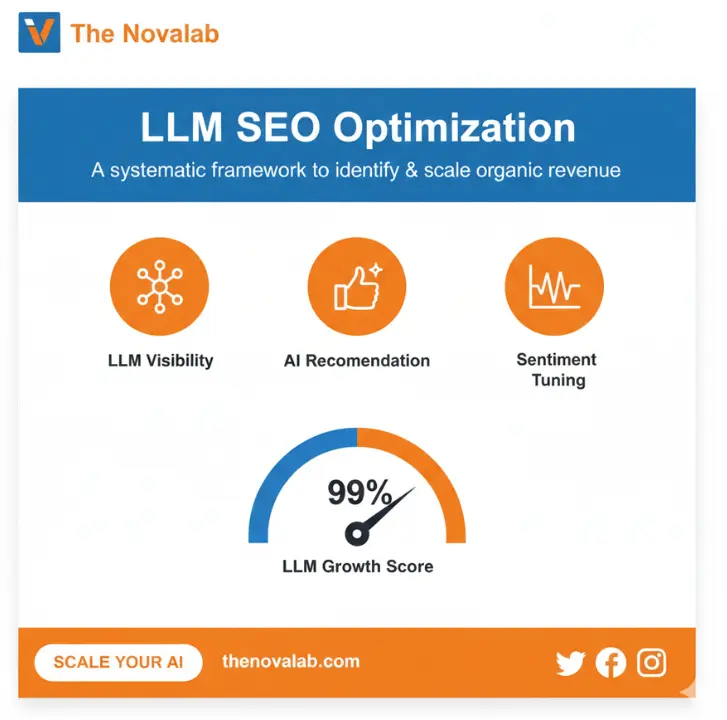
LLM SEO Optimization Services by Novalab SEO Agency
LLM Visibility Audit – Novalab tests brand citations across ChatGPT, Gemini, Perplexity, Claude, and Copilot, identifying entity gaps, accuracy issues, and competitive positioning within LLM-generated responses.
Entity Optimization – The agency defines and reinforces brand entity signals across the website, structured data, knowledge sources, review platforms, and industry publications for consistent LLM recognition.
Content for LLM Comprehension – Novalab restructures existing content and creates new content designed for LLM extraction, with structured answer blocks, clear definitions, and predictable hierarchies.
Technical AI Access – The agency reviews crawler permissions, structured data, and other technical controls that affect how AI systems can access important website content.
Authority Reinforcement – Novalab builds third-party validation through relevant link acquisition, digital PR, review optimization, and strategic external placements.
Citation Monitoring – Monthly tracking of brand citations across major LLM platforms, connected to pipeline attribution where available and reported alongside traditional SEO metrics.
Start Growing With The Novalab SEO Agency
If your SaaS company wants to improve how its brand is understood and surfaced across AI-assisted search experiences, contact Novalab SEO Agency.
Frequently Asked Questions About LLM SEO Optimization Services
Q: What are LLM SEO optimization services? A: LLM SEO optimization services improve how large language models understand, describe, and potentially cite a brand in AI-generated responses. The work can include entity optimization, content structuring for machine comprehension, AI crawler access configuration, authority reinforcement through third-party validation, and ongoing citation monitoring across platforms such as ChatGPT, Gemini, Perplexity, Claude, and Copilot.
Q: How is LLM SEO different from traditional SEO? A: Traditional SEO optimizes for visibility in search result pages. LLM SEO focuses on visibility inside synthesized AI-generated answers. The two disciplines share technical, content, and authority foundations but differ in how visibility is measured and how brand entities are evaluated.
Q: How do LLMs decide which brands to cite? A: Different LLM platforms use different training, retrieval, and ranking systems. Consistent entity descriptions, structured content, factual clarity, technical accessibility, and third-party validation can strengthen the signals available to those systems, but no single factor guarantees citation.
Q: How does LLM SEO relate to GEO and AEO? A: LLM SEO focuses on how models process and retrieve brand information. GEO focuses on visibility within generative search experiences. AEO focuses on visibility across answer-oriented search and AI interfaces. All three share core fundamentals and can be managed as connected parts of a broader AI visibility strategy.
Q: How long does LLM SEO optimization take to show results? A: There is no fixed timeline because visibility depends on the platform, retrieval system, crawl frequency, existing authority, content changes, and model updates. Some changes may become visible after platforms reprocess updated content, while broader entity and authority improvements can take longer to influence AI-assisted discovery.
Q: Why should SaaS companies invest in LLM SEO now? A: AI-assisted research is becoming another important part of SaaS discovery. Building clear entity signals, structured content, technical accessibility, and third-party authority now gives a brand a stronger foundation for visibility as these platforms continue evolving.