
Local Citation Mining for NAP Consistency by Novalab SEO Agency
Local citation mining for NAP consistency is the process of identifying, auditing, and correcting every instance where your business name, address, and phone number appear across the web. These listings exist on directories like Google Business Profile, Yelp, and Bing Places, review platforms, social profiles, data aggregators, mapping services like Apple Maps and MapQuest, and industry-specific sites. Each listing acts as a signal that tells search engines where your business is located, what it is called, and how to contact it. When those signals are consistent, they reinforce trust. When they conflict, they create doubt that directly undermines local search visibility.
Most businesses do not realize how many citations they have or how many contain outdated or incorrect information. A past office move, a phone number change, a slight variation in how the business name is formatted, or a duplicate listing created by a third-party data aggregator can all introduce inconsistencies that compound over time. Search engines encounter conflicting data across multiple sources and lose confidence in which version is accurate. The result is lower rankings in local packs, reduced visibility in Google Maps results, and lost traffic from the exact customers searching for services nearby.
Novalab SEO Agency specializes in local citation mining and NAP consistency as a core part of local search visibility optimization. This is not a surface-level directory submission service. It is a structured process that starts with mining every existing citation across the web, comparing each one against verified business data, and building a correction plan that eliminates conflicts at the source. For businesses with multiple locations, the complexity multiplies because each location requires its own consistent citation profile across dozens or hundreds of platforms.
The goal is to create a unified, accurate presence across every platform where the business appears. Consistent NAP data strengthens local authority, improves trust signals for search engines, and removes a common barrier that prevents businesses from ranking in the local results that drive foot traffic, phone calls, and revenue.
This page explains how local citation mining works, why NAP consistency matters for local SEO for B2B, and how a systematic approach protects and grows local search performance.
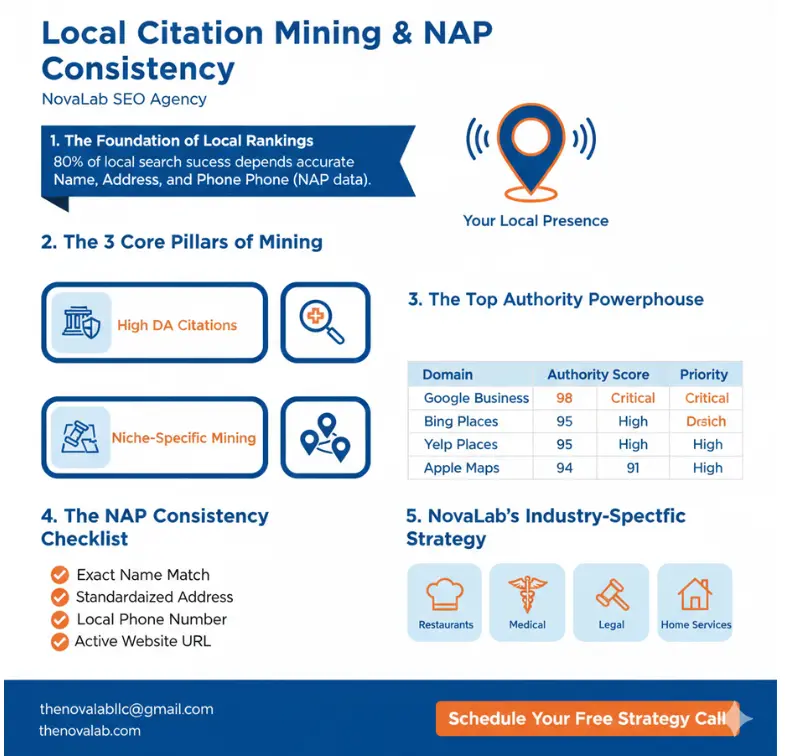
Why NAP Consistency Matters for Local SEO
NAP consistency is one of the most important ranking factors for local search. Google’s local algorithm evaluates how consistently a business’s name, address, and phone number appear across the web when determining which businesses to show in the local pack, Google Maps, and localized organic results. When NAP data is consistent across dozens of authoritative sources, Google gains confidence that the business information is accurate and trustworthy. When NAP data conflicts across sources, Google cannot determine which version is correct, which reduces the likelihood of the business appearing in competitive local results.
The impact extends beyond rankings. Inconsistent citations create confusion for potential customers. A listing that shows an old phone number loses calls. A listing with a previous address sends customers to the wrong location. A duplicate listing splits reviews and engagement between two profiles, weakening both. These problems compound silently because most businesses do not monitor their citation profile after the initial setup.
Data aggregators amplify inconsistencies. Companies like Data Axle, Localeze, Foursquare, and Factual distribute business information to hundreds of downstream directories, apps, and platforms. If the data at the aggregator level is incorrect, that error propagates across the entire network. Fixing individual listings without correcting the source data at the aggregator level is temporary because the incorrect information will be redistributed during the next data sync cycle. Local citation mining addresses this by identifying and correcting data at both the aggregator and individual listing levels.
How Local Citation Mining Works
Local citation mining is the process of discovering every place where a business is listed online, whether the listing was created intentionally or generated automatically by data aggregators and third-party platforms. Many businesses have citations they never created and do not know about. These phantom listings are generated when data aggregators pull information from public records, phone directories, and other sources and distribute it across their partner networks.
Novalab’s citation mining process begins with a comprehensive audit using tools like BrightLocal, Whitespark, Moz Local, and manual search verification. The audit identifies every existing citation across general business directories, industry-specific platforms, social profiles, mapping services, review sites, and data aggregators. Each citation is compared against the verified NAP data to identify exact matches, partial matches, outdated information, formatting inconsistencies, and duplicate listings.
The audit reveals the full scope of the citation landscape. A typical local business has between 40 and 150 citations across the web. Multi-location businesses can have thousands. The audit categorizes each citation by authority level, accuracy status, and priority for correction. High-authority directories like Google Business Profile, Yelp, Bing Places, Facebook, and Apple Maps receive immediate attention because errors on these platforms have the greatest impact on local rankings. Lower-authority directories are corrected systematically to build a clean, consistent citation profile across the entire web.
What NAP Inconsistencies Look Like
NAP inconsistencies take many forms, and even small variations that seem insignificant to a human reader can create problems for search engine algorithms that evaluate consistency programmatically.
Business name variations are the most common issue. A business registered as “Johnson & Smith Legal Associates LLC” might appear as “Johnson and Smith Legal,” “J&S Legal Associates,” or “Johnson Smith Law” across different directories. Each variation looks like a potentially different business to search engines. Abbreviations, missing legal suffixes, ampersands versus “and,” and informal name versions all create inconsistencies that reduce trust signals.
Address formatting differences cause problems even when the physical location is the same. “123 Main Street, Suite 200” versus “123 Main St Ste 200” versus “123 Main Street #200” all represent the same location but register as different data points for algorithms evaluating consistency. Missing suite numbers, inconsistent state abbreviations, and ZIP code variations all contribute to the problem.
Phone number inconsistencies arise when businesses change numbers, use tracking numbers on some platforms but not others, or list different department lines across different directories. A business that uses a local number on Google Business Profile but a toll-free number on Yelp sends mixed signals about its primary contact information.
Duplicate listings are a particularly damaging form of inconsistency. When a business has two or more listings on the same platform, reviews and engagement are split between them, and search engines cannot determine which listing is authoritative. Duplicates often arise from mergers, name changes, relocations, or when both a business owner and a data aggregator create separate listings on the same platform.
Citation Categories and Priority Structure
Not all citations carry equal weight. Novalab structures citation management around a priority hierarchy that focuses effort where the impact on local rankings is greatest.
Critical citations include Google Business Profile, Bing Places, Apple Maps Business Connect, Yelp, and Facebook Business. These platforms have the highest domain authority, the most direct influence on local pack rankings, and the highest visibility to potential customers. Errors on any of these platforms must be corrected immediately because they directly affect how the business appears in the most visible local search results. Google Business Profile optimization can further strengthen one of the most important profiles in this citation ecosystem.
High-priority citations include major general directories like Yellow Pages, BBB, Manta, Foursquare, and MapQuest, as well as the top industry-specific platforms for the business’s vertical. A restaurant needs accurate listings on OpenTable, TripAdvisor, and Zomato. A medical practice needs Healthgrades, Zocdoc, and Vitals. A law firm needs Avvo, FindLaw, and Lawyers.com. A home services company needs HomeAdvisor, Angi, and Thumbtack. These platforms carry significant authority and are frequently referenced by both search engines and potential customers.
Data aggregators represent a separate priority tier because they function as the upstream source for dozens or hundreds of downstream directories. Correcting data at Data Axle, Localeze, Foursquare, and Factual prevents incorrect information from being redistributed across their partner networks. Without aggregator-level corrections, individual listing fixes are temporary.
Medium and low-priority citations include smaller directories, niche platforms, and regional sites. While individually less impactful, consistency across these platforms contributes to the overall citation profile that search engines evaluate when determining local ranking positions.
Novalab provides a comprehensive directory reference organized by industry, authority score, and NAP requirements as a downloadable resource for clients. This reference covers 75+ directories across restaurant, medical, legal, home services, and retail categories with verification methods and priority ratings for each platform.
The Citation Correction Process
Once the citation audit is complete and inconsistencies are identified, Novalab executes a structured correction process that addresses issues at every level of the citation ecosystem.
Aggregator-level corrections are implemented first because they prevent incorrect data from continuing to propagate downstream. Submissions to Data Axle, Localeze, Foursquare, and Factual are made with verified NAP data and monitored through their update cycles, which typically take four to eight weeks to fully propagate across partner networks.
Critical and high-priority platform corrections are executed simultaneously. Each platform has its own claiming, verification, and editing process. Google Business Profile requires phone or postcard verification. Yelp requires email verification and has specific formatting requirements. Apple Maps uses Business Connect with its own verification flow. Novalab manages these processes across all platforms, ensuring that each listing is not only corrected but also fully completed with business hours, categories, descriptions, photos, and service area information that support both local ranking and conversion.
Duplicate listings are identified and either merged or removed through each platform’s duplicate resolution process. This is particularly important on Google Business Profile, where duplicate listings can trigger suspensions or split ranking signals between profiles.
Ongoing monitoring ensures that corrections persist. Data aggregators periodically redistribute information, and third-party platforms sometimes overwrite manual corrections with stale aggregator data. Novalab monitors citation accuracy on a monthly cycle, catching and correcting regressions before they affect local search performance.
Citation Management for Multi-Location Businesses
Multi-location businesses face exponentially greater citation complexity. Each location requires its own consistent citation profile across every relevant platform. A business with ten locations and an average of 80 citations per location has 800 individual listings to manage. Inconsistencies multiply across locations when different offices were set up at different times, by different teams, or using different formatting conventions.
Novalab builds location-level citation standards that define exactly how each location’s name, address, and phone number should appear across all platforms. These standards account for location-specific naming conventions, local phone numbers versus central numbers, suite and unit formatting, and service area definitions. The standards serve as the single source of truth against which all citations are audited and corrected.
Scalable management processes ensure that as new locations are added, their citation profiles are built correctly from the start rather than allowing inconsistencies to accumulate and require cleanup later. When locations close, move, or change phone numbers, the correction process updates all citations systematically rather than relying on individual platform updates that are easily missed.
Measuring Citation Performance
Citation health is measured through several indicators that connect NAP consistency to local search performance.
NAP consistency score measures the percentage of citations that exactly match the verified business data. A score below 80 percent typically indicates active ranking suppression from conflicting signals. Novalab targets 95 percent or higher consistency across all tracked citations.
Duplicate listing count tracks how many platforms have multiple listings for the same location. The target is zero duplicates across all monitored platforms.
Local pack rankings for target keywords track whether improved citation consistency translates into higher positions in the local three-pack and Google Maps results. Citation cleanup typically produces measurable ranking improvements within four to eight weeks for businesses that were previously suppressed by inconsistency issues.
Google Business Profile performance metrics, including views, clicks, calls, and direction requests, provide direct measurement of how local visibility translates into customer actions. Improvements in these metrics after citation cleanup confirm that NAP consistency is driving real business results.
Review distribution across platforms reveals whether duplicate listings are splitting engagement. Consolidating reviews onto a single authoritative profile per platform strengthens social proof and improves conversion rate optimization.
How Novalab Delivers Local Citation Mining
Novalab SEO Agency approaches local citation mining as a structured, ongoing system rather than a one-time cleanup project. The process begins with a comprehensive citation audit that identifies every existing listing, evaluates accuracy, and categorizes findings by priority and impact.
A correction plan is built based on audit findings, addressing aggregator-level data first, then critical platforms, high-priority directories, and industry-specific listings. Each correction is verified after implementation to confirm accuracy. Duplicate listings are resolved through each platform’s official process.
Ongoing monitoring ensures that citations remain accurate as data aggregators redistribute information and platforms update their databases. Monthly citation health reports track consistency scores, ranking changes, and customer engagement metrics across all monitored platforms.
For businesses with local SEO needs across multiple locations, Novalab provides scalable citation management systems with location-level standards, centralized tracking, and coordinated correction workflows that maintain consistency as the business grows. A local SEO marketing agency can connect this citation work with the broader strategy required to improve local visibility.
Start Growing With The Novalab SEO Agency
If you’re looking for an SEO agency that understands your goals and delivers real outcomes, The Novalab SEO Agency is ready to help.
We build strategies designed to grow your organic traffic, strengthen brand visibility, and convert visitors into loyal customers.
Contact our team to discuss your SEO goals.
Let The Novalab SEO Agency guide your business toward better rankings, more traffic, and consistent results.