
How a Novalab SEO agency helps SaaS companies turn AI visibility into revenue and income
The same approach applies when the product is accounting software, where buyers research carefully and trust is earned through accurate, well-structured content that AI engines can cite with confidence.
Search Has Shifted From Rankings to Answers
For more than a decade, SEO success meant ranking on page one of Google. That definition is now outdated.
Buyers increasingly rely on AI-generated answers, conversational search, and large language models to evaluate software before they ever click a website. Visibility is no longer about blue links. It is about whether your company is mentioned, cited, or recommended inside the answer itself.
This shift defines Generative Engine Optimization.
At Novalab, GEO is not a replacement for SEO but the next evolution of it. The focus is on discoverability within AI systems that influence buying decisions and ultimately drive business growth, increasing revenue and income.
These principles apply across niches, and they matter most in compliance-heavy categories like accounting software, where buyers research thoroughly and increasingly ask AI assistants to shortlist vendors before they ever visit a website.
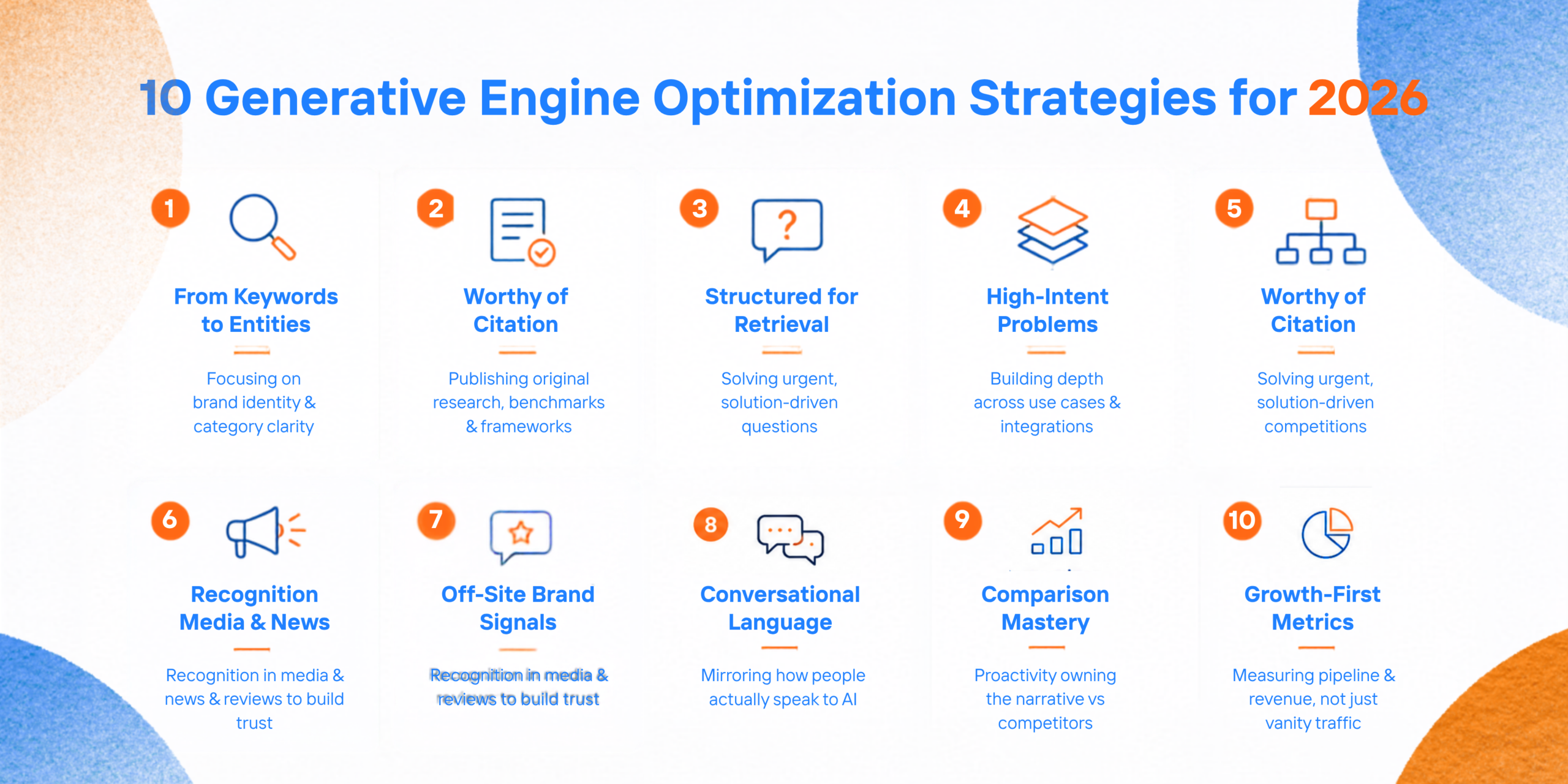
Below are ten strategies shaping how SaaS companies stay visible in this new environment.
1. Move From Keywords to Entities
Traditional SEO revolved around targeting phrases.
Generative search revolves around understanding entities such as your product category, the problems you solve, and how your brand relates to competitors.
If AI systems cannot clearly connect your company to a defined category or outcome, they are unlikely to recommend you. Effective GEO strategies, therefore, prioritize clarity through precise language and pages that unmistakably define what your software does and who it serves.
2. Publish Content Worth Citing
AI engines synthesize information from sources they interpret as trustworthy. Thin or repetitive content rarely appears in generated answers. Original thinking does.
SaaS companies gaining visibility today publish benchmarks, frameworks, research, and deeply practical guides. These materials function as reference points rather than simple marketing assets. When an AI model needs evidence or explanation, it turns to content built with this level of substance. That is also the point of how to get cited in llms.
3. Structure Information for Retrieval
Formatting now carries strategic importance.
Clear hierarchies, concise definitions, and logically organized sections make it easier for language models to extract meaning and reuse it in responses.
Structure is no longer cosmetic. It directly influences whether your expertise is surfaced or ignored, especially when you use schema markup for ai search.
4. Focus on High-Intent Problems
Traffic alone does not grow a SaaS business.
Visibility around urgent, solution-driven questions does.
Generative search favors content that resolves concrete problems such as fixing an issue, comparing options, estimating cost, or implementing a tool. These moments align closely with pipeline creation, which is why GEO must connect to commercial intent rather than vanity metrics.
5. Build Deep Topical Authority
Single articles rarely earn sustained AI visibility.
Comprehensive topic ecosystems do.
When your site demonstrates layered expertise across use cases, integrations, comparisons, pricing, and implementation, AI systems gain confidence in recommending your brand. Authority emerges from depth and coherence rather than volume alone.
6. Expand Brand Signals Beyond Your Website
Language models learn from the broader web. Mentions in media, partnerships, reviews, and industry commentary reinforce credibility.
This changes the role of saas link building. The objective is no longer just authority metrics but recognition across trusted environments that shape how AI interprets your brand.
7. Align With Conversational Search Behavior
Search queries increasingly resemble spoken questions instead of short typed fragments.
Content that mirrors natural language through clear explanations, realistic scenarios, and direct answers fits naturally into AI-driven discovery.
Brands that sound most human often become the ones most frequently surfaced by machines.
8. Control the Comparison Narrative
Evaluation is a critical stage in SaaS buying journeys. Prospects regularly ask AI tools to compare vendors, suggest alternatives, or identify category leaders.
If your company does not publish balanced and high-quality comparison content, competitors or third parties shape that narrative instead. GEO requires proactive ownership of these decision-stage conversations.
9. Maintain Continuous Freshness
Generative systems prioritize relevance.
Outdated statistics, neglected guides, and aging product details gradually reduce visibility.
Sustained GEO performance depends on disciplined updates that keep core resources accurate, expanded, and aligned with the current market reality.
10. Measure What Actually Drives Growth
Rankings and raw traffic reveal little about business impact.
The meaningful question is whether organic visibility influences pipeline, conversions, and long-term revenue.
Modern SEO measurement must connect discovery inside AI experiences to tangible commercial outcomes. Anything less risks optimizing for attention rather than growth.
Why GEO Is Central to the Novalab SEO Agency Approach
Many SaaS companies still operate with playbooks designed for an earlier era of search.
The competitive landscape now favors brands that understand how AI systems interpret authority, relevance, and trust.
Novalab focuses on translating that understanding into scalable organic growth. The goal is to help companies earn inclusion in AI-driven research journeys, capture qualified demand earlier, and convert visibility into measurable revenue and income increases as they grow.
GEO is not a passing trend.
It is the direction search is moving.
Why GEO Matters for SaaS Growth in 2026
As search behavior continues to shift, generative engine optimization is becoming more important for SaaS companies that rely on organic visibility. Ranking in traditional search results is still valuable, but brands also need content that can be understood, cited, and surfaced across AI-driven search experiences.
For SaaS teams, this creates a new opportunity to build authority earlier in the buying journey. Strong GEO strategies can support visibility, trust, qualified traffic, and long-term growth in revenue and income when combined with technical seo for saas and useful content.
Preparing for the Future of Discoverability
As AI continues reshaping how buyers learn about software, including competitive categories such as accounting software, the defining question becomes simple.
Will your brand appear inside the answers that guide decisions?
Companies that invest early in Generative Engine Optimization position themselves to lead the next era of search rather than follow it.