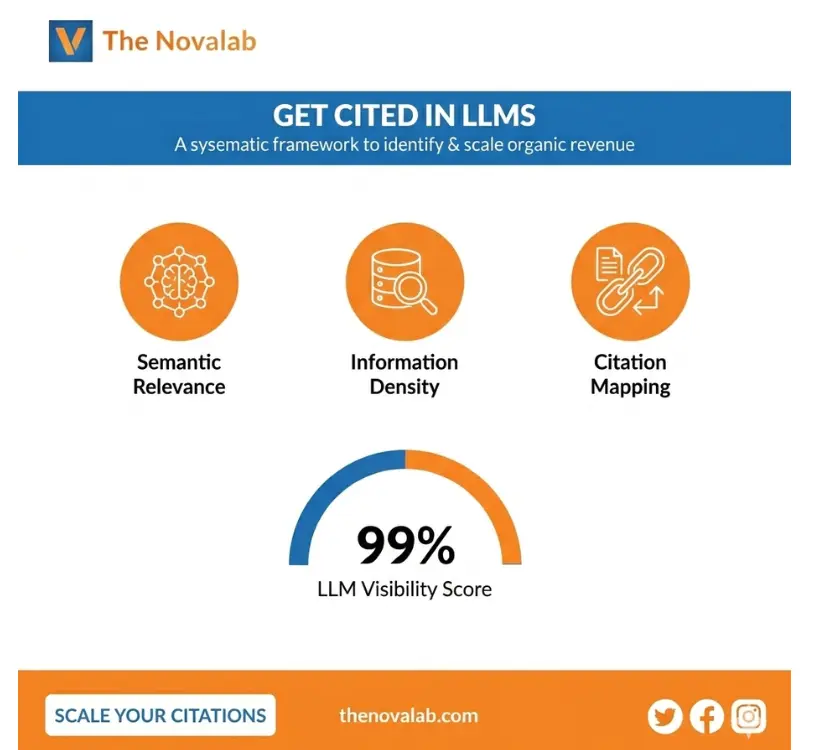
How to Get Cited in LLMs by The Novalab SEO Agency
Search is changing. People still use Google, yet they also ask questions in AI chat tools that write answers for them. In many of those answers, the model adds citations. Those citations can send traffic, build trust, and shape brand demand. That is why many teams now ask a new question: how to get cited in LLMs. A related starting point is understanding how to get cited in ChatGPT.
The Novalab SEO agency treats LLM citations as a visibility channel with rules. It is not the same as classic ranking work, and it is not the same as PR. It sits between them. You need clear sources, a strong page structure, and proof that your pages should be referenced.
When a business grows, it must increase revenue and income. If citations place your brand in front of buyers during research, they can support that growth through higher intent traffic, more branded searches, and stronger conversion rates.
What “Cited in LLMs” Means
A citation in an LLM answer is a reference link attached to a claim in the response. Some systems cite web pages, some cite documents, some cite both. The format differs across products, yet the pattern is consistent. The model looks for pages that match the question, show clear facts, and appear trustworthy.
In practice, citations often go to pages that are easy to parse, direct in wording, and supported by signals that confirm who published the content. If your pages are vague, thin, or hard to read, the model is less likely to reference them.
How LLMs Choose Sources
Models do not read the web the same way that a classic crawler does. They also do not judge pages only by backlinks. Citations tend to favor sources that meet three needs.
First, relevance. The page must answer the question with a tight match. Second, clarity. The answer must be stated in plain terms that can be quoted or summarized. Third, trust. The page must show signals that reduce risk, such as author identity, citations to primary sources, stable URLs, and a known brand footprint.
This is why “how to get cited in LLMs” is part content, part technical SEO , and part brand authority work.
Build Pages That Are Easy to Cite
If you want citations, you need pages that look like sources. Many company blogs are written for clicks, not for reference. LLMs cite reference-style contentmore often.
Use a Source Page Pattern
Create pages that act as primary answers. These are the pages you want cited. They should focus on one topic and cover it fully. They should define terms, explain steps, list constraints, and show examples.
A strong source page often includes:
- A short definition near the top
- A clear process section
- A section that answers common follow-up questions
- A glossary for key terms when the topic is technical
- A last updated date when accuracy changes over time
Keep sentences short. Keep headings specific. Avoid filler intros that delay the answer.
Answer With Verifiable Claims
LLMs are more likely to cite pages that include facts that can be checked. When you state numbers, timeframes, or rules, link to the source when possible. If you publish original data, explain how it was collected.
If your claim is an opinion, label it as an opinion. If your claim is a process, list the steps in a way that can be lifted into an answer.
Create Quote-Ready Sections
Many citations happen because the model finds a paragraph that reads like a direct answer. Write sections that start with a tight statement, then expand.
Example structure:
- One sentence that states the answer
- Two to four sentences that explain why
- A small example that shows how it works
This makes your page easier to reference without misreading.
Strengthen Entity Signals for Your Brand
Citations are not only about the page. They are also about who stands behind the page.
Make “Who We Are” Easy to Confirm
Add a clear About page with:
- Company name used in a consistent form
- Business address or service area when relevant
- A short brand description that matches your main services
- Links to key staff or leadership pages
- Contact details that match across the web
The goal is simple. Reduce confusion about brand identity.
Add Author and Reviewer Details Where It Matters
For guides, research posts, and opinionated analysis, add author info and a reviewer when appropriate. Link to author pages that show expertise.
If you publish in a regulated space, the bar is higher. In those cases, include credentials and a review process.
Align Your Brand Footprint Across the Web
Citations can be influenced by how consistent your brand appears across trusted sites. Keep your company name, description, and category consistent on major profiles and directories that matter in your niche.
Technical SEO Foundations That Support LLM Citations
LLM systems often prefer pages that load fast, render cleanly, and expose content in a stable format.
Make Content Accessible Without Friction
Avoid blocking important sections behind scripts, tabs, or heavy client-side rendering. Keep key text in the HTML that loads on the first request.
If the main answer is only visible after a click or a script event, the model may miss it or treat it as lower confidence.
Use Clean URLs and Stable Canonicals
If the same guide exists at multiple URLs, citations can be split. Canonicalization issues SEO services help establish one canonical version. Keep it stable. Avoid frequent URL changes for evergreen guides.
Improve Index Control
LLM citation systems often pull from pages that are indexed and easy to fetch. Addressing website indexing issues SEO helps keep important source pages accessible. That means you should control crawl waste and index bloat. Pages that are thin, duplicative, or auto-generated can dilute site quality signals.
This is where technical work links to citations. Better crawl focus can lead to better coverage of your strongest pages.
Add Structured Data That Matches Page Intent
Schema does not guarantee citations, yet it helps machines interpret content. This also supports SEO for AI Overviews. Use a schema that matches the page type, such as Article, FAQPage, HowTo, Organization, and Person when relevant.
Keep the schema accurate. Do not mark up contentthat is not present on the page.
Publish Content That LLMs Often Cite
Some formats attract citations more often because they match common user prompts.
Definitions and Glossaries
People ask models, “What is X?” and “Explain X.” A glossary page that clearly defines terms can earn citations across many prompts.
Step-by-Step Guides
“How to” content matches a large share of prompts. If your guide is clear and specific, it can become the cited source for a workflow.
Comparison Pages With Clear Criteria
People ask “X vs Y” questions. Pages that compare options with clear criteria and fair framing can be cited often, especially when they avoid hype.
Original Research and Benchmarks
If you publish original studies, surveys, or performance benchmarks, you can earn citations because you offer data that others do not have.
Explain methods, sample sizes, and limits. Make charts readable. Provide a table version of key data.
Earn Trust Signals That Influence Citations
Citations often cluster around trusted domains. You can raise trust by building signals that show you are a real, accountable publisher.
Editorial Standards
Create a short editorial standards page that explains how you write, review, and update content. Link to it from your footer.
Update Discipline
If topics change, update the guide and note what changed. Models and users both respond well to current pages.
Earn References From Trusted Sources
When reputable sites cite your research or reference your guide, it can improve your position as a source. Guest posting services can support relevant authority building when placements are earned on trusted sites. This is classic authority work, yet the goal shifts from ranking alone to being referenced as a source.
Measure Progress on “How to Get Cited in LLMs”
Measurement is still early, yet you can track meaningful signals.
Track referral traffic from AI tools when available
Track brand search growth and direct traffic trends
Track which pages are shared and linked as references
Track citations in AI answers by running a prompt set on a schedule and recording sources
The Novalab SEO agency builds prompt sets based on real buyer questions. We then compare citation share over time and tie it to business pages and conversion paths.
When a business grows, it must increase revenue and income. Tracking must connect citations to leads, pipeline, and sales, not vanity metrics.
How The Novalab SEO Agency Helps You Get Cited in LLMs
The Novalab SEO agency approaches citations as a system.
We audit which pages can serve as sources
We map prompts to pages and gaps
We rewrite key pages for clarity and reference value
We improve entity signals across the site
We tighten technical foundations that affect access and indexing
We track citation share and tie results to leads and sales
If your goal is to own buyer questions inside AI answers, you need pages built to be cited. You also need a brand footprint that is easy to verify. With the right structure, “how to get cited in LLMs” becomes a repeatable program that supports demand, pipeline, and increasing revenue and income.
Contact The Novalab SEO Agency to discuss improving your visibility in LLM answers.