
Technical SEO Services
Every piece of content a SaaS company publishes depends on a technical foundation that most visitors never see. Search engines must be able to discover pages, crawl them efficiently, interpret their content correctly, and index them without confusion. When any part of that chain breaks, rankings suffer regardless of content quality or backlink strength. A SaaS company can produce the best comparison page in its category, earn links from authoritative publications, and still rank on page three because a canonical conflict is directing search engines to the wrong URL or a JavaScript rendering issue is hiding the content from crawlers entirely.
Technical SEO services address the infrastructure layer that determines whether content can perform in search. The scope includes crawl management, site architecture, indexation control, page speed, structured data, internal linking, redirect logic, and server configuration. These are not one-time fixes. SaaS websites evolve constantly. New features launch, pages are added, templates change, plugins are updated, and integrations are added. Each change can introduce technical debt that accumulates until it visibly impacts organic performance.
Novalab SEO Agency provides technical SEO services built for SaaS companies running on WordPress, Bricks Builder, and other modern CMS platforms. The agency audits the full technical stack, identifies issues that suppress organic visibility, and delivers developer-ready task sheets that prioritize fixes by business impact. Every recommendation connects to measurable outcomes: stronger crawl efficiency, cleaner indexation, faster load times, and ultimately more pipeline and revenue from organic search across Google, ChatGPT, Gemini, Perplexity, Claude, and Copilot.
Why SaaS Companies Need Technical SEO Services
SaaS websites are fundamentally different from brochure sites or e-commerce stores. They contain product pages with dynamic elements, feature pages with interactive demos, pricing pages with regional variations, documentation hubs that update frequently, blog archives that grow continuously, and landing pages from past campaigns that may or may not still serve a purpose. Many SaaS companies also run their marketing site alongside an authenticated application, which creates routing complexity that can confuse search engine crawlers if the boundaries between the app and marketing site are not clearly defined. A SaaS SEO agency that knows this architecture will not treat it like a brochure site.
This architectural complexity makes SaaS sites more vulnerable to technical SEO issues than simpler websites. A plugin update can change how metadata is rendered. A template change can break internal links across dozens of pages. A new feature launch can create URL patterns that dilute crawl budget. A CDN configuration change can introduce caching issues that serve stale content to search engines. Without structured technical SEO services monitoring these changes and catching issues before they compound, organic performance degrades gradually until the business notices a traffic decline that is already weeks or months old.
Content Cannot Rank Without Technical Access
The relationship between technical SEO and content performance is direct. A page that search engines cannot access, cannot crawl efficiently, or cannot render correctly will not rank, regardless of how well-researched the keyword targeting is or how strong the content quality. SaaS companies that invest in SEO content without maintaining the technical foundation are building on an unstable base. Technical SEO services ensure that every content investment has the technical support it needs to produce results. SEO content for SaaS still needs that crawlable foundation before it can rank.
Technical Debt Compounds Silently
SaaS companies ship frequently. Marketing teams publish blog posts, update landing pages, launch campaign pages, and modify navigation. Development teams push code updates, add integrations, and change templates. Each of these actions can create small technical issues that individually have minimal impact but collectively erode organic performance over time. A few orphan pages become dozens. A handful of redirect chains becomes hundreds. A minor crawl inefficiency becomes a significant budget waste across thousands of URLs. Technical SEO services prevent this accumulation by maintaining ongoing visibility into the site’s technical health.
What Technical SEO Services Include
Technical SEO services cover the full scope of infrastructure work required to make a website discoverable, crawlable, indexable, and performant in search. Novalab SEO Agency structures this work across seven core areas, each of which addresses a distinct category of technical risk.
Crawl Management and Robots Configuration
Search engines allocate a finite crawl budget to each domain. Crawl budget determines how many pages search engines will crawl in a given session and how frequently they return. For SaaS sites with large page counts, inefficient crawl spending means that high-value pages may not be crawled frequently enough to reflect content updates, while low-value pages consume budget that should be directed elsewhere.
Novalab SEO Agency audits crawl patterns using server log file analysis and Search Console crawl stats. The agency identifies pages that receive excessive crawl attention without contributing to organic performance, such as filtered URLs, pagination chains, parameter variations, and staging remnants. Robots.txt is configured to block non-productive paths while ensuring full access to all indexable content. XML sitemaps are structured to include only canonical, indexable URLs and are organized by content type for efficient processing. Crawl budget optimization services are how that crawl spend gets redirected to pages that drive pipeline.
Site Architecture and Information Hierarchy
Site architecture determines how authority flows through a website and how search engines understand the relationships between pages. A flat architecture where every page is one click from the homepage distributes authority broadly but may lack topical depth signals. A deep architecture with many levels of hierarchy can concentrate authority, but may leave important pages too far from the root for efficient crawling.
For SaaS companies, the optimal architecture balances depth with accessibility. Product pages, feature pages, and pricing pages should be reachable within two to three clicks from the homepage. Blog content should be organized into topical clusters that reinforce the site’s authority on core categories. Documentation and help center content should be structured to support both user navigation and search engine understanding.
Novalab SEO Agency evaluates site architecture through crawl analysis and internal link mapping. The agency identifies structural weaknesses such as orphan pages with no internal links, shallow pages that lack topical context, and bottleneck pages that concentrate too much authority without passing it downstream. Recommendations restructure navigation, internal linking, and URL hierarchy to create a more effective flow of authority and relevance.
Indexation Control
Not every page on a SaaS website should be indexed. Tag pages, search result pages, filtered views, author archives, pagination pages beyond the first, staging URLs, and thin parameter variations all consume index space without contributing to organic performance. Allowing search engines to index these pages dilutes the site’s quality signals and wastes crawl budget.
Novalab SEO Agency audits indexation status across the entire site, comparing the pages that are indexed against the pages that should be indexed. The agency identifies over-indexed content that should carry noindex directives and under-indexed content that is blocked by accidental noindex tags, robots.txt rules, or canonical tag errors. The output is a clean index that contains only the pages designed to rank, which strengthens the overall quality signals of the domain.
Canonical Tag Management
Canonical tags tell search engines which version of a page should be treated as the primary version when multiple URLs contain similar or identical content. Incorrect canonical implementation is one of the most common technical SEO issues on SaaS sites. Self-referencing canonical errors, cross-domain canonical conflicts, canonical tags pointing to non-indexable pages, and canonical and hreflang misalignment all create confusion that can suppress rankings.
Novalab SEO Agency validates canonical tags across every indexable page, ensures self-referencing canonicals are in place, and confirms that canonical signals align with hreflang implementation on multilingual sites. This work prevents duplicate content issues and ensures that ranking signals consolidate on the correct pages. Hreflang implementation service is how those multilingual signals stay aligned with canonicals.
Page Speed and Core Web Vitals
Page speed affects both rankings and conversions. Google evaluates real-user performance through Core Web Vitals metrics: Largest Contentful Paint (LCP) for loading speed, Interaction to Next Paint (INP) for interactivity, and Cumulative Layout Shift (CLS) for visual stability. SaaS sites that fail these thresholds face a ranking disadvantage and deliver a weaker user experience that reduces demo requests and trial signups.
Novalab SEO Agency audits Core Web Vitals using both lab tools and real-user CrUX data. The agency identifies root causes for each metric failure, including unoptimized images, render-blocking resources, heavy JavaScript execution, and layout instability from unsized elements. Detailed optimization work for Core Web Vitals is covered through the agency’s dedicated Core Web Vitals optimization services, which connect directly to the broader technical SEO engagement.
Structured Data and Schema Markup
Structured data helps search engines understand page content beyond what text analysis alone can determine. For SaaS companies, relevant schema types include Organization, FAQ, Breadcrumb, Product, SoftwareApplication, and HowTo. Properly implemented structured data can enable rich results in search, increase click-through rates, and improve visibility in AI-powered answer platforms. Schema markup for AI search is how those answer platforms read the same markup.
Novalab SEO Agency audits existing structured data for validity and completeness, identifies pages where additional schema would improve visibility, and delivers JSON-LD implementation specifications for the development team. FAQ schema is applied to every service page that includes a frequently asked questions section. Organization schema ensures that brand information displays correctly in knowledge panels and branded searches.
Redirect and Error Management
Broken links, redirect chains, redirect loops, and 404 errors waste crawl budget, lose backlink authority, and create poor user experiences. SaaS sites accumulate these issues over time as pages are created, moved, renamed, and retired without systematic redirect management.
Novalab SEO Agency crawls the full site to identify every broken internal link, every redirect chain longer than one hop, every redirect loop, and every page returning 4xx or 5xx status codes. The agency delivers a prioritized fix list that resolves the highest-impact errors first and ensures that backlink authority flows to the correct destination pages. This work connects directly to the agency’s SEO migration services for sites undergoing URL structure changes.
How Novalab SEO Agency Delivers Technical SEO Services
Novalab SEO Agency follows a structured process that moves from audit through implementation to ongoing monitoring. Every phase produces deliverables designed for development teams to execute directly.
Phase 1: Technical SEO Audit
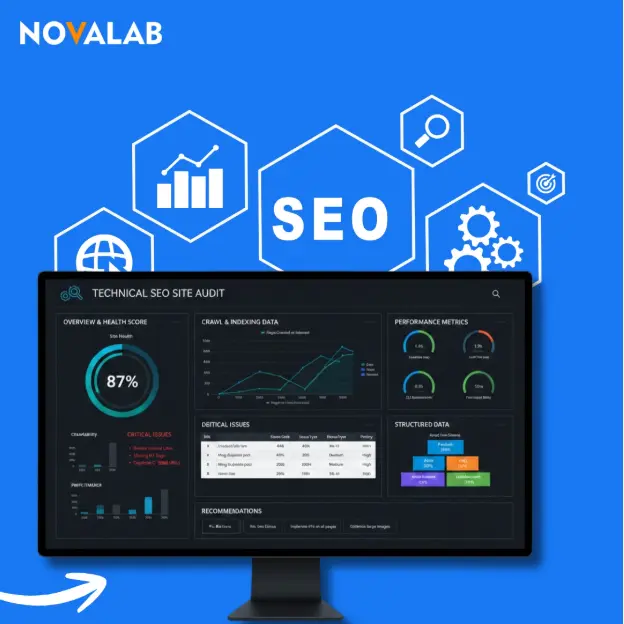
The engagement begins with a comprehensive technical audit that crawls the entire site and evaluates every indexable URL against Novalab’s SaaS technical SEO framework. The audit covers crawl access, indexation status, canonical configuration, internal linking structure, page speed, structured data, redirect health, mobile usability, and server response behavior. An enterprise SEO audit is how that first pass gets scored before developer task sheets go out.
The output is a prioritized audit report organized by severity and business impact. Critical issues that affect high-traffic or high-revenue pages are flagged for immediate action. Lower-priority issues are documented for phased remediation. The report includes specific technical details for each issue, the affected URLs, the expected impact of the fix, and implementation instructions for the development team.
Phase 2: Developer Task Sheets and Implementation Support
Novalab translates audit findings into structured developer task sheets. Each task specifies the issue, the affected page or template, the required change, the expected outcome, and the priority ranking. These task sheets are designed to eliminate ambiguity. Development teams and CMS managers can execute each task without additional research or interpretation.
For clients running WordPress with Bricks Builder, Novalab provides platform-specific guidance that accounts for the CMS’s rendering behavior, plugin interactions, and template architecture. The agency works directly with the development team to ensure that fixes are implemented correctly and that no new issues are introduced during the remediation process.
Phase 3: Validation and Re-Testing
After implementation, Novalab re-crawls the site and validates that each fix produced the expected improvement. The agency verifies that resolved issues remain fixed, that no regressions were introduced, and that the overall technical health score has improved. Any issues that were not fully resolved are documented and escalated for follow-up.
Phase 4: Ongoing Technical Monitoring
Technical SEO is not a one-time project. SaaS sites change constantly, and each change can introduce new issues. Novalab provides ongoing technical monitoring that catches regressions before they impact organic performance. Monthly crawl audits track changes in indexation status, crawl efficiency, page speed, internal linking health, and error rates. The agency flags new issues proactively and provides remediation recommendations as part of the ongoing engagement.
Technical SEO for SaaS vs. Generic Technical SEO
Generic technical SEO services apply the same audit checklist to every type of website. SaaS technical SEO requires a fundamentally different approach because SaaS sites have unique characteristics that generic providers do not account for.
SaaS marketing sites often sit alongside authenticated applications on the same domain or subdomain. This creates routing complexity that affects how search engines distinguish between public marketing content and private application interfaces. Incorrectly configured boundaries can lead to crawlers attempting to access application routes, wasting crawl budget, and potentially indexing pages that should remain private.
SaaS companies use modern JavaScript frameworks for interactive elements on marketing pages. Pricing calculators, feature comparison tools, and interactive demos may render content client-side, which creates risks for search engine discoverability if the content is not accessible in the initial HTML response or through server-side rendering.
SaaS documentation and help center content updates frequently as products evolve. This creates a continuous stream of new and modified URLs that must be managed to prevent indexation bloat, thin content accumulation, and internal linking gaps.
Novalab SEO Agency addresses all of these SaaS-specific challenges through its technical SEO for SaaS framework, which is designed for the architectural patterns, publishing cadences, and growth requirements that SaaS companies face.
Log File Analysis for SaaS Sites
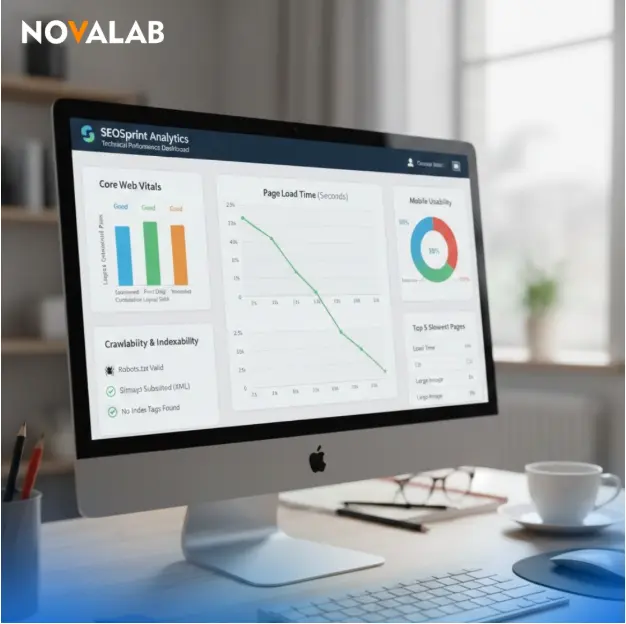
Server log file analysis reveals how search engines actually interact with a website, as opposed to how tools predict they will interact. Log files show which pages Googlebot crawls, how frequently it returns, which pages it ignores, and where it encounters errors. This data is essential for understanding crawl budget allocation and identifying pages that receive insufficient crawl attention. Log file analysis SEO is how that Googlebot trail gets read before crawl directives change.
For SaaS sites with thousands of URLs across product pages, documentation, blog content, and landing pages, log file analysis often reveals that search engines spend a disproportionate amount of crawl budget on low-value pages while under-crawling high-priority content. Novalab SEO Agency performs log file analysis as part of its technical SEO services to identify these imbalances and implement crawl directives that redirect crawler attention to the pages that drive pipeline and revenue.
Internal Linking Architecture for SaaS
Internal links distribute authority across a website and signal to search engines which pages are most important. SaaS sites commonly suffer from disconnected architectures where the blog, product pages, feature pages, documentation, and resource center exist in isolated silos with minimal cross-linking. This isolation limits the flow of authority between content types and prevents search engines from understanding the topical relationships that tie the site together.
Novalab SEO Agency builds internal linking maps that connect related content across all sections of the site. Blog posts link to relevant product and feature pages. Product pages connect to supporting documentation and case studies. Comparison pages link to pricing. Every link is contextually relevant and serves both user navigation and search engine understanding. This internal linking methodology supports stronger topical authority and improves rankings across the full content inventory. The same approach is applied in Novalab’s SEO consulting for SaaS engagements.
Benefits of Professional Technical SEO Services for SaaS
SaaS companies that invest in professional technical SEO services gain a foundation that amplifies every other SEO activity. Content performs better when search engines can access and render it correctly. Backlinks deliver more value when redirect chains do not dilute their authority. Localized pages rank in the right markets when hreflang and canonical signals are configured correctly. Speed improvements reduce bounce rates and increase conversion rates from existing traffic. SaaS link building only compounds when those redirect chains are already clean.
The compounding nature of technical SEO is its most significant advantage. Fixes applied today continue to deliver value for months and years. A clean crawl configuration ensures that every new page published gets discovered and indexed efficiently. A strong internal linking architecture ensures that every new piece of content strengthens the authority of existing pages. A fast, stable site experience ensures that visitors who arrive from organic search stay, engage, and convert. For SaaS companies managing customer acquisition cost across multiple channels, this compounding organic growth reduces CAC and strengthens pipeline diversity over time.
Why SaaS Companies Choose Novalab for Technical SEO Services
SaaS companies choose Novalab SEO Agency for technical SEO because the agency combines infrastructure expertise with an understanding of SaaS business metrics. The agency does not deliver generic audit reports filled with low-priority warnings. It delivers prioritized, developer-ready specifications that connect every fix to its expected impact on crawl efficiency, indexation quality, page speed, and pipeline.
Novalab integrates technical SEO work with the full range of services that SaaS companies need for organic growth. Technical audits inform migration planning. Crawl analysis supports international SEO architecture decisions. Speed optimization connects to Core Web Vitals work. Internal linking improvements support content strategy execution. This integration ensures that technical SEO is not a standalone project but a connected component of a unified growth strategy. International SEO consulting is how those architecture decisions get made before hreflang goes live.
Technical SEO Services by Novalab SEO Agency
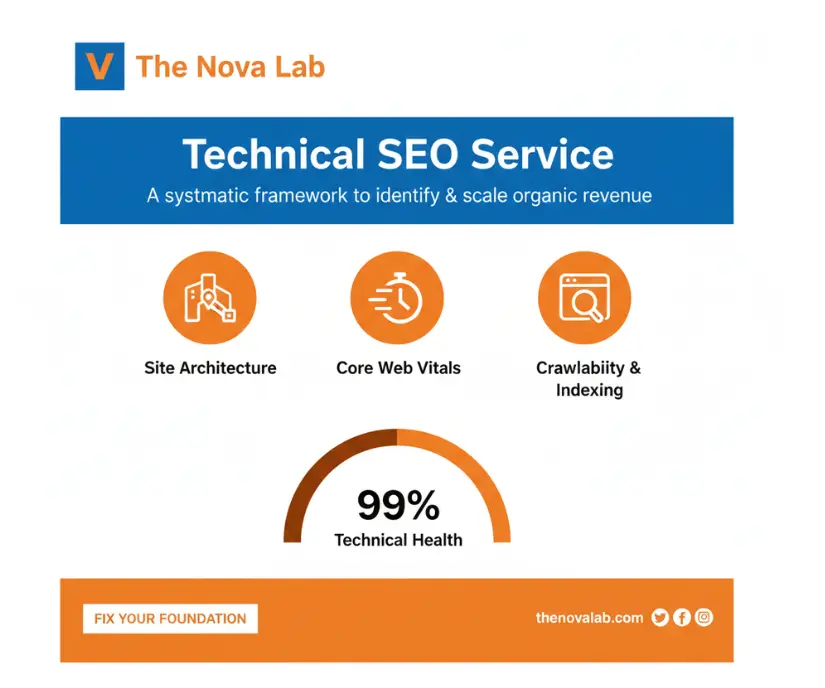
Comprehensive Technical Audit – Novalab crawls the full site and evaluates every indexable URL across crawl access, indexation, canonicalization, page speed, structured data, internal linking, redirects, and mobile usability.
Crawl Management – The agency optimizes robots.txt, XML sitemaps, and internal linking to ensure crawl budget concentrates on high-value pages that drive pipeline and revenue.
Indexation Control – Novalab audits index coverage, removes low-value pages from the index, and ensures all high-priority content is discoverable and indexable.
Site Architecture Optimization – The agency restructures navigation, URL hierarchy, and internal linking to improve authority flow and topical signal clarity.
Structured Data Implementation – Novalab implements and validates JSON-LD schema markup across all relevant page types, including FAQ, Organization, Breadcrumb, and Product schema.
Developer Task Sheets – Every finding is translated into a prioritized, actionable task with specific implementation instructions designed for immediate execution by the development team.
Ongoing Monitoring – Monthly technical audits track changes, catch regressions, and ensure that the site’s technical foundation remains strong as content and code evolve.
A strong website starts with a strong foundation, and technical SEO services are that foundation. Technical SEO services for website performance sit on that same foundation when speed is the bottleneck.
Start Growing With The Novalab SEO Agency
If you’re looking for an SEO agency that understands your goals and delivers real outcomes, Novalab SEO Agency is ready to help.
We build strategies designed to grow your organic traffic, strengthen brand visibility, and convert visitors into loyal customers.
Contact the team today to request a free SEO audit or consultation.
Let Novalab SEO Agency guide your business toward better rankings, more traffic, and consistent results.
Frequently Asked Questions About Technical SEO Services
Q: What are technical SEO services? A: Technical SEO services address the infrastructure layer of a website that determines whether content can be discovered, crawled, indexed, and ranked by search engines. This includes crawl management, site architecture, indexation control, canonical configuration, page speed, structured data, redirect health, and mobile usability. The goal is to remove technical barriers that prevent content from performing in search.
Q: Why do SaaS companies need technical SEO services? A: SaaS websites are architecturally complex, with product pages, documentation hubs, blog archives, pricing pages, and application routes that create unique technical challenges. Without ongoing technical SEO, issues accumulate silently and erode organic performance over time. Technical SEO services prevent this accumulation and ensure that every content and link building investment has the technical support to produce results.
Q: What does a technical SEO audit include? A: A comprehensive technical SEO audit covers crawl access and robots configuration, indexation status and coverage, canonical tag validation, internal linking analysis, page speed and Core Web Vitals, structured data validation, redirect and error identification, mobile usability, server response behavior, and log file analysis. The output is a prioritized report with developer-ready implementation instructions.
Q: How is technical SEO for SaaS different from generic technical SEO? A: SaaS sites have unique characteristics including authenticated applications sharing domains with marketing sites, JavaScript-rendered interactive elements, frequently updating documentation, and complex URL architectures from feature pages and integrations. Generic technical SEO checklists do not account for these patterns. Novalab applies a SaaS-specific framework that addresses these challenges directly.
Q: How often should technical SEO audits be performed? A: SaaS companies should conduct a comprehensive technical SEO audit at least quarterly, with lighter monthly monitoring between audits. Sites that publish frequently, push regular code updates, or are planning migrations should increase audit frequency. Novalab provides ongoing monthly monitoring as part of its technical SEO services to catch issues before they impact performance.
Q: How long does it take to see results from technical SEO fixes? A: Quick wins like fixing broken redirects, resolving canonical conflicts, and correcting robots.txt errors can produce ranking improvements within two to four weeks. Larger structural changes such as site architecture optimization and internal linking restructuring typically show results over six to twelve weeks as search engines recrawl and re-evaluate the site.